
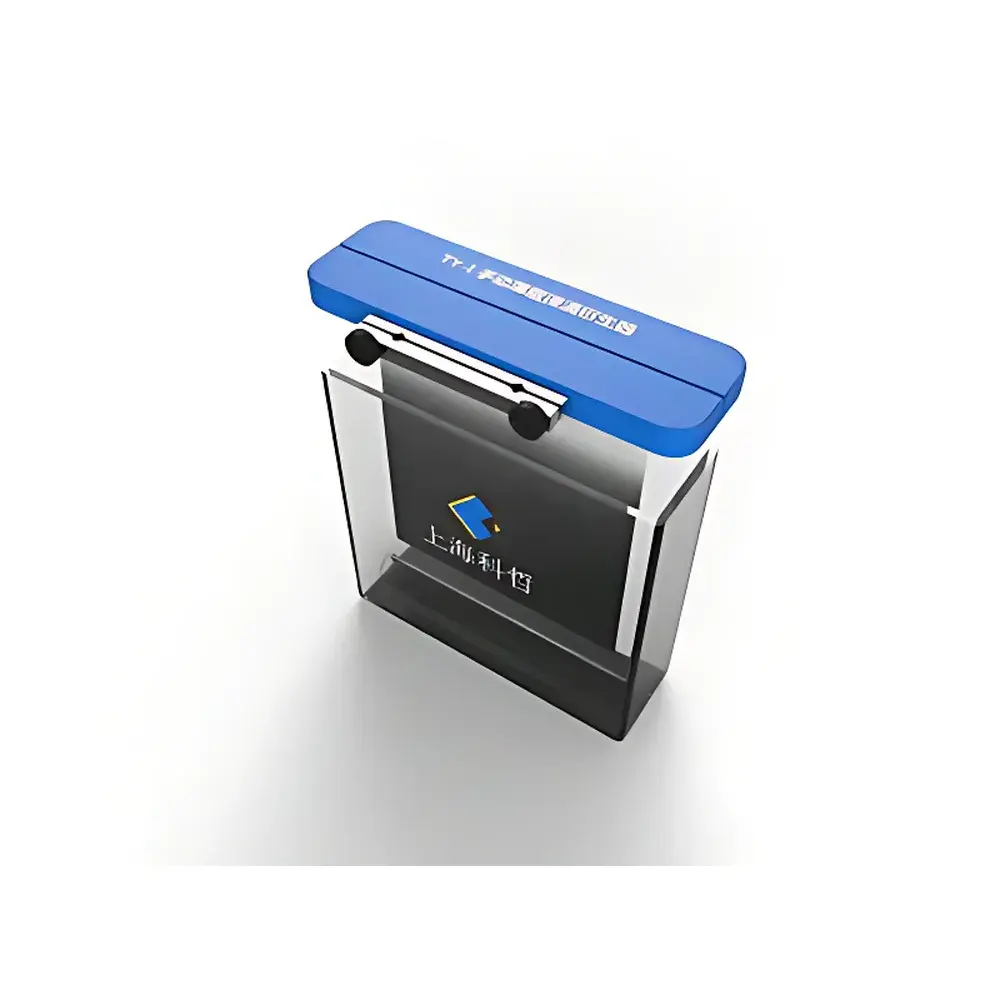
KEZHE SHANGHAI TY-I Manual Thin-Layer Immersion Derivatizer
| Brand | KEZHE SHANGHAI |
|---|---|
| Origin | Shanghai, China |
| Manufacturer Type | Direct Manufacturer |
| Product Origin | Domestic (China) |
| Model | TY-I |
| Instrument Category | TLC Imaging & Derivatization System |
| Light Sources | UV 254 nm, UV 365 nm, Visible White Light |
| Imaging Resolution | ≥4 MP |
| Maximum Sample Platform Size | 200 × 200 mm |
| Derivatization Modes | Immersion and Spray |
| Immersion Chamber Options | 200 mm and 100 mm formats |
| Compliance | Designed for GLP-compliant manual derivatization workflows in analytical laboratories |
Overview
The KEZHE SHANGHAI TY-I Manual Thin-Layer Immersion Derivatizer is a purpose-built laboratory tool engineered to perform controlled chemical derivatization of thin-layer chromatography (TLC) plates prior to visualization or densitometric analysis. Unlike automated systems, the TY-I operates via manual immersion—leveraging precise physical handling to ensure uniform reagent contact across the stationary phase surface. It supports both immersion and spray-based derivatization protocols, enabling method flexibility for diverse analyte classes including amines, carbonyls, phenols, and heterocyclic compounds. The device does not incorporate optical detection or spectral measurement capabilities; rather, it serves as a dedicated pre-detection sample preparation module that interfaces seamlessly with standalone TLC scanners, UV cabinets, or digital imaging stations. Its mechanical architecture prioritizes reproducibility in reagent exposure time, temperature stability (ambient operation), and plate alignment—critical parameters affecting derivatization completeness and spot morphology fidelity.
Key Features
- Dual-mode derivatization support: immersion (primary mode) and manual spray application for method optimization and compound-specific protocol adaptation.
- Interchangeable immersion chambers: standardized 200 mm and 100 mm configurations accommodate standard TLC plates (e.g., 20 × 20 cm and 10 × 10 cm), minimizing cross-contamination and enabling batch processing scalability.
- Optimized immersion geometry: sloped chamber base and low-turbulence reagent reservoir design reduce air bubble entrapment and promote laminar flow during plate insertion, ensuring consistent derivatization kinetics across the entire active area.
- Chemical-resistant construction: body fabricated from high-grade polypropylene and borosilicate glass components compatible with common derivatizing reagents—including anisaldehyde-sulfuric acid, p-anisaldehyde, ninhydrin, Dragendorff’s reagent, and iodine vapor—without degradation or leaching.
- Ergonomic manual actuation: spring-assisted lift mechanism and calibrated depth-stop guide facilitate repeatable plate immersion depth (±0.5 mm tolerance) and dwell time control, supporting SOP-driven manual operation.
Sample Compatibility & Compliance
The TY-I accommodates silica gel, alumina, cellulose, and reversed-phase (C18) TLC plates with thicknesses ranging from 0.1 mm to 0.5 mm. It is validated for use with commercially available precoated plates (e.g., Merck Silica Gel 60 F254, Analtech Uniplates). No electrical or pneumatic interfaces are required—operation is fully manual and intrinsically safe in fume hood environments. While the instrument itself is not certified to ISO/IEC 17025 or ASTM D6982, its design aligns with Good Laboratory Practice (GLP) principles for documented manual sample preparation: users maintain full traceability through handwritten or electronic logs recording reagent lot numbers, immersion duration, ambient temperature/humidity, and operator ID. It supports audit-ready workflows when integrated into quality-controlled analytical sequences compliant with USP , ICH Q5C, and pharmacopoeial monographs requiring derivatization prior to identity or purity assessment.
Software & Data Management
The TY-I is a hardware-only platform with no embedded firmware, connectivity ports, or onboard software. All operational parameters—including immersion duration, reagent volume, and ambient conditions—are recorded externally using laboratory notebooks or LIMS-integrated electronic lab notebooks (ELNs). When paired with third-party TLC imaging systems (e.g., CAMAG Reprostar, Bioscan TLC Visualizer), derivatized plates may be scanned under UV254 nm, UV365 nm, or visible light illumination per user-defined acquisition settings. Image metadata (e.g., timestamp, operator, plate ID) must be manually synchronized with derivatization logs to preserve data integrity under FDA 21 CFR Part 11 requirements where electronic records are employed.
Applications
- Pharmaceutical impurity profiling: derivatization of secondary amines in API intermediates using ninhydrin or o-phthalaldehyde for enhanced UV/fluorescence response.
- Natural product screening: visualization of terpenoids and alkaloids on silica plates via vanillin-sulfuric acid charring at 105°C post-immersion.
- Food safety testing: detection of mycotoxins (e.g., aflatoxin B1) after post-chromatographic derivatization with bromine vapor or trifluoroacetic acid.
- Forensic toxicology: enhancement of opioid and benzodiazepine spots using Dragendorff’s reagent followed by densitometric quantification.
- Academic teaching labs: hands-on instruction in TLC method development, emphasizing reagent selection, reaction kinetics, and spot resolution optimization.
FAQ
Is the TY-I compatible with HPTLC plates?
Yes—its 200 × 200 mm platform supports standard HPTLC plates (e.g., 10 × 10 cm and 20 × 20 cm formats), provided the backing material is rigid enough to withstand manual immersion without warping.
Can the immersion chamber be cleaned with organic solvents?
Yes—polypropylene and borosilicate components tolerate acetone, methanol, chloroform, and ethyl acetate; avoid prolonged exposure to concentrated sulfuric acid or hot nitric acid.
Does the device include timing functionality?
No—timing is performed externally using a calibrated stopwatch or LIMS-triggered timer; immersion duration must be manually recorded per GLP documentation standards.
What safety precautions apply during operation?
All derivatization procedures must be conducted inside a certified chemical fume hood; appropriate PPE—including nitrile gloves, lab coat, and splash goggles—is mandatory when handling corrosive or volatile reagents.
Is calibration required before use?
No formal calibration is specified; however, users should verify immersion depth consistency using a calibrated depth gauge during initial setup and after maintenance.






