
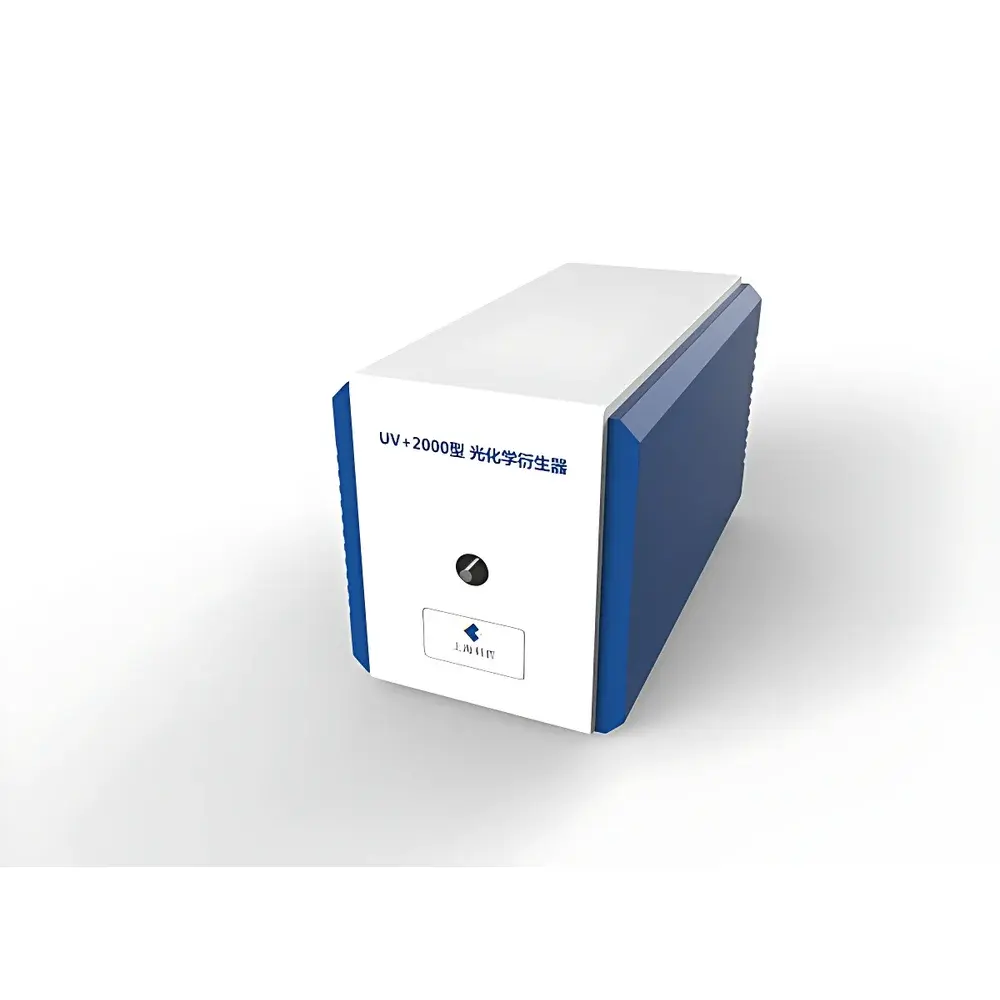
KEZHE SHANGHAI UV+2000 Photochemical Derivatization Unit
| Brand | KEZHE SHANGHAI |
|---|---|
| Origin | Shanghai, China |
| Manufacturer Type | Direct Manufacturer |
| Product Origin | Domestic (China) |
| Model | UV+2000 |
| Instrument Type | Fluorescence Detector (FD) Compatible Derivatization Device |
| Wavelength Range | 195–600 nm |
| Measurement Mode | Dual-Beam |
| Light Source | Xenon Lamp |
| Maximum Flow Rate | 2 mL/min (customizable) |
Overview
The KEZHE SHANGHAI UV+2000 Photochemical Derivatization Unit is an inline, reagent-free post-column derivatization system engineered for high-sensitivity fluorescence detection in high-performance liquid chromatography (HPLC) and ultra-high-performance liquid chromatography (UHPLC) workflows. Unlike conventional chemical derivatization methods requiring hazardous reagents, pumps, mixing tees, or thermostatic reactors, the UV+2000 employs controlled ultraviolet irradiation to induce photochemical conversion of analytes—primarily aflatoxins (B1, B2, G1, G2) and sulfonamides—into highly fluorescent derivatives directly within a fused-silica reaction coil. This principle leverages photolysis-driven structural rearrangement under precisely regulated xenon lamp output, enabling quantitative enhancement of native fluorescence without introducing corrosive acids or organic solvents into the HPLC flow path. The device operates on dual-beam optical architecture to ensure stable baseline performance and minimize lamp intensity drift over extended duty cycles (>3,000 operational hours), making it suitable for regulated pharmaceutical, food safety, and clinical QC laboratories.
Key Features
- Reagent-free derivatization: Eliminates consumable reagents, associated storage hazards, and waste disposal protocols.
- No auxiliary hardware required: Fully integrated design eliminates need for separate derivatization pumps, mixers, or column ovens—reducing system footprint and maintenance complexity.
- Inline HPLC integration: Installed between analytical column and fluorescence detector via standard 1/16″ stainless steel or PEEK tubing interfaces; compatible with all major HPLC/UHPLC platforms.
- Optimized photoreactor coil: Precision-wound, low-dead-volume quartz-lined capillary ensures uniform UV exposure and complete derivatization kinetics—even at UHPLC flow rates up to 2 mL/min.
- Stable xenon lamp source: Broad-spectrum output (195–600 nm) enables versatile application across multiple fluorogenic compound classes; lamp intensity is adjustable via optional analog/digital control module.
- Extended service life & zero-post-run flush: Engineered for continuous operation without solvent rinsing or lamp cooldown delays; supports unattended overnight runs.
- Regulatory-ready configuration: Compliant with AOAC Official Methods 2005.08 and 2008.02, AOCS Aa 11-05, European Pharmacopoeia 2.8.18, Taiwan Food and Drug Administration Notice No. 0981800370, and Chinese Pharmacopoeia 2015 Edition (Supplemental Photoderivatization Method).
Sample Compatibility & Compliance
The UV+2000 delivers validated derivatization for primary mycotoxin targets including aflatoxin B1, B2, G1, and G2—with reported limits of detection (LOD) <0.5 ppb under optimized HPLC-FLD conditions. It further extends utility to sulfonamide antibiotics (LOD ≤10 ppb), barbiturates, amino acids, peptides, and select vitamins (e.g., B2, B6). Performance equivalence to iodine-based electrochemical derivatization has been demonstrated per AOAC interlaboratory studies. All configurations meet GLP/GMP-aligned documentation requirements; optional firmware modules support audit-trail logging for 21 CFR Part 11 compliance when paired with validated LIMS or CDS platforms.
Software & Data Management
While the base UV+2000 operates as a standalone hardware module, optional intelligent management software provides real-time lamp usage tracking, cumulative irradiation dose logging, scheduled power cycling, and event-triggered notifications (e.g., lamp aging alerts, flow interruption detection). Data export is supported via CSV and XML formats compatible with laboratory information management systems (LIMS) and chromatography data systems (CDS). Firmware updates are delivered via secure USB interface with version-controlled release notes and traceable calibration history.
Applications
- Aflatoxin quantification in cereals, nuts, spices, and dairy products per ISO 16050 and EU Commission Regulation (EC) No. 401/2006.
- Sulfonamide residue screening in animal-derived foods (muscle, liver, milk) per EU SANTE/11945/2015 guidelines.
- Pharmaceutical impurity profiling of barbiturate sedatives and vitamin formulations under ICH Q2(R2) validation frameworks.
- Research-scale derivatization optimization for novel fluorogenic analytes requiring wavelength-specific photolysis.
- Method transfer from iodine-based electrochemical derivatization to eliminate redox instability and column fouling in routine QC labs.
FAQ
Does the UV+2000 require chemical reagents or carrier gas?
No. It performs purely photochemical derivatization using only UV irradiation—no reagents, no gases, no pump-driven delivery systems.
Is the UV+2000 compatible with third-party fluorescence detectors?
Yes. It interfaces via standard 1/16″ tubing and requires no proprietary electrical or communication protocols; compatibility confirmed with Agilent, Waters, Shimadzu, and Thermo Fisher FLD models.
What maintenance is required during routine operation?
None beyond periodic visual inspection of tubing integrity and lamp housing cleanliness; no solvent flushing, lamp alignment, or optical recalibration is needed.
Can the derivatization efficiency be validated per ICH guidelines?
Yes. Full method validation packages—including specificity, linearity (5–500 ppb), precision (RSD <3.5%), robustness, and LOD/LOQ determination—are supported through application notes aligned with ICH Q2(R2) and USP <1225>.
Is firmware upgrade capability included?
Yes. Field-upgradable firmware supports new wavelength calibration profiles, enhanced lamp lifetime algorithms, and future regulatory extensions (e.g., enhanced 21 CFR Part 11 audit trail features).




