
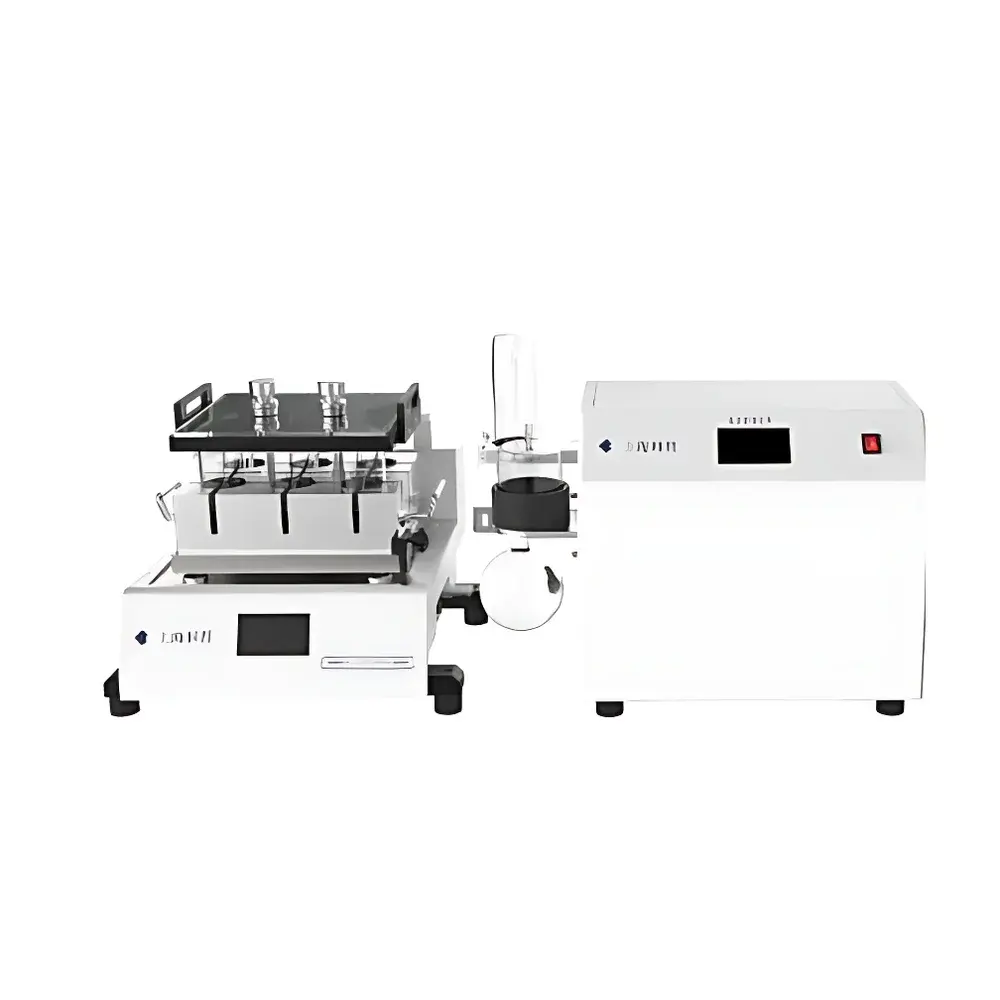
KEZHE SHANGHAI VNH-1200Easy Vacuum Parallel Concentrator
| Brand | KEZHE SHANGHAI |
|---|---|
| Origin | Shanghai, China |
| Manufacturer Type | Direct Manufacturer |
| Instrument Type | Vacuum Centrifugal Concentrator |
| Temperature Range | 25–80 °C |
| Temperature Control Accuracy | ±1 °C |
| Sample Capacity per Tube | 3 mL (tail tube volume) |
| Final Absolute Vacuum | 30 mbar |
| Vacuum Pump Flow Rate | 30 L/min |
| Cooling Circulator Temp Range | 10 °C to Ambient |
| Heating Platform Max Temp | 100 °C |
| Rotational Speed | 0–250 rpm |
| Power Supply | 220–240 V, 50/60 Hz |
| Max Power Consumption | 2200 W |
Overview
The KEZHE SHANGHAI VNH-1200Easy Vacuum Parallel Concentrator is an engineered solution for high-throughput, solvent removal under controlled low-pressure and precise thermal conditions. Unlike nitrogen blow-down systems or conventional rotary evaporators, this instrument operates on the principle of vacuum-assisted evaporation combined with regulated conductive heating and active condensate recovery—enabling simultaneous concentration of multiple samples while maintaining analyte integrity. Its design integrates a digitally regulated vacuum control system with a thermally uniform heating platform (metal or water bath configurable), ensuring consistent vapor pressure gradients across all sample positions. This eliminates differential boiling points caused by uneven vacuum distribution or localized overheating—critical for preserving thermolabile compounds, minimizing co-evaporation losses, and achieving inter-sample reproducibility required in quantitative bioanalysis, environmental residue testing, and pharmaceutical QC workflows.
Key Features
- Vacuum-controlled parallel processing for 1–6, 12 (standard), 24, or 48 samples—fully automated endpoint detection and shutdown
- Selectable heating interface: programmable metal block or water bath, supporting temperature stability within ±1 °C across full range (25–80 °C standard; up to 100 °C optional)
- Integrated reflux module directs condensed solvent vapor along inner tube walls, enhancing solute recovery and reducing wall loss
- Dedicated vacuum-sealed lid per sample rack prevents cross-contamination and ensures independent pressure regulation
- Cold-finger tail-tube geometry maintains bottom-volume temperatures significantly below bulk solution temperature—preserving heat-sensitive analytes (e.g., peptides, nucleotides, labile metabolites)
- Onboard solvent condensation and collection system complies with ISO 14001 laboratory emission guidelines; zero venting into ambient air
- Brushless, maintenance-free diaphragm vacuum pump with continuously adjustable speed (0–30 L/min) and digital feedback control
- Large-format capacitive touchscreen interface with pre-programmed methods, real-time vacuum/temperature logging, and user-accessible parameter locking
Sample Compatibility & Compliance
The VNH-1200Easy accommodates standard 12–48 position racks with interchangeable tube holders for volumes ranging from 1–30 mL (standard configuration), expandable to 5–250 mL via optional adapters. Tail-tube volumes are precisely manufactured at 0.3 mL, 1 mL, or 3 mL—calibrated for final volume accuracy per ICH Q2(R2) guidance on volumetric endpoints. All wetted components comply with USP Class VI biocompatibility standards and are resistant to common organic solvents (e.g., acetonitrile, methanol, ethyl acetate, dichloromethane). The system supports GLP/GMP-aligned operation through audit-trail-enabled method storage, electronic signature-capable user accounts, and exportable CSV logs traceable to ASTM E2500-22 requirements for equipment qualification.
Software & Data Management
The embedded control firmware provides method-based workflow automation—including ramp-and-hold temperature profiles, multi-stage vacuum ramping (30 mbar to atmospheric), and rotational agitation (0–250 rpm) synchronized with evaporation phase. All operational parameters—including actual vacuum pressure (absolute mbar), block temperature, runtime, and pump status—are timestamped and stored internally for ≥10,000 cycles. Data export is supported via USB 2.0 to industry-standard formats (CSV, PDF report templates). Optional Ethernet connectivity enables remote monitoring and integration with LIMS platforms compliant with FDA 21 CFR Part 11 Annex 11 requirements for electronic records and signatures.
Applications
This concentrator is routinely deployed in regulated laboratories performing LC-MS/MS sample preparation for clinical toxicology, pesticide residue analysis per EU SANTE/11312/2021, and residual solvent quantification per ICH Q3C(R8). It is validated for direct coupling with ASE (accelerated solvent extraction) and SPE (solid-phase extraction) platforms—eliminating intermediate transfer steps and associated analyte loss or contamination risk. Additional use cases include nucleic acid cleanup prior to NGS library prep, natural product fraction concentration, and post-digestion peptide concentration in proteomics pipelines where reproducible final volume and minimal thermal degradation are non-negotiable.
FAQ
Does the VNH-1200Easy require nitrogen gas for operation?
No—this system relies solely on vacuum-driven evaporation and does not utilize nitrogen purge or blow-down mechanisms.
Can the instrument be integrated with ASE or SPE workstations?
Yes—its standardized tube geometry and modular rack design allow seamless transition from extraction to concentration without manual sample transfer.
What vacuum level accuracy is maintained during multi-sample runs?
The digital vacuum controller delivers continuous, gradient-free regulation across the full 30 mbar–atmospheric range, with repeatability better than ±2 mbar over 24-hour operation.
Is cold trap condensation efficiency validated for common solvents?
Condensate recovery rates exceed 98% for methanol, acetonitrile, and ethyl acetate at ≤40 °C cooling bath temperature, per internal validation per ISO/IEC 17025:2017 clause 7.7.
How is temperature uniformity verified across the heating block?
Each production unit undergoes thermal mapping per ASTM E2251-22 using calibrated RTD probes at ≥9 spatial points; certified uniformity is ±0.8 °C at 60 °C.



