
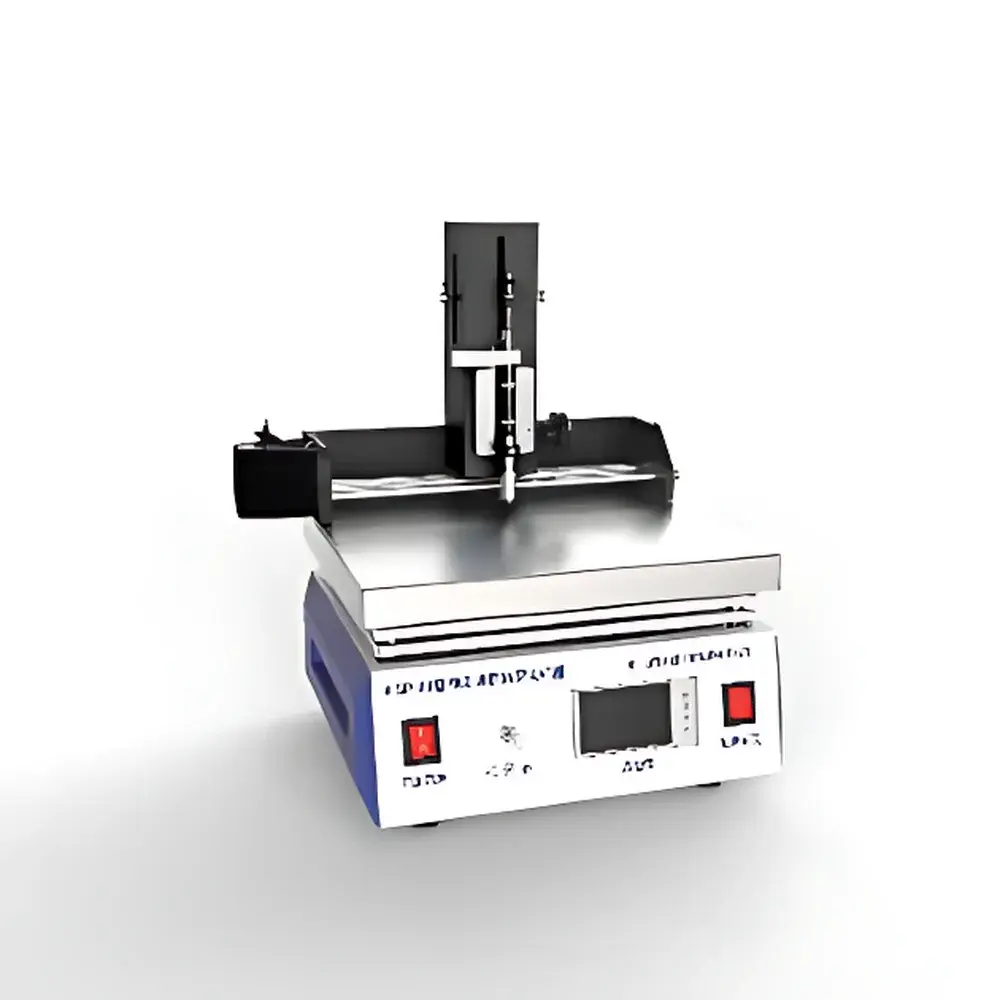
KEZHE SP-III Electric Thin-Layer Strip Sample Applicator
| Brand | KEZHE / KEZHE SHANGHAI |
|---|---|
| Origin | Shanghai, China |
| Manufacturer Type | Direct Manufacturer |
| Regional Classification | Domestic (China) |
| Model | SP-III |
| Instrument Category | Thin-Layer Sample Applicator |
| Operation Mode | Automatic |
| Measurement Modes | Reflectance Absorption, Reflectance Fluorescence, Transmission Absorption, Transmission Fluorescence |
| Wavelength Range | 190–800 nm |
| Light Sources | Xenon Lamp, Tungsten-Halogen Lamp, High-Pressure Mercury Lamp |
| Monochromator | Holographic Grating (1200 lines/mm), Nitrogen Purge Compatible |
| Spectral Bandwidth | 5 nm |
| Wavelength Accuracy | < 1 nm |
| Wavelength Repeatability | < 0.2 nm |
| Minimum Spatial Resolution | 25 µm |
| Imaging Wavelengths | 254 nm, 365 nm, White Light |
| Sample Stage Capacity | Up to 200 mm × 200 mm TLC Plates |
| Scanning Speed | Up to 100 mm/s |
| Spotting Length | 0–200 mm |
| Spotting Width | 0.7–3 mm (Standard: 1–2 mm) |
| Spotting Temperature Range | Ambient to 100 °C |
| Heating Platform Temperature Range | Ambient to 200 °C |
| Spotting Modes | Circular Spot, Linear Strip, Contact & Non-Contact |
Overview
The KEZHE SP-III Electric Thin-Layer Strip Sample Applicator is an engineered solution for high-precision, reproducible sample deposition in quantitative thin-layer chromatography (TLC) workflows. Designed specifically to enhance compatibility with densitometric scanning—particularly for HPTLC and validated TLC quantitation—the SP-III employs a motorized, digitally controlled spotting arm capable of both contact and non-contact linear strip application. Unlike conventional circular-spot applicators, the SP-III minimizes adsorbent disturbance (e.g., silica gel cracking or channeling), reduces analyte loss due to needle adhesion, and enables precise volumetric delivery across extended linear zones. Its integrated CNC digital heating stage—featuring PID-controlled temperature regulation, cast-aluminum uniform-heating architecture, and ceramic-glass top surface—eliminates the need for external charring or derivatization ovens while ensuring thermal stability during pre- or post-application activation. The system operates as a standalone unit or as a coordinated module within full TLC analysis pipelines compliant with pharmacopoeial standards (e.g., USP , EP 2.2.27, and Chinese Pharmacopoeia Chp IV).
Key Features
- Motor-driven linear strip spotting with programmable length (0–200 mm) and adjustable width (0.7–3 mm), optimized for calibration curve linearity and large-volume loading without solvent evaporation artifacts
- Dual-mode deposition: contact spotting for maximum transfer efficiency; non-contact aerosol-assisted spotting to prevent adsorbent damage and needle clogging
- CNC-machined heated stage with PID temperature control (ambient to 200 °C), uniform aluminum heating plate, and chemically inert ceramic-glass surface for consistent activation and easy decontamination
- High-stability synchronous motor drive system with low failure rate and long service life—designed for >10,000 operational cycles under routine lab conditions
- Modular pneumatic delivery system with calibrated nozzle set, supporting solvent compatibility across polar (methanol, acetonitrile) and non-polar (hexane, chloroform) mobile phases
- Integrated lateral translation mechanism enabling multi-track parallel spotting on standard 200 × 200 mm TLC plates, reducing inter-run variability
Sample Compatibility & Compliance
The SP-III accommodates all commercially available planar chromatographic supports—including silica gel 60 F254, alumina, cellulose, RP-18, and chiral stationary phases—without mechanical or thermal compromise. Its non-contact mode eliminates physical interaction between the dispensing tip and fragile layers, preserving plate integrity during repeated use. The instrument’s thermal profile and spotting repeatability support method validation per ICH Q2(R2) guidelines for accuracy, precision, and robustness. When used in conjunction with KEZHE’s certified TLC scanners (e.g., CS-9301, CS-9600), the SP-III contributes to full audit-trail-capable workflows aligned with FDA 21 CFR Part 11 requirements for electronic records and signatures—provided software modules include timestamped operation logs, user authentication, and parameter lockout functions.
Software & Data Management
While the SP-III operates as a hardware-integrated benchtop device without embedded touchscreen interface, it interfaces via RS-232 or USB with KEZHE’s proprietary TLC Station software suite (v5.0+). This platform allows users to define multi-step spotting protocols—including variable speed ramping, dwell time at start/end positions, and z-axis lift height—stored as encrypted method files. All executed runs generate timestamped metadata (date/time, operator ID, plate ID, temperature setpoint, spotting dimensions), exportable in CSV or XML format for LIMS integration. Software-generated reports include spotting deviation histograms and positional error heatmaps—critical for GLP/GMP documentation and internal QC review.
Applications
- Quantitative residual solvent analysis in pharmaceutical intermediates (ICH Q3C)
- Stability-indicating assays of degradation products in forced degradation studies
- Herbal fingerprint profiling with multi-analyte calibration using internal standards
- Preparative TLC fraction collection where uniform band geometry improves recovery yield
- Method development for bioanalytical applications (e.g., plasma extract analysis) requiring low-ng detection limits
- Academic research in natural product isolation, where reproducible band morphology directly impacts downstream MS/NMR identification
FAQ
Can the SP-III be used with glass-backed TLC plates?
Yes—the stage design and clamping mechanism accommodate both flexible polyester-backed and rigid glass-supported plates up to 3 mm thickness.
Is nitrogen purge functionality available for the optical path?
The monochromator module supports optional nitrogen purging to minimize ozone generation and UV absorption below 220 nm—required for accurate 190–220 nm reflectance measurements.
What maintenance is required for long-term reliability?
Routine cleaning of the nozzle assembly with appropriate solvents and periodic calibration of the heating stage against NIST-traceable thermocouples are recommended every 6 months or after 500 runs.
Does the SP-III meet ISO/IEC 17025 requirements for accredited labs?
When operated within documented SOPs—including daily verification of spotting width uniformity using calibrated reticles and annual third-party metrological verification—it satisfies clause 6.4.10 (Equipment Verification) and 6.5.2 (Measurement Traceability) of ISO/IEC 17025:2017.
Can custom spotting patterns be programmed beyond linear strips?
The current firmware supports only straight-line and discrete circular patterns; complex geometries (e.g., zigzag, spiral) require external motion controller integration or upgrade to the SP-30E series.





