
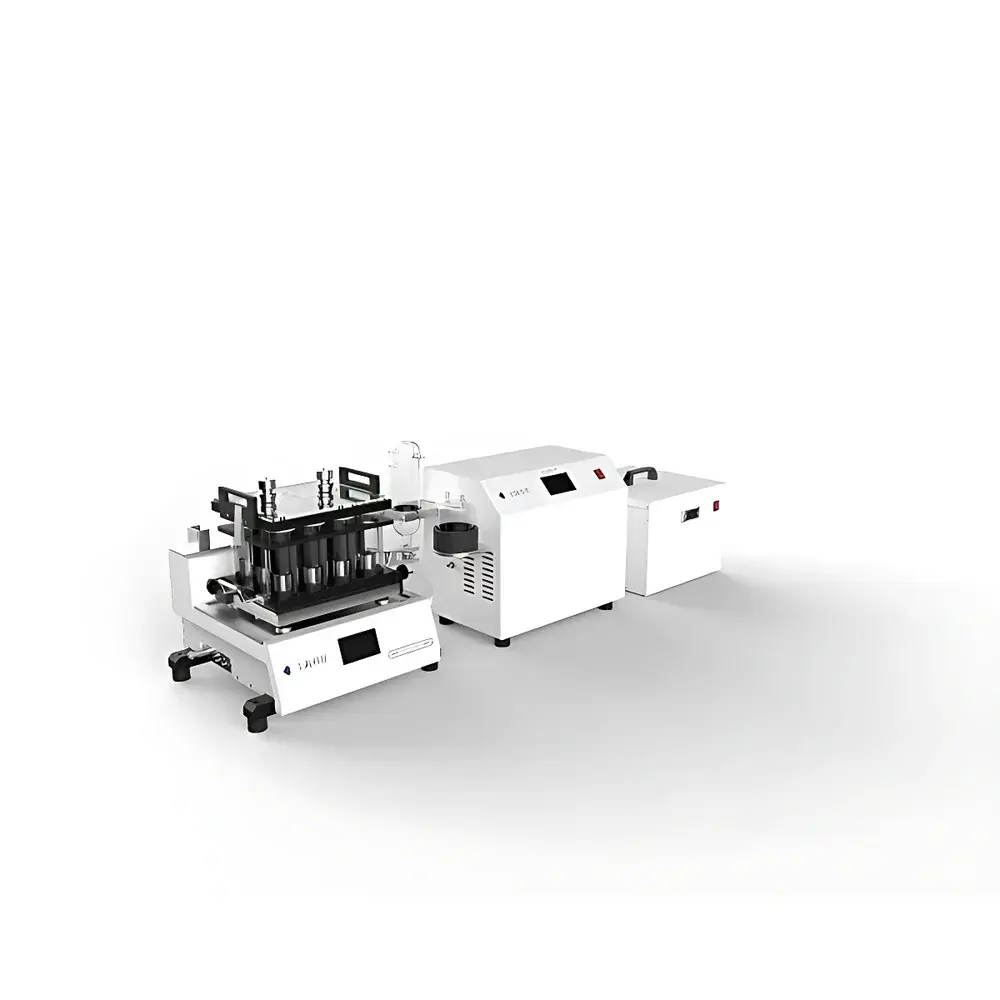
KEZHE VNH-1200Smart Vacuum Parallel Concentrator
| Brand | KEZHE SHANGHAI |
|---|---|
| Origin | Shanghai, China |
| Manufacturer Type | Direct Manufacturer |
| Instrument Type | Vacuum Centrifugal Concentrator |
| Temperature Range | Ambient to 100 °C |
| Temperature Control Accuracy | ±1 °C |
| Sample Capacity | 1–48 positions (standard: 24) |
| Final Absolute Vacuum | 30 mbar |
| Condensate Recovery | Integrated |
| Heating Options | Metal Bath or Water Bath (selectable) |
| Programmable Stages | 6-step gradient temperature control (0–10 h per stage) |
| Rotational Speed | 0–250 rpm |
| Solvent Recovery Efficiency | >95% |
| Cooling Circulator Compatibility | 10 °C to ambient |
| Vacuum Pump Flow Rate | 30 L/min |
| Power Supply | 220–240 V, 50/60 Hz |
| Max Power Consumption | 2200 W |
Overview
The KEZHE VNH-1200Smart Vacuum Parallel Concentrator is an engineered solution for high-throughput, solvent-sensitive sample preparation in analytical and preparative laboratories. It operates on the principle of vacuum-assisted evaporation under controlled thermal conditions—leveraging reduced pressure to lower the boiling point of solvents while maintaining sample integrity through precise temperature regulation and localized cooling at the sample tail-tube interface. Unlike nitrogen blow-down systems, this instrument eliminates compressed gas dependency, thereby reducing operational overhead and eliminating risks associated with uncontrolled gas flow or sample oxidation. Its parallel architecture enables simultaneous processing of up to 48 samples (standard configuration: 24-position), making it especially suitable for applications requiring batch reproducibility—such as LC-MS sample prep, environmental residue analysis, pharmaceutical stability testing, and natural product isolation workflows.
Key Features
- Vacuum-driven parallel concentration across 1–48 sample positions (configurable; standard 24-position rack)
- Two heating platform options: thermostatically controlled metal bath or water bath—both calibrated to ±1 °C accuracy over a range of ambient to 100 °C
- Integrated tail-tube cooling design: maintains condensation zone at low temperature (<10 °C when paired with optional chiller), preventing thermal degradation of thermolabile analytes
- Reflux-capable sample tubes with precision-engineered tail volumes (0.3 mL, 1 mL, or 3 mL) enabling accurate endpoint detection and quantitative recovery
- Dedicated vacuum lid per sample rack ensures physical isolation—eliminating cross-contamination between adjacent vessels
- Onboard solvent condensation and recovery system captures >95% of evaporated solvents (e.g., methanol, acetonitrile, ethyl acetate), minimizing lab emissions and supporting green chemistry compliance
- Intuitive 7-inch capacitive touchscreen interface with programmable 6-stage temperature/vacuum profiles (time per stage: 0–10 hours)
- Variable-speed vortex agitation (0–250 rpm) enhances mass transfer without foaming or splashing
- Modular vacuum control: LCD-displayed digital vacuum controller allows setpoint definition (30 mbar–atmospheric) and gradient ramping
- Low-maintenance, oil-free diaphragm vacuum pump (30 L/min flow rate) with adjustable speed and automatic shut-off at target vacuum
Sample Compatibility & Compliance
The VNH-1200Smart accommodates standard conical-bottom glass or polypropylene tubes (1–30 mL volume range in standard configuration; custom racks support 5–250 mL formats). Its sealed vacuum manifold and individual rack lids meet ISO 554 and ASTM D1353 requirements for moisture-sensitive handling. When operated with validated SOPs and integrated cooling, the system supports GLP-compliant workflows—including those aligned with USP Analytical Instrument Qualification. The absence of nitrogen purge eliminates potential for oxygen ingress, improving stability for redox-sensitive compounds (e.g., catechols, thiols, nitroaromatics). All wetted components are chemically resistant to common organic solvents and compatible with cleaning validation protocols per FDA 21 CFR Part 11 Annex 11 guidelines.
Software & Data Management
The instrument features embedded firmware with audit-trail-enabled operation logging—recording timestamps, vacuum setpoints, temperature profiles, run duration, and error codes. While no external PC software is required for basic operation, optional USB export enables CSV-formatted data archival for LIMS integration. System parameters—including calibration offsets, user access levels (admin/operator), and maintenance alerts—are stored locally with non-volatile memory retention. Firmware updates are performed via secure USB key, ensuring traceability and version control in regulated environments.
Applications
- Routine quantitation of pesticide residues in food matrices (AOAC 2007.01, EN 15662)
- Concentration of metabolite extracts prior to NMR or HRMS analysis
- Parallel cleanup and concentration following ASE (Accelerated Solvent Extraction) or SPE (Solid-Phase Extraction)—enabling direct tube-to-tube transfer without intermediate vial transfers
- Pre-concentration of aqueous environmental samples (e.g., PFAS, pharmaceuticals in wastewater) prior to LC-MS/MS analysis
- Lyophilization-adjacent drying of small-volume biological standards where freeze-drying is impractical
- High-throughput formulation screening involving volatile solvent removal from combinatorial libraries
FAQ
Does the VNH-1200Smart require nitrogen gas for operation?
No—it operates exclusively under vacuum without nitrogen purge, reducing consumable costs and safety hazards.
Can the system be integrated with ASE or SPE platforms?
Yes—its modular rack design accepts standard ASE collection vials and SPE elution tubes, enabling seamless post-extraction concentration without sample transfer.
What is the lowest achievable final vacuum level?
The absolute vacuum limit is 30 mbar, verified using calibrated capacitance manometers traceable to NIST standards.
Is solvent recovery mandatory, or can vapors be vented?
The condenser is integral and non-bypassable; all solvent vapors are condensed and collected—no atmospheric venting is permitted or supported.
How is temperature uniformity maintained across all sample positions?
Each heating block undergoes factory calibration using multi-point RTD mapping; spatial deviation is ≤±0.8 °C at 60 °C across the full 24-position surface.



