
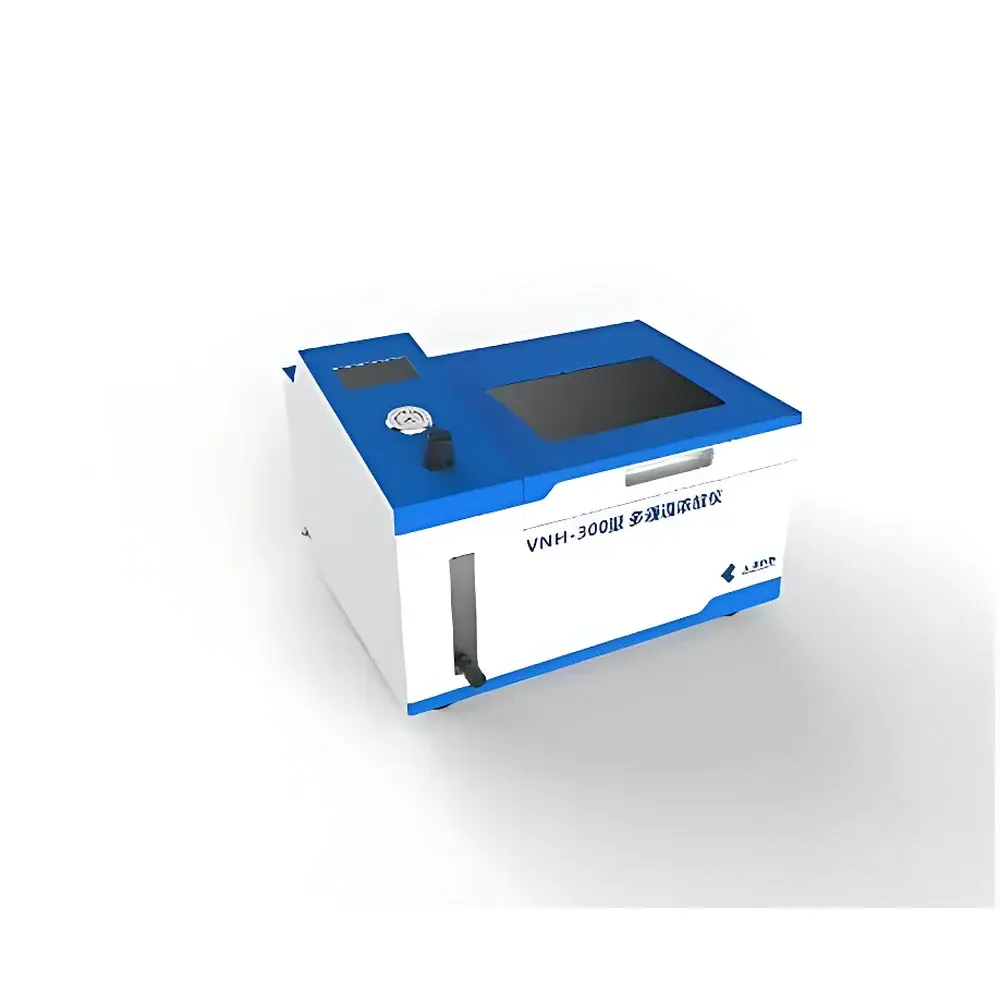
KEZHE VNH-300 Multi-Channel Automated Nitrogen Evaporator
| Brand | KEZHE SHANGHAI |
|---|---|
| Origin | Shanghai, China |
| Manufacturer Type | Direct Manufacturer |
| Region Classification | Domestic (China) |
| Model | VNH-300 |
| Instrument Type | Automated Quantitative Concentrator |
| Temperature Range | Ambient to 80 °C |
| Temperature Control Accuracy | ±0.5 °C |
| Sample Capacity per Channel | 250 mL |
| Final Volume Setpoint Range | 0–1 mL |
| Heating Method | Dry Block Heating |
| Number of Channels | 6 |
| Maximum Gas Flow per Channel | 10 L/min |
| Control Interface | Touchscreen HMI |
Overview
The KEZHE VNH-300 Multi-Channel Automated Nitrogen Evaporator is an engineered solution for high-throughput, reproducible solvent removal in analytical laboratories performing environmental, food safety, and regulatory-compliant residue analysis. It operates on the principle of controlled dry-block heating combined with precisely regulated nitrogen gas flow to accelerate solvent evaporation while maintaining sample integrity. Unlike traditional water bath evaporators, the VNH-300 eliminates immersion-based thermal transfer—removing risks associated with bath depletion, cross-contamination, and inconsistent heat distribution. Its modular 6-channel architecture supports independent operation of each position, enabling flexible batch processing of heterogeneous samples without inter-channel interference. Designed for integration into validated workflows, the system meets foundational requirements for method robustness under ISO/IEC 17025-accredited testing environments.
Key Features
- Dry block heating system with PTFE-coated aluminum heating blocks—ensures uniform thermal distribution, corrosion resistance, and no risk of dry-out or electrical hazard.
- Independent channel control: Each of the six positions can be activated, paused, or terminated individually via touchscreen interface—supporting mixed-sample batches with varying solvents and volatility profiles.
- Integrated electronic mass flow controllers (MFCs) deliver precise, programmable nitrogen flow (0–10 L/min per channel), minimizing solvent loss variability and preventing foaming or splashing.
- Optical endpoint detection system uses non-contact infrared sensing to monitor liquid meniscus height—enabling accurate final volume targeting (0–1 mL) regardless of sample color, turbidity, or UV absorbance.
- Vortex-assisted gas dispersion design directs nitrogen tangentially across the sample surface, enhancing convective mass transfer while suppressing vortex-induced splashing and analyte loss.
- 250 mL borosilicate glass concentrator tubes accommodate large-volume extractions (e.g., from ASE, GPC, or liquid–liquid partitioning), reducing need for intermediate transfers.
- Touchscreen HMI with intuitive workflow navigation, password-protected method storage, and real-time display of temperature, flow rate, and countdown timers.
Sample Compatibility & Compliance
The VNH-300 is compatible with common organic solvents used in EPA, ISO, and DIN methods—including hexane, acetone, ethyl acetate, dichloromethane, and acetonitrile. Its dry-heating architecture avoids solvent reactivity issues associated with water bath contamination. The instrument supports compliance with DIN EN ISO 9377-2 (determination of hydrocarbons in water), EPA Method 505/508/8081, and AOAC Official Methods requiring quantitative concentration prior to GC or LC analysis. Optional accessories—including a certified organic compound purification module (DIN EN ISO 9377-2 compliant) and inline PTFE membrane solvent drying unit—extend its applicability to trace-level analyses requiring ultra-low moisture content. All operational parameters are logged with timestamped audit trails, supporting GLP/GMP documentation requirements and alignment with FDA 21 CFR Part 11 principles when paired with appropriate LIMS integration.
Software & Data Management
The embedded control firmware records all critical process variables—including setpoint temperature, actual block temperature, nitrogen flow rate per channel, elapsed time, and endpoint confirmation status—for each run. Data export is supported via USB flash drive in CSV format, enabling direct import into laboratory information management systems (LIMS) or statistical process control (SPC) platforms. User-defined method templates (up to 99) can be saved with unique identifiers, including channel-specific ramp/hold profiles and final volume thresholds. System access levels include operator, supervisor, and administrator roles with configurable password policies. Audit logs capture user login/logout events, parameter modifications, and method execution history—providing full traceability required for internal quality audits and external accreditation assessments.
Applications
- Preparative concentration of pesticide residue extracts (e.g., QuEChERS, AOAC 2007.01) prior to GC–MS/MS analysis.
- Post-GPC fraction cleanup of lipid-rich environmental matrices (soil, sediment, biota) before PAH quantification per EPA Method 8270.
- High-volume solvent reduction following accelerated solvent extraction (ASE) using DIONEX systems—particularly for semi-volatile organics in solid-phase samples.
- Automated concentration of aqueous extracts processed under DIN EN ISO 9377-2 for petroleum hydrocarbon profiling in wastewater and groundwater monitoring programs.
- Parallel processing of clinical or forensic toxicology samples where consistent recovery of low-abundance analytes (e.g., benzodiazepines, opioids) is critical.
FAQ
What types of solvents are compatible with the VNH-300?
The system is validated for use with low-boiling-point organic solvents including acetone, hexane, ethyl acetate, dichloromethane, and acetonitrile. High-boiling solvents (e.g., DMSO, glycerol) are not recommended due to thermal stability limits of the dry block.
Can the VNH-300 be integrated with third-party extraction platforms?
Yes—it features standardized mechanical mounting interfaces and analog/digital I/O ports for synchronization with ASE, GPC, and automated SPE systems. Protocol handshaking is supported via TTL trigger signals.
Is calibration traceable to national standards?
Temperature sensors are factory-calibrated against NIST-traceable references; users may perform field verification using certified RTD probes. Flow calibration certificates are available upon request.
Does the system support 21 CFR Part 11 compliance?
Out-of-the-box, it provides audit trail logging and role-based access control. Full Part 11 compliance requires deployment within a validated IT infrastructure and supplementary electronic signature policy configuration.
What maintenance is required for long-term reliability?
Annual inspection of heating block uniformity, MFC zero drift verification, and optical sensor cleaning with isopropyl alcohol are recommended. No consumables beyond standard glassware are required.



