
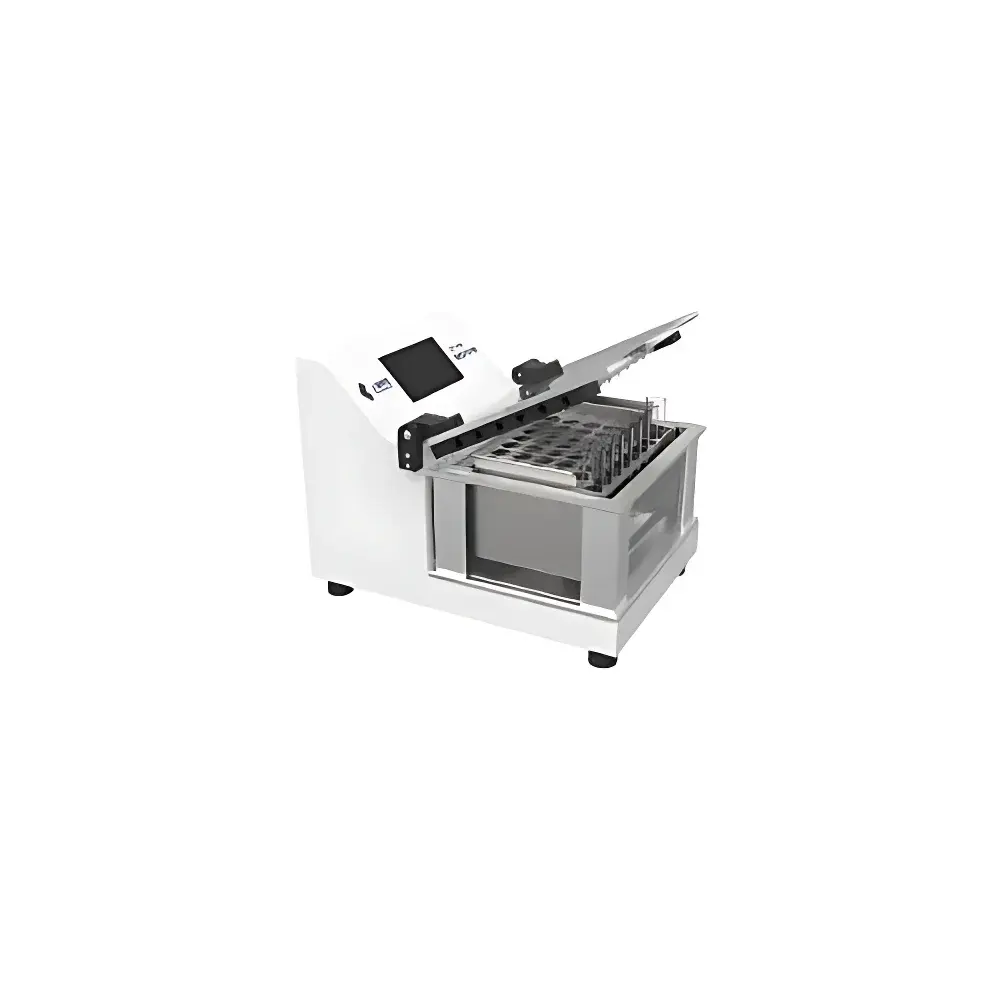
KEZHE VNH-600 Visual-Window Parallel Evaporative Concentrator
| Brand | KEZHE SHANGHAI |
|---|---|
| Origin | Shanghai, China |
| Manufacturer Type | Direct Manufacturer |
| Product Category | Domestic |
| Model | VNH-600 |
| Instrument Type | Automated Quantitative Concentrator |
| Temperature Range | Ambient to 80 °C |
| Temperature Control Accuracy | ±0.5 °C |
| Sample Vessel Capacity Options | 80 mL, 100 mL, 120 mL, 500 mL (120 mL standard) |
| Sample Throughput | 6 / 24 / 48 positions |
| Compatible Tube Volume | 1.5–200 mL |
| Heating Method | Water Bath |
| Gas Source | Nitrogen or Inert Gas |
| Max Gas Flow Rate | 15 L/min |
| Endpoint Detection | Infrared-based Quantitative Termination |
| Gas Flow Control | Independent per-channel with on/off valve |
| Airflow Design | Vortex-shear gas delivery |
| Safety Features | Real-time overheat/overpressure/low-water-level alerts |
| Viewing Window | Triple-side optical-grade transparent acrylic |
| Illumination | Adjustable 4-color LED bath lighting |
| Condensation Prevention | High-capacity axial exhaust fan |
Overview
The KEZHE VNH-600 Visual-Window Parallel Evaporative Concentrator is an engineered solution for high-throughput, reproducible solvent removal in analytical and preparative laboratories. It operates on the principle of combined water-bath heating and regulated inert-gas (typically nitrogen) sparging—leveraging controlled thermal energy transfer and mass-transfer enhancement via vortex-shear airflow dynamics. Unlike single-mode evaporators, the VNH-600 integrates a modular platform architecture that supports three interchangeable concentration systems (e.g., standard tube rack, microplate adapter, and large-volume flask holder), enabling method flexibility across diverse sample matrices and volume ranges—from microliter-scale biofluid extracts to 500 mL environmental water samples. Its triple-side optical-grade acrylic viewing windows provide unobstructed, multi-angle visual monitoring without compromising structural integrity or thermal insulation. This transparency is complemented by a calibrated, four-color LED illumination system embedded within the water bath, allowing operators to distinguish subtle meniscus changes—even in colored or turbid solutions—without opening the chamber or interrupting the process.
Key Features
- Modular platform supporting three interchangeable sample-handling systems: standard tube racks (6/24/48 positions), microplate adapters, and large-volume flask holders—enabling seamless transition between low- and high-volume workflows.
- Triple-side transparent acrylic enclosure with anti-fogging design, featuring a high-flow axial exhaust fan to maintain optical clarity during prolonged operation at elevated temperatures.
- Infrared-based endpoint detection system providing quantitative termination independent of sample color, turbidity, or absorbance—ensuring consistent final volumes across heterogeneous sample sets.
- Per-channel gas flow control with individual solenoid valves; each nitrogen needle can be activated, deactivated, or flow-adjusted independently to minimize gas consumption and prevent cross-contamination.
- Vortex-shear gas delivery geometry optimized for turbulent boundary layer disruption at the liquid surface—enhancing evaporation kinetics while minimizing bumping or splashing.
- Automated gas flow ramping: as liquid level recedes during concentration, the system dynamically increases gas flow to the active channels, maintaining optimal surface shear and evaporation rate.
- Tool-free, quick-release nitrogen needle assembly—designed for rapid disassembly, ultrasonic cleaning, and reinstallation without recalibration.
- Universal tube rack compatibility accommodating 1.5 mL to 200 mL vessels; no hardware modification required when switching between tube sizes or formats.
- Adjustable lateral positioning of gas nozzles to align precisely with varying tube diameters and meniscus heights—critical for reproducibility in regulated environments.
- Touchscreen HMI with real-time graphical display of temperature profile, gas pressure, elapsed time, and active channel status—supporting audit-ready operation logs.
Sample Compatibility & Compliance
The VNH-600 accommodates a broad spectrum of sample types—including aqueous extracts, organic solvent mixtures (e.g., ethyl acetate, dichloromethane, acetonitrile), biological fluids (plasma, urine, tissue homogenates), and environmental matrices (soil leachates, wastewater filtrates). Its inert-gas environment and absence of direct heating elements eliminate thermal degradation risks for thermolabile analytes such as pesticides, pharmaceuticals, hormones, and nucleic acid fragments. The system meets fundamental design criteria aligned with ISO/IEC 17025:2017 for laboratory equipment qualification and supports GLP-compliant workflows through traceable parameter logging and user-access-controlled settings. While not certified to FDA 21 CFR Part 11 out-of-the-box, its data export functionality (CSV/Excel) and timestamped event logs facilitate integration into validated LIMS or ELN platforms requiring electronic record integrity.
Software & Data Management
The embedded controller runs a deterministic real-time operating system with non-volatile memory for method storage (up to 99 protocols). Each protocol stores temperature ramp profiles, gas flow setpoints per channel, endpoint volume thresholds, illumination color selection, and safety interlock configurations. All operational events—including start/stop timestamps, temperature deviations >±0.3 °C, gas pressure anomalies, and infrared detection triggers—are recorded with millisecond resolution and exported via USB interface. Audit trail functionality includes user ID tagging (with optional password protection), change history for critical parameters, and tamper-evident log files compatible with third-party validation software. Remote monitoring is supported via optional Ethernet module (KEZHE NetLink v2.1), enabling integration into centralized lab infrastructure management systems.
Applications
- Preparative sample cleanup prior to GC-MS or LC-MS/MS analysis in environmental residue testing (e.g., EPA Methods 508.1, 8081B).
- High-throughput concentration of clinical biosamples in pharmacokinetic studies under CLIA- or CAP-accredited conditions.
- Parallel processing of solid-phase extraction (SPE) eluates across multiple drug classes in forensic toxicology screening.
- Reduction of large-volume water samples (up to 500 mL) for trace metal or organic contaminant analysis per ISO 17294-2.
- Method development for volatile organic compound (VOC) recovery in food safety labs, where visual confirmation of endpoint prevents over-evaporation of aldehydes or esters.
- Concentration of nanoparticle suspensions and colloidal formulations where shear-sensitive stability must be preserved—enabled by precise gas flow modulation and absence of mechanical agitation.
FAQ
What inert gases are compatible with the VNH-600?
Nitrogen is the default and most widely used gas; argon and helium may also be employed depending on analyte volatility and matrix compatibility. Gas inlet pressure must be regulated to 0.2–0.4 MPa.
Can the VNH-600 be validated for GMP environments?
Yes—the system supports IQ/OQ documentation packages (available upon request), and its parameter logging, user access controls, and calibration traceability align with Annex 11 and USP guidelines for analytical instrument qualification.
Is the infrared endpoint sensor affected by ethanol or acetone vapor?
No—the sensor operates in the near-infrared range (850–940 nm) and is optically isolated from the chamber atmosphere by sapphire windows; vapor interference is negligible under standard operating conditions.
How often does the water bath require maintenance?
Deionized water should be replaced weekly; biocide additive (KEZHE BathGuard™) is recommended for extended runs. Annual calibration of the PT100 temperature probe is advised per ISO/IEC 17025 requirements.
Does the VNH-600 support custom tube rack fabrication?
Yes—KEZHE provides CAD templates and dimensional specifications for OEM-style rack design; mechanical tolerances must adhere to ±0.1 mm for automated alignment repeatability.



