
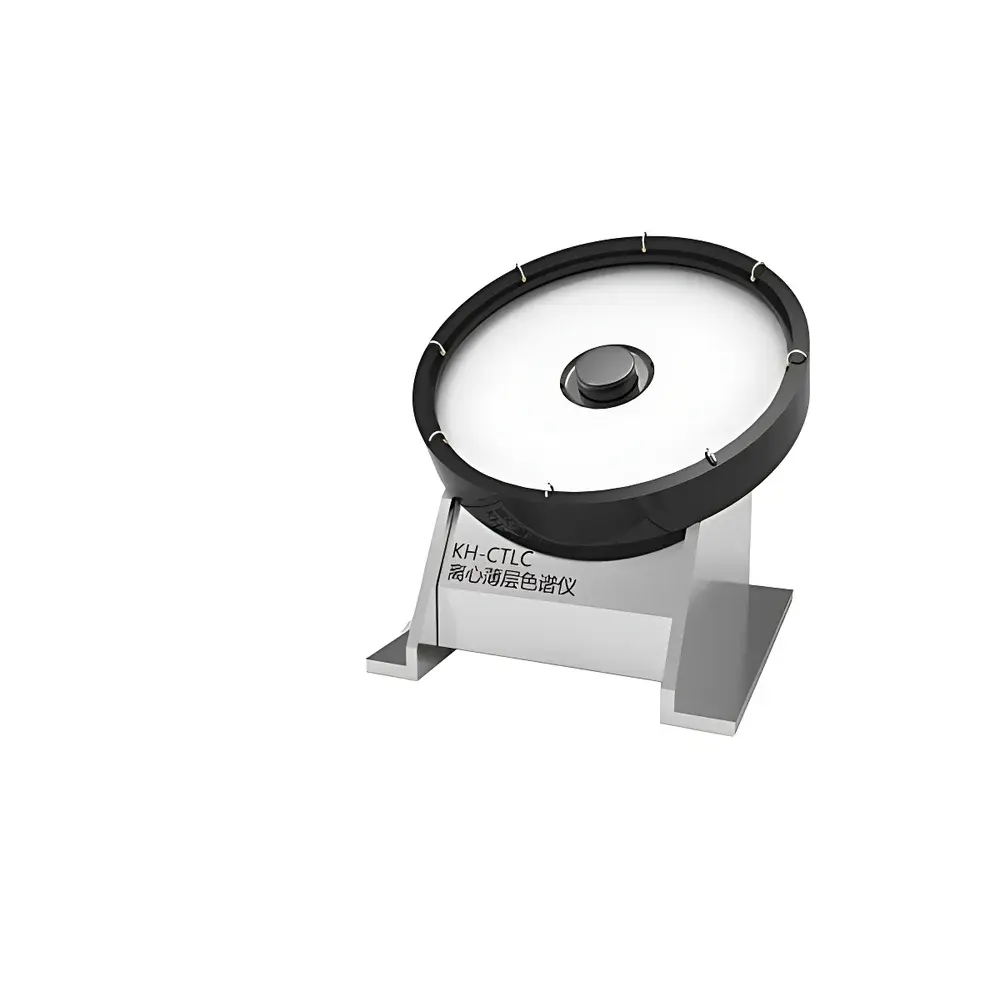
KH-CTLC-I Preparative Centrifugal Thin-Layer Chromatography System
| Brand | KEZHE SHANGHAI |
|---|---|
| Origin | Shanghai, China |
| Manufacturer Type | Direct Manufacturer |
| Instrument Type | Forced-Flow Centrifugal TLC System |
| UV Wavelengths | 254 nm & 365 nm |
| UV Source | Dual-Band UV Lamp |
| Separation Capacity | 100 mg – 2 g per run |
| Rotational Speed Range | 100 – 1450 rpm |
| Plate Diameter | 245 mm |
| Adsorbent Layer Thickness Options | 1, 2, 3, 4, 6, 8 mm |
| Solvent Consumption | < 350 mL per separation |
| Reusable Plates | Yes |
| Gradient Elution Capability | On-line, programmable via manual valve control |
| Plate Preparation Included | Yes (with scraper & plate former) |
Overview
The KH-CTLC-I Preparative Centrifugal Thin-Layer Chromatography System is an engineered solution for medium-resolution, gram-scale compound isolation in synthetic organic chemistry, natural product purification, and pharmaceutical process development. Unlike conventional planar TLC or flash chromatography, the KH-CTLC-I employs centrifugal force-driven solvent migration across a rotating circular silica-coated plate—enabling forced-flow elution under controlled rotational dynamics. This principle eliminates capillary diffusion limitations, significantly accelerating migration while maintaining band integrity through uniform radial flow. Designed for reproducible preparative separations without column packing or high-pressure systems, it bridges the gap between analytical TLC and low-pressure liquid chromatography (LPLC), offering a robust, non-destructive alternative to traditional scraping-based preparative TLC plates.
Key Features
- Centrifugally driven forced-flow elution ensures consistent solvent front velocity and minimizes band broadening—critical for isolating thermally or oxidatively labile compounds.
- Adjustable rotational speed (100–1450 rpm) and manual flow control enable fine-tuning of resolution vs. throughput trade-offs across diverse compound classes.
- Reusable 245 mm diameter glass-backed silica plates with selectable adsorbent thicknesses (1–8 mm) reduce consumable costs and eliminate repetitive plate preparation or adsorbent disposal.
- Integrated dual-wavelength UV observation (254 nm and 365 nm) supports real-time monitoring of compound migration and fraction collection under ambient or darkroom conditions.
- Compact footprint (< 0.5 m²), tool-free assembly, and maintenance-free operation make it suitable for shared labs, teaching facilities, and QC environments with limited bench space and technical staffing.
- Safety-engineered enclosure with interlocked optical cover prevents UV exposure during operation and ensures mechanical stability at high rotational speeds.
Sample Compatibility & Compliance
The KH-CTLC-I accommodates a wide polarity range—from non-polar hydrocarbons to moderately polar alkaloids and glycosides—when paired with standard silica gel or reversed-phase (C18) precoated plates. Its open-system architecture allows direct application of crude extracts, reaction mixtures, or partially purified fractions without pre-filtration. While not a regulated GMP instrument per se, its design supports GLP-aligned workflows: manual logbook documentation, traceable solvent batches, and visual fraction tracking meet basic audit requirements for early-stage R&D. The system complies with IEC 61010-1 for laboratory electrical safety and incorporates UV shielding conforming to EN 62471 (Photobiological Safety of Lamps).
Software & Data Management
The KH-CTLC-I operates as a manually controlled, hardware-centric platform—intentionally omitting embedded software to maximize reliability, minimize calibration drift, and avoid regulatory validation overhead. All operational parameters (rotation speed, elution time, solvent composition, plate thickness) are recorded externally in lab notebooks or LIMS-compatible spreadsheets. This analog-first approach aligns with ISO/IEC 17025 Clause 7.7 (Control of Records) and facilitates straightforward 21 CFR Part 11 compliance when integrated into validated electronic record systems via external documentation protocols. Optional digital tachometer and timer accessories enable timestamped speed verification for method transfer documentation.
Applications
- Purification of natural product isolates (e.g., flavonoids, terpenoids, indole alkaloids) from plant extracts at 100 mg–2 g scale.
- Rapid cleanup of Suzuki or Heck coupling reaction mixtures prior to NMR analysis or crystallization.
- Isolation of synthetic intermediates where column chromatography leads to decomposition or poor recovery.
- Method scouting for flash or HPLC methods—TLC-like visualization combined with gram-level output enables rapid retention window estimation.
- Teaching chromatographic principles—including flow dynamics, adsorption isotherms, and resolution optimization—in undergraduate organic laboratories.
FAQ
Can the KH-CTLC-I be used with reversed-phase or amino-modified plates?
Yes—any commercially available circular TLC plate (245 mm diameter) with compatible backing material may be mounted, provided thickness falls within the 1–8 mm specification range.
Is gradient elution truly programmable or manually implemented?
Gradient elution is performed manually using the integrated multi-port injection valve; users switch solvents mid-run by actuating the valve—no motorized pumps or controllers required.
What is the expected lifetime of a single silica plate under repeated use?
With proper cleaning (e.g., methanol/chloroform sonication) and storage in desiccated conditions, a standard silica plate typically sustains ≥20 separation cycles without significant resolution loss.
Does the system support automated fraction collection?
No—fraction collection is manual and visually guided via UV inspection; however, the low solvent volume (<350 mL) and radial elution geometry simplify timed or zone-based manual harvesting.
How does resolution compare to conventional preparative TLC on 20 × 20 cm plates?
Radial flow and forced convection yield ~1.8× higher peak capacity than gravity-fed rectangular plates of equivalent adsorbent mass, particularly for compounds with k′ values between 0.3 and 5.



