KHLAB PCR Laboratory Ventilation Monitoring System
| Brand | KHLAB |
|---|---|
| Origin | Zhejiang, China |
| Manufacturer Type | Authorized Distributor |
| Product Origin | Domestic (China) |
| Model | PCR Laboratory Ventilation Monitoring System |
| Pricing | Available Upon Request |
| Design Experience | 10+ Years |
Overview
The KHLAB PCR Laboratory Ventilation Monitoring System is an engineered solution for continuous, real-time surveillance of critical airflow and pressure parameters within polymerase chain reaction (PCR) laboratory environments. Designed in accordance with biosafety and molecular diagnostics infrastructure requirements, the system implements a multi-point differential pressure sensing architecture coupled with volumetric airflow monitoring to ensure strict adherence to the four-zone isolation principle—reagent preparation, sample processing, amplification, and product analysis. It operates on the fundamental principle of dynamic pressure cascade control: maintaining monotonic, stepwise negative pressure gradients (e.g., −5 Pa to −30 Pa across zones) to enforce unidirectional airflow from clean to contaminated areas, thereby minimizing cross-contamination and aerosol-mediated pathogen transmission. The system integrates seamlessly with existing HVAC infrastructure and supports fail-safe alarm escalation protocols compliant with ISO 14644-1 (cleanroom classification), ISO 15189 (medical laboratory quality), and GB 50346–2011 (Chinese biosafety laboratory construction standards).
Key Features
- Multi-channel differential pressure monitoring across all four PCR zones, with ±0.5 Pa resolution and <1.5% full-scale accuracy
- Real-time airflow velocity and volume tracking at supply and exhaust ducts using calibrated thermal anemometry and pitot-static sensors
- Automated pressure gradient validation: continuously verifies monotonic decay across zones and triggers Level 1–3 alarms upon deviation exceeding user-defined thresholds
- Redundant sensor architecture with automatic fault detection and sensor health diagnostics
- Modular I/O interface supporting integration with BMS (Building Management Systems) via Modbus RTU/TCP and BACnet MS/TP protocols
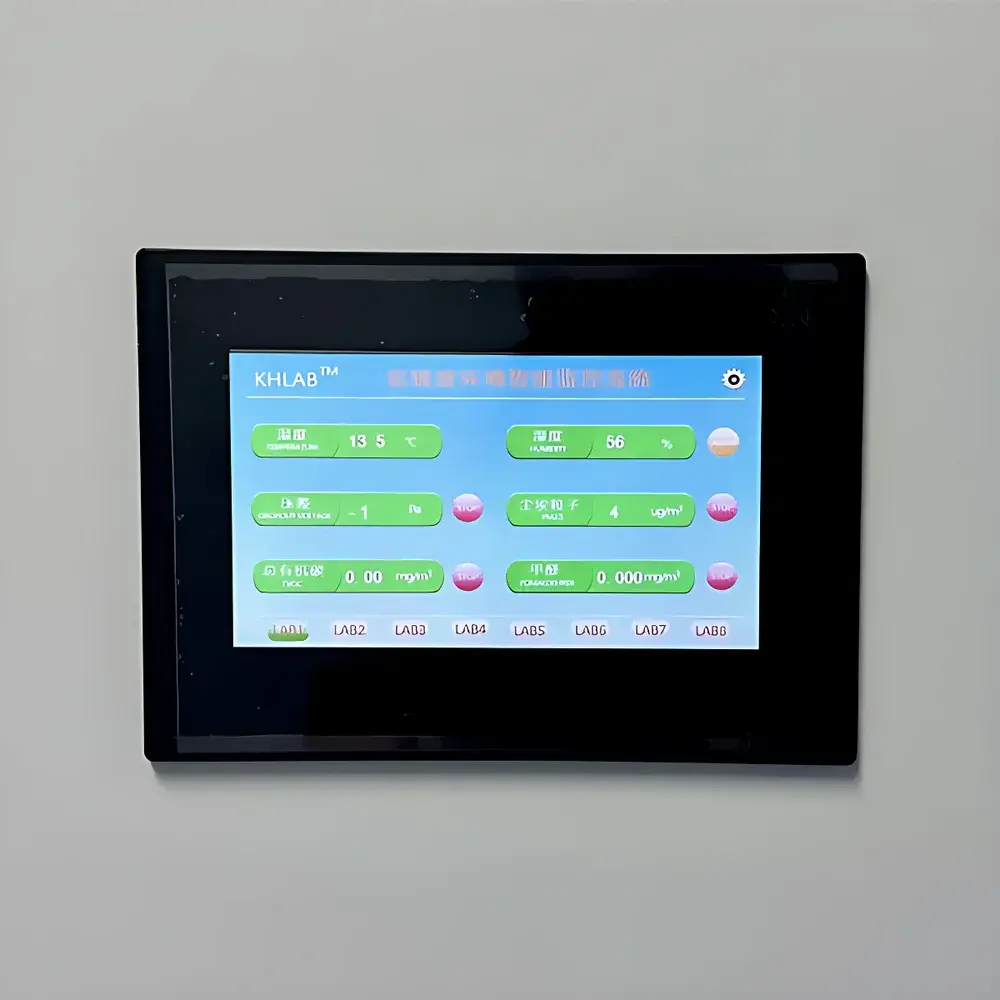
- Local HMI with color-coded zone status indicators and configurable alarm history log (retention ≥90 days)
- Fail-safe relay outputs for emergency shutdown of non-essential equipment or activation of backup ventilation circuits
Sample Compatibility & Compliance
The system is not designed for sample analysis but for environmental parameter assurance in nucleic acid testing facilities. It supports operation in ambient temperature ranges of 10–35 °C and relative humidity up to 80% non-condensing. All sensors and enclosures meet IP54 ingress protection rating for laboratory-grade durability. The monitoring architecture aligns with national and international regulatory expectations for diagnostic laboratories, including CNAS-CL01:2018 (equivalent to ISO/IEC 17025), WHO Laboratory Biosafety Manual (4th ed.), and CDC/NIH Biosafety in Microbiological and Biomedical Laboratories (BMBL). Data integrity features—including time-stamped event logging, user-access audit trails, and immutable alarm records—support GLP and ISO 13485-aligned quality management systems.
Software & Data Management
The embedded firmware provides local data acquisition, trend visualization, and alarm management through a web-based interface accessible via secure HTTPS (TLS 1.2+). Remote access requires role-based authentication (admin/operator/viewer) and supports optional 2FA. Historical pressure and airflow data are stored in SQLite databases with daily automated export (CSV/JSON) capability. For enterprise deployment, the system supports OPC UA server integration enabling centralized dashboarding in SCADA or LIMS platforms. Audit logs record all configuration changes, user logins, and alarm acknowledgments—fully traceable for FDA 21 CFR Part 11 compliance when paired with validated electronic signature modules. Data retention policies are configurable per institutional SOPs.
Applications
- Continuous verification of pressure differentials in clinical PCR labs performing SARS-CoV-2, influenza, or other respiratory pathogen testing
- Commissioning and routine performance qualification of new or renovated molecular diagnostics suites
- Supporting accreditation audits (e.g., CAP, CLIA, CNAS) by providing objective, timestamped evidence of environmental control
- Root cause analysis during contamination events via retrospective pressure/airflow correlation
- Integration into hospital-wide infection prevention and control (IPC) dashboards for proactive risk mitigation
FAQ
Does this system replace HVAC commissioning or periodic certification?
No—it complements but does not substitute formal HVAC commissioning (per ASHRAE Guideline 1-2021) or annual airflow/pressure certification by accredited third-party providers.
Can it interface with existing building automation systems?
Yes—native Modbus RTU/TCP and BACnet MS/TP support enables bidirectional communication with most commercial BMS platforms without middleware.
Is cloud-based remote monitoring available?
Cloud connectivity is optional and implemented only via customer-managed, on-premise edge gateway deployments to maintain data sovereignty and comply with regional health data regulations (e.g., China’s PIPL, EU GDPR).
What maintenance is required for long-term reliability?
Annual sensor recalibration (traceable to NIM-certified standards) and quarterly functional verification of alarm relays and communication interfaces are recommended per manufacturer guidelines.
How does the system handle power outages or network interruptions?
Onboard non-volatile memory retains >72 hours of high-frequency sensor data during offline operation; all events synchronize automatically upon network recovery.