
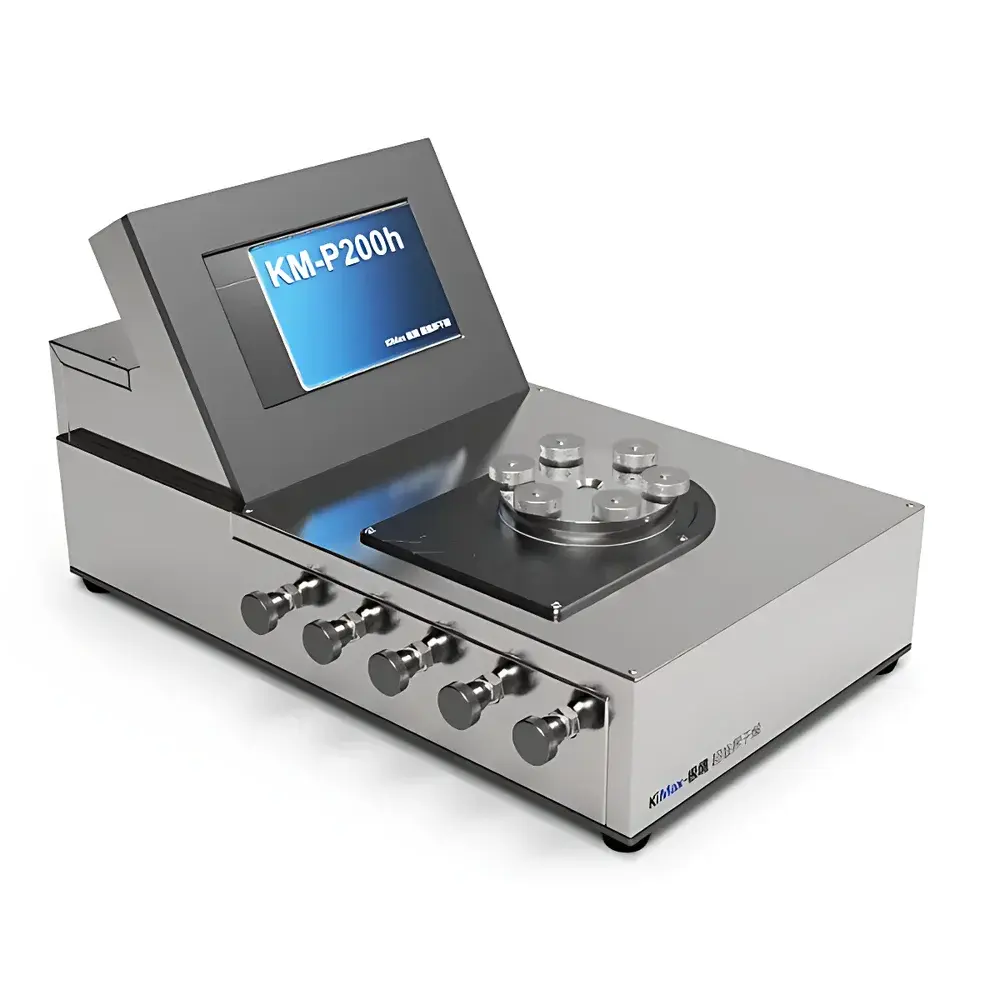
KiMax KM-Ph Cleanroom-Grade Supercritical Drying System
| Brand | KiMax |
|---|---|
| Origin | Beijing, China |
| Model | KM-Ph |
| Pressure Range | 0–14 MPa |
| Temperature Range | 0–50 °C |
| Chamber Volume Options | 100 mL / 230 mL |
| Chamber Diameter | 63 mm / 86 mm |
| Chamber Depth | 32 mm / 40 mm |
| Filtration Grade | 0.02 µm |
| Display | VGA Resistive Touchscreen |
| CO₂ Flow Control | 20 SCFH (1.25″ chamber), 60 SCFH (2.5″ & 3.4″ chambers) |
| Cooling Time (1.25″ chamber) | <60 s |
| Material Compatibility | CO₂, acetone, ultra-pure alcohols (inert internal surfaces) |
Overview
The KiMax KM-Ph Cleanroom-Grade Supercritical Drying System is an engineered solution for high-integrity sample preparation in semiconductor, nanomaterials, and life science laboratories requiring ISO Class 5 (Class 100) or better environmental control. It employs supercritical carbon dioxide (scCO₂) drying—a non-destructive, solvent-free process that replaces liquid-phase removal with phase transition above the critical point (31.1 °C, 7.38 MPa)—thereby eliminating capillary forces and surface tension-induced collapse of delicate nanostructures. Unlike conventional air-drying or freeze-drying, scCO₂ drying preserves the original morphology of aerogels, MEMS devices, porous scaffolds, and lithographically patterned wafers at sub-100 nm feature resolution. The KM-Ph variant integrates cleanroom-grade particulate filtration (0.02 µm), HF-compatible wafer fixtures, and fully inert wetted-path materials—including electropolished stainless steel and fluoropolymer-sealed components—to meet stringent contamination control requirements in front-end semiconductor fabrication and GLP-compliant biomaterial research.
Key Features
- Cleanroom-optimized design with integrated 0.02 µm particulate filtration on all gas inlet and exhaust paths—validated for ≤100 particles/ft³ (≥0.1 µm) under continuous operation.
- Dual-chamber configuration options: 100 mL (63 mm Ø × 32 mm depth) and 230 mL (86 mm Ø × 40 mm depth), both supporting full 200 mm (8″) and partial 300 mm (12″) wafer handling via standardized HF-compatible clamping fixtures.
- Non-mechanical fluid actuation system eliminates rotating seals and stirring elements—reducing maintenance intervals and eliminating particle generation from wear debris.
- Precision slow-fill mode enables controlled LCO₂ infusion at ≤0.5 MPa/min ramp rate, critical for fragile hydrogels, cryo-sectioned tissues, and low-density silica aerogels.
- Adiabatic rapid-cooling capability (<60 s cooldown for 1.25″-ID chamber) minimizes thermal stress and supports high-throughput batch processing without external chiller dependency.
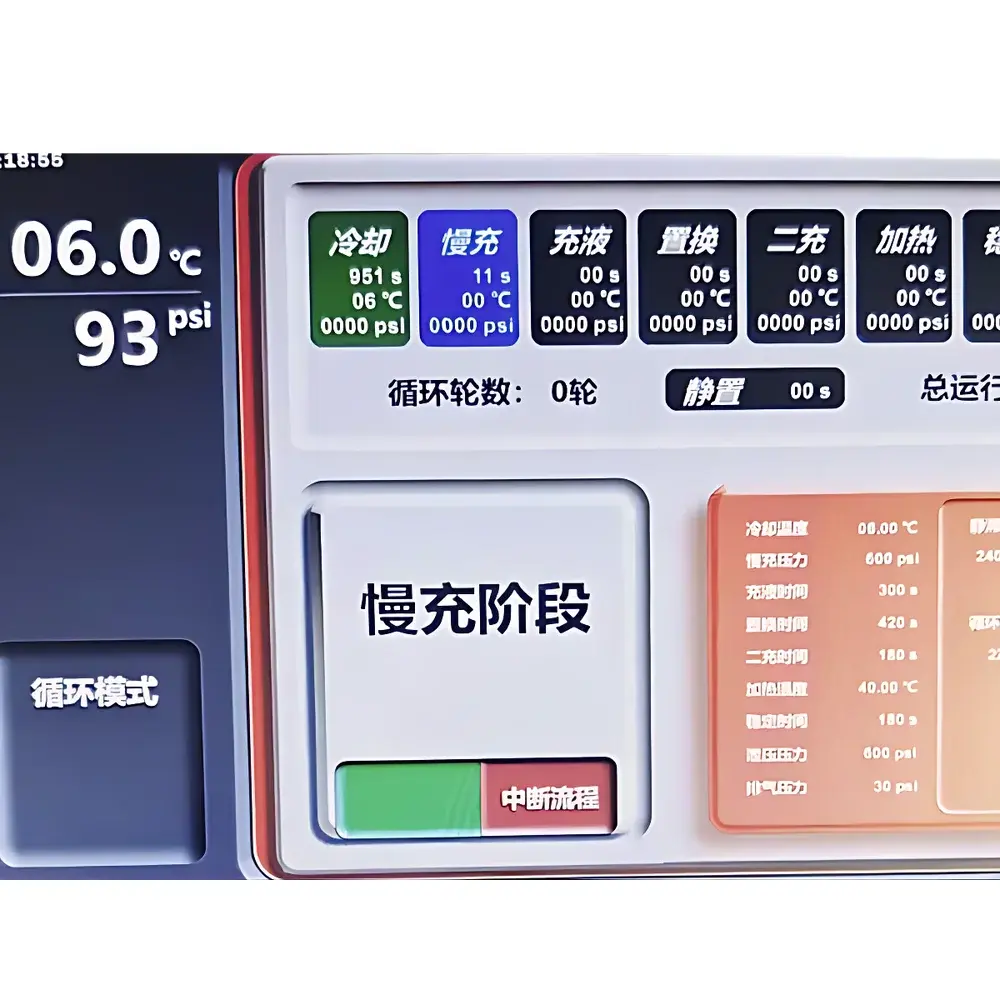
- VGA resistive touchscreen interface with real-time visualization of pressure (0–2000 psi), temperature (0–50 °C), and process stage progression; supports up to 99 user-defined drying protocols with timestamped execution logs.
Sample Compatibility & Compliance
The KM-Ph accommodates a broad spectrum of sensitive specimens—including silicon wafers post-etching, metal–organic frameworks (MOFs), electrospun polymer nanofibers, decellularized extracellular matrices, and sol–gel-derived aerogels—without structural distortion or chemical residue. All internal surfaces are passivated for compatibility with CO₂, acetone, methanol, and isopropanol. The system conforms to ASTM F2457 (Standard Practice for Critical Point Drying of Biological Specimens) and supports audit-ready documentation per FDA 21 CFR Part 11 when paired with optional electronic log export. Chamber O-rings and viewports comply with USP <661.1> extractables testing, and the entire fluid path meets ISO 14644-1 Class 5 particulate limits during active drying cycles.
Software & Data Management
The embedded control firmware records pressure, temperature, time, and valve state at 1 Hz resolution and stores data locally in CSV format with SHA-256 checksum integrity verification. Protocol files include operator ID, timestamp, chamber ID, and version-controlled parameter sets. Optional USB export enables integration into LIMS environments and supports automated report generation compliant with ISO/IEC 17025 documentation standards. Audit trails retain all user actions—including recipe edits, manual overrides, and calibration events—for ≥12 months without external storage.
Applications
- Semiconductor R&D: Drying of high-aspect-ratio etched structures (e.g., FinFET fins, nanowire arrays) without stiction or pattern collapse.
- Nanomaterial synthesis: Preservation of specific surface area (>800 m²/g) and pore volume integrity in SiO₂, TiO₂, and carbon aerogels.
- Biomedical engineering: Structural retention of collagen-based hydrogels, vascular scaffolds, and 3D-bioprinted constructs prior to SEM imaging or mechanical testing.
- MEMS/NEMS fabrication: Post-release drying of cantilevers, resonators, and microfluidic channels where residual stress must remain below 50 MPa.
- Quality control labs: Routine validation of drying efficacy using gravimetric loss tracking and BET surface area correlation studies.
FAQ
What cleanroom classifications is the KM-Ph certified for?
The KM-Ph is designed and validated for operation within ISO 14644-1 Class 5 (formerly Federal Standard 209E Class 100) environments. Its integrated 0.02 µm filtration and sealed exhaust pathway prevent recirculation of particulates into the cleanroom.
Can the system dry samples containing aqueous buffers or saline solutions?
Yes—provided samples undergo prior solvent exchange (e.g., water → ethanol → liquid CO₂) using standard graded dehydration protocols. The KM-Ph’s slow-fill and extended dwell cycles accommodate diffusion-limited exchange in dense biological matrices.
Is remote monitoring or network connectivity supported?
The base system operates as a standalone instrument with local touchscreen control. Ethernet or Wi-Fi connectivity is available via optional OEM-integrated IoT module (part number KM-Ph-IO-ETH), enabling SNMP-based status polling and secure TLS 1.2 data upload.
What maintenance intervals are recommended for the 0.02 µm filter cartridges?
Under typical usage (≤5 drying cycles/week), replace inlet and exhaust filters every 6 months or after 200 operational hours—whichever occurs first. Filter replacement requires no tools and takes <90 seconds.
Does the KM-Ph support regulatory compliance for GMP manufacturing environments?
Yes—when configured with optional 21 CFR Part 11-compliant firmware (KM-Ph-FW-P11), it provides electronic signatures, role-based access control, and immutable audit trails required for pharmaceutical and medical device manufacturing QC workflows.



