
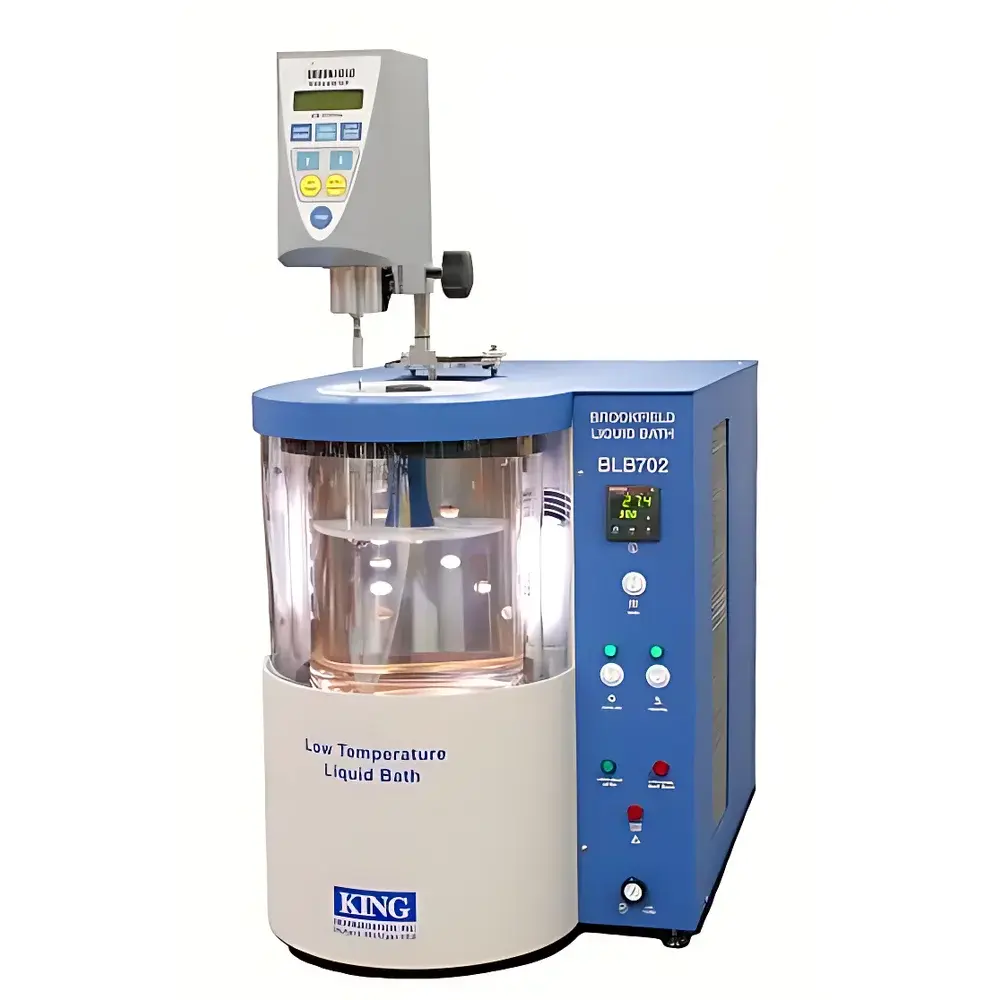
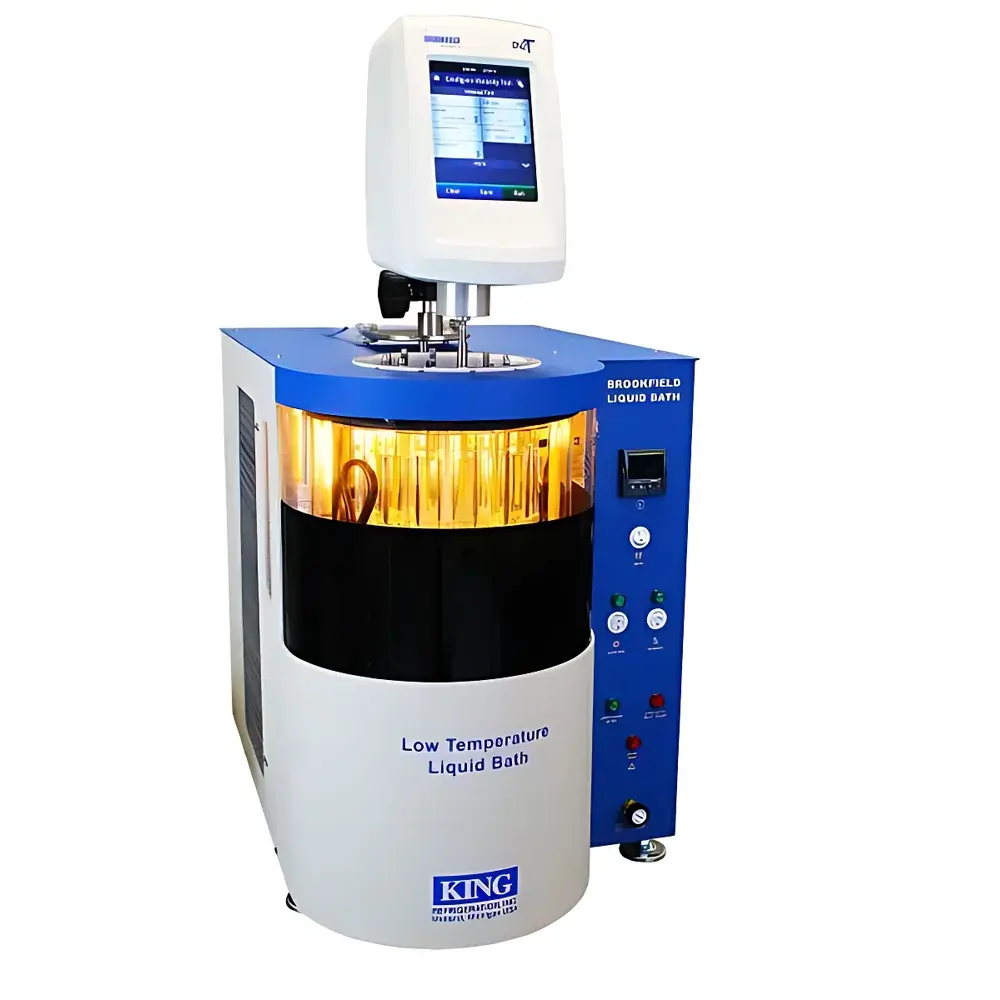
KING BLB701/BLB702/BLB-DIN Low-Temperature Brookfield Viscometer
| Brand | Tannas & King |
|---|---|
| Origin | USA |
| Manufacturer Type | Authorized Distributor |
| Origin Category | Imported |
| Model | BLB701 / BLB702 / BLB DIN |
| Product Type | Laboratory Instrument |
| Test Parameter | Low-Temperature Apparent Viscosity (ASTM D2983, IP 295, GB/T 6538) |
| Compliance | ASTM D2983, IP 295, GB/T 6538 |
| Dimensions (W×D×H) | 48 × 53 × 66 cm |
| Weight | ~68 kg |
| Voltage | 220 VAC, 50/60 Hz, Single Phase |
| Fuse Rating | BLB701: 10 A |
| BLB702 | 2 × 10 A |
| BLB-DIN | 12 A max |
| Cooling Capacity | 600 W at 0 °C, 300 W at −40 °C, 100 W at −70 °C |
| Heating Capacity | 600 W |
| Temperature Range | BLB701: 30 °C to −40 °C |
| BLB702 | 30 °C to −70 °C |
| BLB-DIN | 30 °C to −55 °C |
| Viewing Window | ~41 × 23 cm |
| Sample Capacity | 12-position bath |
| Bath Volume | 3.8 L |
| Safety Features | High-pressure cutoff, over-temperature limit, low-fluid-level detection and auto-shutdown |
| Certification | CE |
| Shipping Weight | 122–136 kg |
| Shipping Dimensions | 81 × 76 × 104 cm |
Overview
The KING BLB701, BLB702, and BLB-DIN Low-Temperature Brookfield Viscometers are engineered for precise measurement of apparent viscosity of lubricating oils, gear oils, engine oils, and other petroleum-based fluids under controlled sub-ambient conditions. These instruments implement the standardized rotational viscometry principle defined in ASTM D2983—“Standard Test Method for Low-Temperature Viscosity of Lubricants Measured by the Brookfield Viscometer”—and are fully compatible with parallel specifications including IP 295 and GB/T 6538. Unlike early cold-box methodologies that relied on manual transfer of samples from external refrigerated chambers, the modern BLB series integrates a patented SimAir™ test cell immersed directly in a thermally stabilized liquid bath. This design eliminates thermal lag, minimizes sample handling error, and ensures high reproducibility across repeated measurements at temperatures as low as −70 °C.
Key Features
- Three model variants optimized for distinct low-temperature ranges: BLB701 (−40 °C), BLB702 (−70 °C), and BLB-DIN (−55 °C), each calibrated to meet regional regulatory and industry testing requirements.
- Integrated SimAir™ temperature-controlled test cell with direct immersion in a 3.8 L recirculating liquid bath, enabling rapid thermal equilibration and stable setpoint maintenance (±0.1 °C).
- Twelve-position sample capacity allows unattended sequential testing—critical for routine QC labs processing multi-lot lubricant batches.
- Large viewing window (41 × 23 cm) facilitates real-time visual verification of spindle immersion depth, sample homogeneity, and ice crystal formation during cooling cycles.
- Comprehensive safety architecture: dual-stage thermal protection, low-bath-level sensor with automatic power cutoff, high-pressure interlock, and CE-compliant electrical isolation.
- Modular power system with model-specific fuse configurations and robust 600 W heating/cooling capacity to sustain dynamic thermal loads during extended ramp-down protocols.
Sample Compatibility & Compliance
The BLB series is validated for use with SAE 0W–20 through 25W–60 multigrade engine oils, aviation turbine oils (MIL-PRF-23699, MIL-PRF-6081), industrial gear oils (ISO VG 68–680), and synthetic ester-based lubricants. All models comply with the mechanical, thermal, and reporting requirements of ASTM D2983 (including spindle geometry, torque calibration traceability, and data logging intervals), IP 295 (Institute of Petroleum), and GB/T 6538 (Chinese National Standard). The instrument’s firmware and operational procedures support audit-ready documentation aligned with GLP and GMP environments. While not inherently 21 CFR Part 11 compliant, the system interfaces with third-party LIMS platforms supporting electronic signature and audit-trail functionality when deployed in regulated pharmaceutical or aerospace lubricant qualification workflows.
Software & Data Management
The BLB viscometers operate via front-panel digital interface with intuitive menu navigation and real-time display of bath temperature, spindle speed (rpm), torque (%), and calculated viscosity (cP or mPa·s). Raw measurement data—including timestamp, setpoint, actual bath temperature, spindle ID, and rotational speed—is stored internally and exportable via USB port in CSV format. Optional PC-based software (TannasViscoControl™) enables automated test sequencing, statistical process control (SPC) charting, comparative trend analysis across multiple lots or formulations, and generation of ASTM-compliant test reports. All data fields adhere to ISO/IEC 17025 metadata conventions, including instrument identification, calibration certificate reference, operator ID, and environmental condition logging.
Applications
- Determination of low-temperature pumpability and cranking viscosity of automotive engine oils per SAE J300 classification.
- Quality assurance of military-grade lubricants requiring conformance to MIL-STD-45662A calibration traceability.
- Formulation development of synthetic base stocks where viscosity index improver (VII) performance must be quantified below −30 °C.
- Failure analysis of in-service oils exhibiting abnormal wax crystallization or additive dropout at low temperatures.
- Validation of cold-start performance in electric vehicle (EV) gearbox fluids operating in arctic climates.
- Third-party certification testing for OEM lubricant approvals (e.g., GM Dexos®, Ford WSS-M2C945-A, VW TL 521 82).
FAQ
What is the primary difference between BLB701, BLB702, and BLB-DIN models?
The distinction lies in their certified low-temperature limits and compliance alignment: BLB701 reaches −40 °C and supports ASTM D2983; BLB702 extends to −70 °C for extreme-climate validation; BLB-DIN is configured for −55 °C operation and optimized for German DIN and European OEM specifications.
Does the instrument include a Brookfield viscometer, or is it sold separately?
The BLB system is a complete turnkey platform: it includes the temperature-controlled bath, SimAir™ test cell, integrated controller, and mounting hardware for a standard Brookfield DV2T or AMETEK CAP2000-series viscometer (not included in base configuration; selected during ordering).
Can the BLB series be used for non-petroleum fluids such as bio-lubricants or hydraulic fluids?
Yes—provided the fluid remains Newtonian or exhibits predictable shear-thinning behavior within the tested rpm range and temperature window, and does not chemically degrade the silicone oil bath medium or stainless-steel test cell components.
Is remote monitoring or Ethernet connectivity available?
Standard units feature USB host interface only; optional Ethernet-to-USB gateway modules and API-enabled firmware upgrades are available through authorized Tannas & King service partners for integration into centralized lab automation networks.
How frequently does the liquid bath require maintenance or fluid replacement?
Under normal operation with distilled water or certified low-temperature silicone oil (e.g., Dow Corning 200 Fluid, 50 cSt), bath fluid should be inspected quarterly and replaced annually—or sooner if discoloration, particulate contamination, or viscosity drift exceeding ±5% is observed.
Related Products







