
Kingfar ErgoSIM Cockpit Photometric Ergonomics Laboratory
| Brand | Kingfar |
|---|---|
| Origin | Imported |
| Manufacturer Type | Authorized Distributor |
| Pricing | Upon Request |
Overview
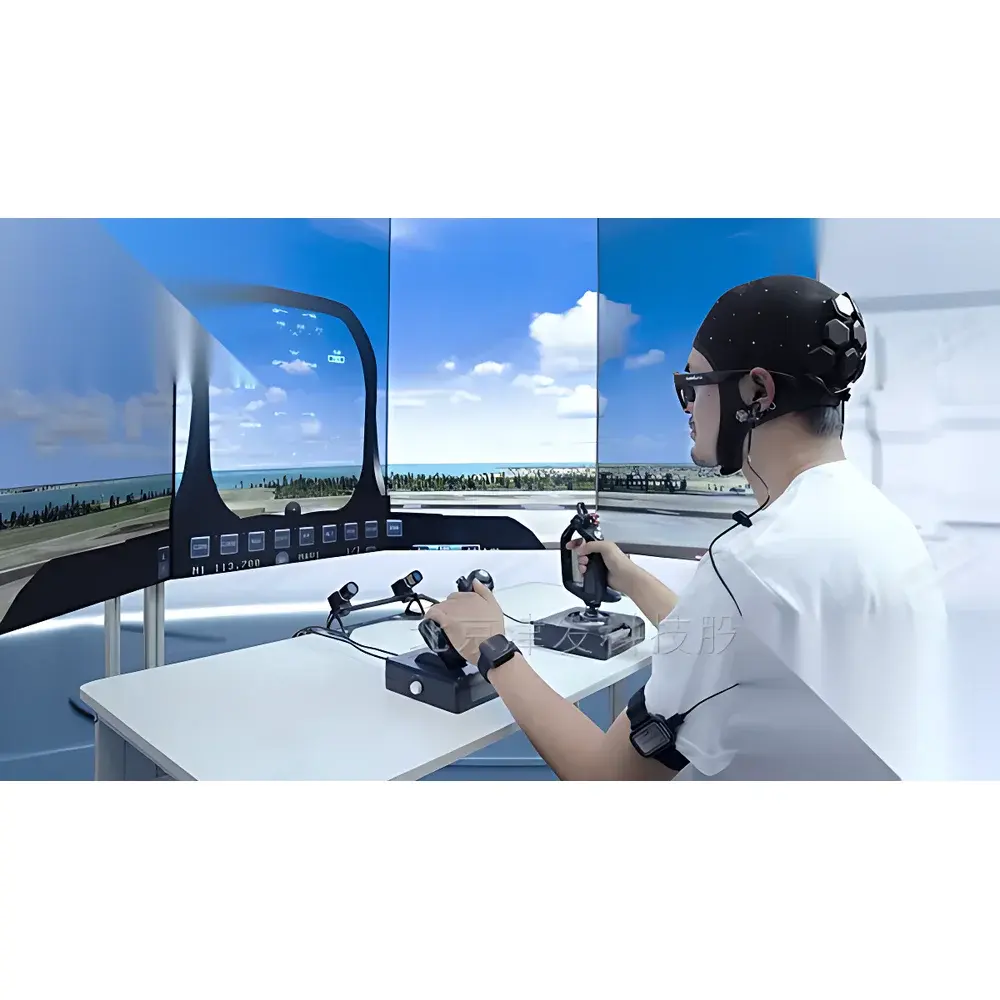
The Kingfar ErgoSIM Cockpit Photometric Ergonomics Laboratory is a purpose-built, integrated research infrastructure engineered for rigorous human factors evaluation of cockpit optical environments in defense, aerospace, and high-stakes vehicle operation contexts. Unlike generic lighting test setups, this laboratory implements a closed-loop, multi-modal measurement architecture grounded in the “Human-Machine-Environment” (HME) and “Human-Information-Physical Systems” (HIPS) theoretical frameworks. It enables synchronized acquisition and analysis of photometric stimuli (e.g., luminance distribution, spectral composition, temporal dynamics), operator physiological responses (EEG, EDA, HRV, EMG), oculomotor behavior (gaze position, fixation duration, saccade amplitude), cognitive metrics (task performance, reaction latency, mental workload via NASA-TLX or EEG-based indices), and environmental parameters (ambient illuminance, glare source geometry, spectral irradiance). The core measurement principle integrates calibrated photometric simulation with real-time biometric synchronization—ensuring traceable, reproducible quantification of how optical conditions directly modulate perceptual fidelity, visual comfort, and operational readiness under mission-relevant scenarios.
Key Features
- Modular, ISO/IEC 17025-aligned laboratory architecture comprising acoustically isolated test chambers and a centralized control & observation suite.
- Full-spectrum photometric simulation system covering daylight (D65–D50), lunar illumination, cloud cover, fog, lightning transients, and specular reflection modeling—calibrated to CIE S 026/E:2019 and IESNA LM-79 standards.
- ErgoLAB Human-Machine-Environment Synchronized Cloud Platform: Enables time-aligned streaming (≤1 ms jitter) of up to 32 concurrent data streams—including analog biosignals (16-bit resolution, 2 kHz sampling), digital eye-tracking (120 Hz, <0.5° accuracy), motion capture (Vicon or OptiTrack integration), simulator telemetry (UDP/FSUIPC), and environmental sensor networks (lux, CCT, UGR, SR).
- Comprehensive analytical modules compliant with GLP/GMP documentation requirements: including ISO 8596-compliant glare assessment (UGR, DGI), EN 12464-1 lighting design validation, ASTM E2877 fatigue onset detection, and FDA 21 CFR Part 11–ready audit trails.
- Embedded AI-driven analytics: Multi-layer perceptron models trained on >50,000 annotated cockpit exposure trials for predictive classification of visual discomfort thresholds, cognitive load states, and fatigue progression.
Sample Compatibility & Compliance
The laboratory supports full-scale cockpit mockups (fixed-wing, rotary-wing, armored vehicle, submarine conning tower), HUD/HMI prototypes, and wearable display systems. All photometric sensors are NIST-traceable (calibration certificate provided per installation). System compliance includes: CE Directive 2014/30/EU (EMC), FCC Part 15 Subpart B (radiated emissions), RoHS 2011/65/EU, ISO 9001:2015 (QMS), ISO 14001:2015 (EMS), and OHSAS 18001:2007 (occupational health). Data management workflows adhere to ISO/IEC 27001 information security controls and support 21 CFR Part 11 electronic signature implementation for regulated defense R&D contracts.
Software & Data Management
ErgoLAB software operates on a client-server architecture with PostgreSQL backend and RESTful API access. Raw data is stored in HDF5 format with embedded metadata (sensor model, calibration date, experimental protocol ID). Analysis pipelines are version-controlled (Git-integrated) and exportable as Docker containers for cross-lab reproducibility. Reporting modules generate PDF/HTML outputs compliant with MIL-STD-1472G human engineering verification protocols. Audit logs record all user actions, parameter changes, and data exports with SHA-256 hashing for forensic integrity verification.
Applications
- Quantitative glare hazard mapping per ISO/CIE 15386 and MIL-STD-1472G Annex G—identifying UGR > 19 zones and recommending diffuser geometry or anti-reflective coating specifications.
- Dynamic lighting optimization for night-vision goggle (NVG) compatibility: spectral power distribution (SPD) tuning to minimize scotopic-to-photopic ratio disruption while maintaining target recognition thresholds.
- Cognitive workload validation under variable ambient light: correlating pupillary response entropy (PRE) with task-switching latency during simulated low-visibility landings.
- HMI legibility benchmarking: measuring minimum contrast ratio (CR ≥ 5:1) and character subtense (≥ 20 arcmin) across 120 viewing angles using calibrated HDR displays and gaze-contingent rendering.
- Long-duration fatigue modeling: integrating actigraphy, blink rate variability, and alpha-theta EEG power ratios to predict vigilance decrement onset within ±8.3 minutes (95% CI).
FAQ
Does the system support real-time closed-loop lighting adaptation based on operator state feedback?
Yes—via API integration with DALI-2 or DMX512 lighting controllers, enabling dynamic luminance adjustment triggered by validated physiological thresholds (e.g., sustained pupil constriction <3.2 mm indicating alertness decline).
Can raw biometric data be exported in open formats for third-party analysis?
All signal streams export natively to .mat, .edf, and .csv with IEEE 11073-10201 semantic annotations; no proprietary binary lock-in.
Is on-site installation and ISO/IEC 17025 method validation included?
Installation, photometric sensor calibration, and traceable uncertainty budgeting per ISO/IEC 17025 Clause 7.8.2 are standard deliverables for turnkey deployments.
What level of technical support is provided post-installation?
Includes 24/7 remote diagnostics, annual on-site metrology recalibration, and dedicated application scientist support for experimental protocol development and statistical consulting.
Are custom integrations with flight simulators (e.g., CAE 7000XR, L3Harris VSTEP) supported?
Pre-certified drivers exist for major simulation platforms; custom SDK integration is available under NDA with documented API specifications and latency benchmarks.



