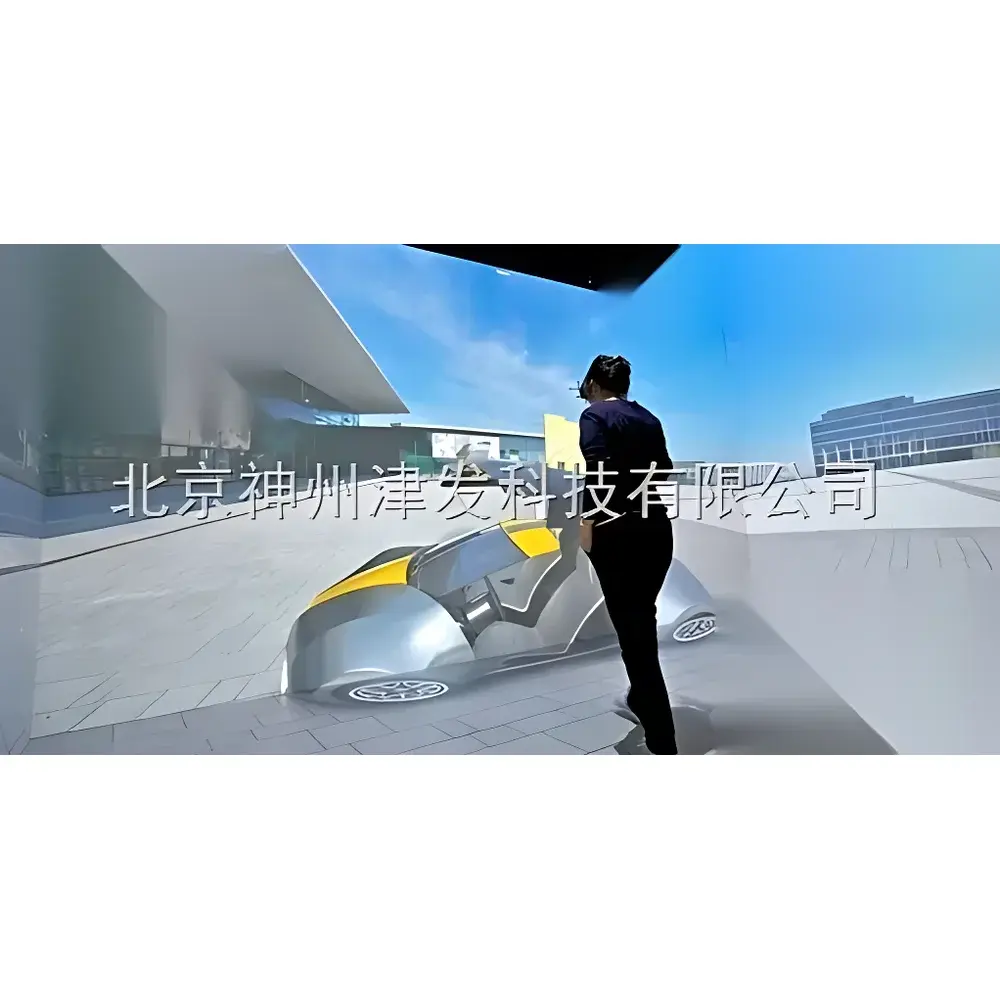
Kingfar VR-Industrial Design System (WorldViz Integrated)
| Brand | Kingfar |
|---|---|
| Origin | Imported |
| Manufacturer Type | Authorized Distributor |
| Pricing | Available Upon Request |
Overview
The Kingfar VR-Industrial Design System (WorldViz Integrated) is a turnkey, PC-cluster-based virtual reality platform engineered for real-time, 1:1 scale collaborative design review and human-centered evaluation in industrial product development. Built upon WorldViz’s Vizard real-time 3D engine and PPT (Precision Position Tracking) framework, the system implements stereo-rendered, low-latency immersive visualization grounded in geometrically accurate optical calibration and spatially registered tracking. Unlike post-processed VR pipelines requiring model re-export or format conversion, this solution delivers native synchronization between desktop CAD/CAID workflows (e.g., SolidWorks, Rhino, Alias, Siemens NX) and the VR environment—enabling designers, ergonomics analysts, and cross-functional stakeholders to interact with unmodified source geometry in true scale, with millimeter-level positional fidelity and sub-20ms end-to-end latency. The architecture supports both single-user desktop VR and multi-user, multi-surface environments—including stereoscopic wall projection, cylindrical projection arrays, and fully enclosed CAVE systems—making it suitable for early-stage concept validation, assembly sequence analysis, anthropometric fit assessment, and usability testing under ISO 9241-210 and ANSI/HFES 200 ergonomic evaluation protocols.
Key Features
- Native CAD synchronization: Direct streaming of native 3D model data without mesh conversion, UV remapping, or topology optimization
- True-scale stereo rendering: Dual-channel 1080p@120Hz or 4K@60Hz per eye, calibrated for photogrammetric accuracy and depth perception consistency
- Multi-device interaction support: Plug-and-play integration with HTC Vive Pro, Varjo XR-3, Manus Prime X, and Force Dimension haptic interfaces
- Scalable cluster rendering: Synchronized multi-GPU output across up to 8 display surfaces via NVIDIA Mosaic or AMD Eyefinity, managed through WorldViz ClusterSync
- Real-time collaborative review: Multi-user co-presence with synchronized viewpoint anchoring, annotation overlays, and version-controlled scene snapshots
- Hardware-agnostic tracking: Support for OptiTrack Flex 13, ART TrackMaster, and NDI Polaris Spectra optical tracking systems with sub-0.1° rotational and sub-0.25mm positional RMS error
Sample Compatibility & Compliance
The system accepts native geometry from major industrial design software suites—including STEP AP242, JT Open, and Parasolid XT formats—without loss of parametric relationships or metadata. It is routinely deployed in GLP-compliant design verification labs conducting human factors validation per IEC 62366-1 and FDA Human Factors Engineering Guidance for Medical Devices. All tracking and rendering subsystems comply with ISO/IEC 17025 calibration traceability requirements when paired with certified metrology-grade reference targets. The software runtime environment supports audit trail logging and user-access controls aligned with 21 CFR Part 11 Annex 11 principles for regulated design documentation integrity.
Software & Data Management
Powered by WorldViz Vizard 6.x SDK and integrated with Kingfar’s proprietary DesignSync middleware, the platform provides structured project lifecycle management: session recording with synchronized eye-tracking (via Tobii Pro Fusion integration), time-stamped annotation export in JSON-LD schema, and automated report generation compliant with IEEE 1012 test documentation standards. All rendered assets and interaction logs are stored in vendor-agnostic HDF5 containers, enabling interoperability with MATLAB, Python (via h5py), and enterprise PLM systems including Teamcenter and Windchill. Version control is enforced via Git LFS integration, supporting branching for design iteration tracking and rollback capability during regulatory submission preparation.
Applications
- Ergonomic workspace layout validation against ISO 11228 lifting guidelines and EN 1005-4 posture assessment criteria
- Automotive HMI prototype evaluation using ISO 15007-2 visual occlusion and glance duration metrics
- Medical device usability testing per IEC 62366-1 use error identification workflows
- Factory floor simulation for maintenance task sequencing and tool reach envelope analysis
- Consumer product form-factor assessment using gaze heatmap aggregation and Fitts’ Law-based interaction modeling
- Architectural interior walkthroughs with daylight simulation and acoustic ray-tracing overlay (via integration with ODEON or CATT-Acoustic)
FAQ
Does the system require custom programming to integrate with existing CAD tools?
No. The Kingfar VR-Industrial Design System uses WorldViz’s native CAD bridge plugins, enabling direct live-linking without scripting or API development.
Can multiple users simultaneously interact within the same virtual environment?
Yes—up to 16 concurrent users with independent avatars, synchronized spatial audio, and shared annotation layers.
Is hardware calibration traceable to national standards?
All optical tracking subsystems ship with NIST-traceable calibration certificates; on-site recalibration services are available per ISO/IEC 17025 scope.
What level of technical support is provided post-deployment?
Kingfar offers tiered SLA options including 24/7 remote engineering support, annual on-site system validation, and quarterly Vizard SDK update deployment.
How is data security maintained during collaborative design reviews?
All network traffic is encrypted via TLS 1.3; local storage encryption follows AES-256 standards; role-based access control (RBAC) enforces ISO 27001-aligned permission hierarchies.