
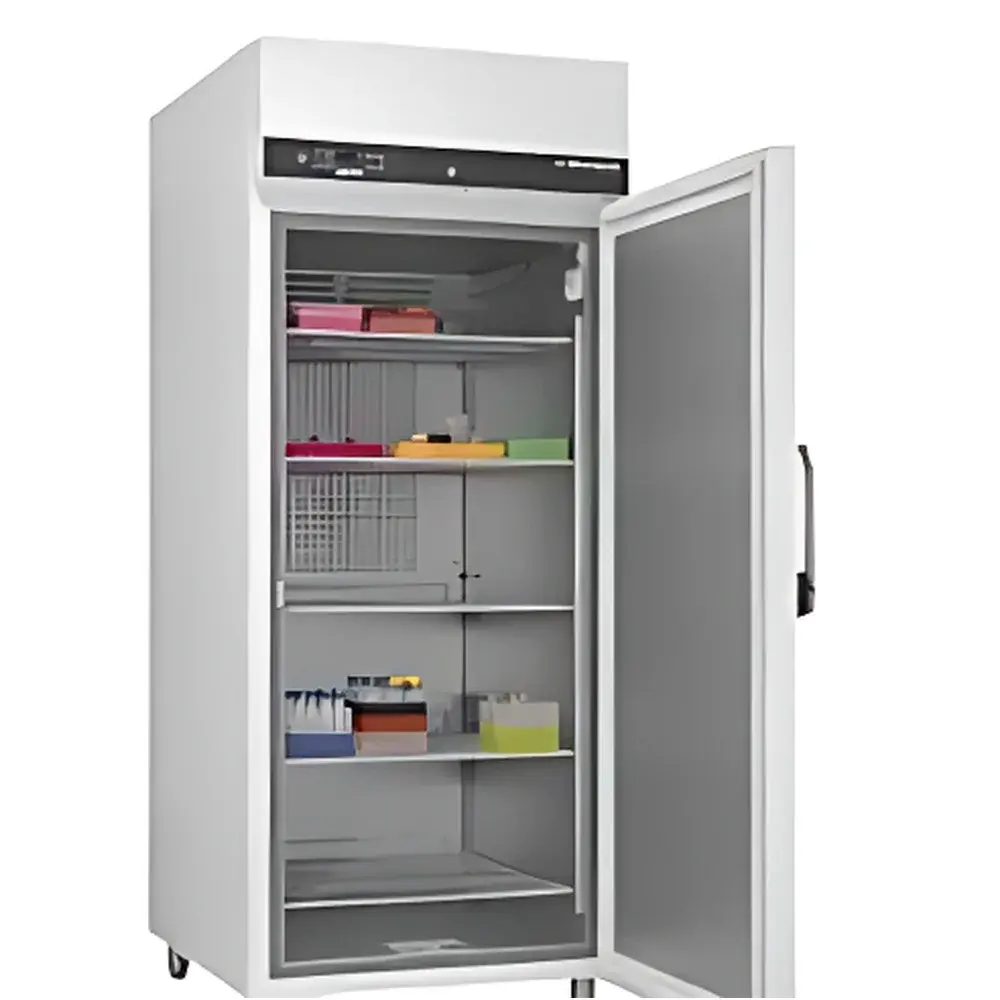
KIRSCH SUPER-720 Laboratory Refrigerated Cabinet
| Brand | KIRSCH |
|---|---|
| Origin | Germany |
| Model | SUPER-720 |
| Type | Laboratory Refrigerated Cabinet (0–20 °C) |
| Effective Volume | 700 L |
| Interior Dimensions (W×D×H) | 620 × 770 × 1400 mm |
| Exterior Dimensions (W×D×H) | 770 × 980 × 1960 mm |
| Power Supply | 220–240 V, 50/60 Hz |
| Rated Power | 370 W |
| Insulation Thickness | 70 mm |
| Door | Magnetic Seal, Auto-Closing, Reversible Hinge |
| Cooling System | Forced-Air Circulation with Automatic Defrost |
| Interface | RS485 for PC Connectivity and Temperature Logging |
| Safety | Dual-Sensor Redundancy, Audible/Visual Alarm, Lockable Control Panel |
| Compliance | Designed to meet IEC 61000-6-3 (EMC), IEC 61000-6-2 (Immunity), and EN 60335-1 (Household and Similar Electrical Appliances Safety) |
Overview
The KIRSCH SUPER-720 is a high-performance, German-engineered laboratory refrigerated cabinet designed for stable, precise temperature maintenance in the range of 0 °C to +20 °C. Unlike ultra-low-temperature freezers or cryogenic storage units, the SUPER-720 operates within the critical ambient-cooled preservation zone—ideal for short- to medium-term storage of biological reagents, cell culture media, diagnostic kits, pharmaceutical intermediates, and temperature-sensitive standards. Its forced-air circulation system ensures uniform thermal distribution (< ±0.8 °C spatial variation at steady state), minimizing thermal gradients across shelves and supporting reproducible experimental conditions. The unit complies with key electrical safety and electromagnetic compatibility directives applicable to laboratory-grade equipment in EU and North American markets, including EN 60335-1 and IEC 61000 series standards.
Key Features
- 700 L effective storage volume with optimized interior geometry (620 × 770 × 1400 mm), accommodating standard ISO/ANSI-compliant labware stacks and multi-tier shelving configurations.
- 70 mm thick, CFC-free polyurethane insulation integrated into a rigid white-coated galvanized steel outer casing—providing corrosion resistance and long-term thermal integrity.
- Smooth anodized aluminum interior lining with five adjustable, plastic-coated wire shelves; shelf supports are recessed into side walls to maximize usable depth and simplify cleaning.
- Auto-closing, reversible magnetic door seal with replaceable gasket—engineered for >100,000 operational cycles and tested per DIN EN 12519 for air leakage performance.
- Microprocessor-based dual-sensor control system: primary Pt100 sensor for regulation, secondary redundant sensor for fault detection and alarm triggering.
- Intelligent forced-air management: fan speed dynamically modulates during door opening events to suppress temperature overshoot; automatic fan shutdown during defrost cycles reduces thermal load.
- Digital membrane keypad with lockable interface, min/max temperature memory (retained after power interruption), and real-time display with 0.1 °C resolution.
- Integrated stainless steel condensate heater tray with overheat protection—prevents ice accumulation and eliminates manual draining requirements.
Sample Compatibility & Compliance
The SUPER-720 is validated for continuous operation under GLP-aligned workflows where traceable, auditable temperature stability is required. Its design accommodates common life science sample formats—including 50 mL conical tubes, 15 mL centrifuge tubes, 96-well plates (with appropriate racks), and sealed vials up to 100 mL. All internal surfaces are non-porous and compatible with standard laboratory disinfectants (e.g., 70% ethanol, 0.5% sodium hypochlorite). The unit meets essential regulatory prerequisites for use in ISO 17025-accredited testing laboratories and supports compliance with Annex 11 (EU GMP) data integrity expectations when paired with validated third-party temperature monitoring software via its RS485 port.
Software & Data Management
The built-in RS485 interface enables bidirectional communication with external data loggers or LIMS-integrated platforms using Modbus RTU protocol. Users can configure logging intervals (1–60 min), set alarm thresholds (deviation >±2 °C from setpoint), and export timestamped CSV files for audit trails. While the cabinet itself does not include embedded data storage, its firmware supports time-stamped event logging—including door openings, compressor start/stop cycles, defrost initiation, and alarm activations—with retention of the last 1,000 events. When connected to compliant enterprise systems, the SUPER-720 satisfies FDA 21 CFR Part 11 requirements for electronic records through external validation of the full data chain.
Applications
- Storage of enzyme solutions, antibodies, and lyophilized reagents requiring strict avoidance of freezing-induced denaturation.
- Controlled-temperature staging of samples prior to downstream analysis (e.g., HPLC injection, ELISA plate incubation, or flow cytometry preparation).
- Buffer and saline solution conditioning in clinical pathology labs to ensure consistent assay performance.
- Intermediate storage of QC reference materials used in pharmaceutical stability studies (ICH Q5C).
- Backup refrigeration for cold-chain continuity during HVAC maintenance or power fluctuations in core facilities.
FAQ
What is the temperature uniformity specification across the chamber volume?
Measured uniformity is ≤ ±0.8 °C at nominal setpoint (4 °C), verified per ISO 10551 methodology using nine calibrated thermistors at defined grid positions.
Can the SUPER-720 be validated for IQ/OQ protocols?
Yes—the unit provides accessible sensor access points, documented calibration procedures, and a complete technical file (available upon request) supporting vendor-assisted or user-led qualification under GAMP 5 guidelines.
Is remote alarm notification supported natively?
The cabinet includes dry-contact relay outputs for integration with building management systems (BMS); Ethernet or cellular telemetry requires external gateway hardware.
What maintenance intervals are recommended?
Condenser coil cleaning every 6 months (or more frequently in dusty environments); door gasket inspection quarterly; annual verification of sensor accuracy using NIST-traceable references.
Does the unit comply with energy efficiency regulations such as EU Ecodesign Directive 2019/2024?
Yes—it meets Tier 2 energy efficiency class requirements for refrigerated cabinets under EN 62552-3:2017, with measured annual energy consumption of 1,280 kWh/year at 25 °C ambient.




