
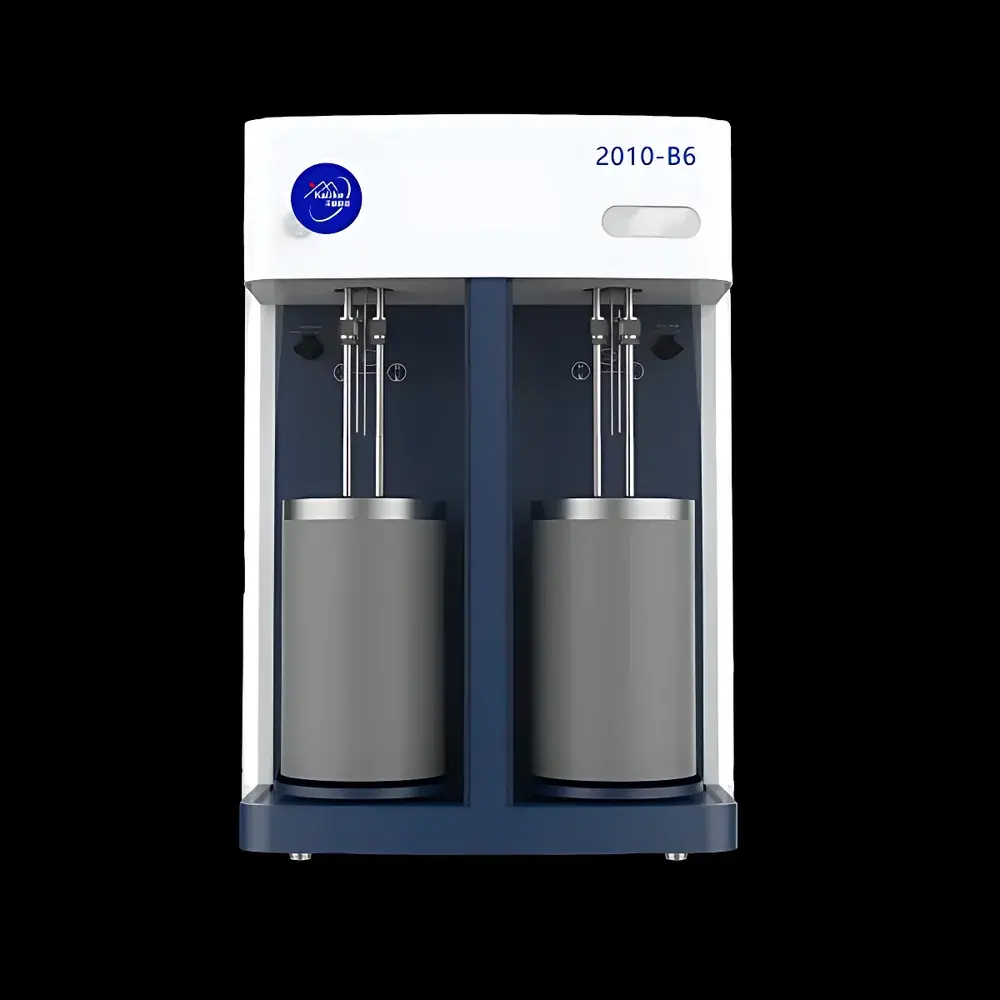
KLA2010-B6 Automated Static Volumetric Specific Surface Area and Pore Size Analyzer
| Brand | KaLiKe |
|---|---|
| Origin | Chongqing, China |
| Model | KLA2010-B6 |
| Instrument Type | Specific Surface Area and Pore Size Analyzer |
| Principle | Static Volumetric Gas Adsorption Method |
| Number of Analysis Stations | 6 |
| Surface Area Range | 0.0005 m²/g (using Kr adsorption) to unlimited |
| Pressure Range | 0–133 kPa |
| Measurement Theory | Gas adsorption based on static vacuum volumetric method |
| Sensor Repeatability Error | < ±0.1% |
| Ambient Temperature Operation | Yes |
| Temperature Control Accuracy | ±0.5 °C |
| Vacuum System | Custom-designed stainless-steel vacuum system with metal-sealed joints, silver-plated internal surfaces, dual-layer vacuum shielding, and ultra-high vacuum capability up to 1×10⁻⁸ Torr (standard pump base: 1×10⁻² Pa / 1×10⁻⁴ Torr) |
| AD Resolution | 24-bit |
| Pressure Transducer | High-precision capacitive absolute pressure transducer (accuracy: 0.1%) |
| Liquid Nitrogen Dewar Capacity | Sustains >70 h unattended operation |
| Isothermal Jacket | Integrated liquid nitrogen isothermal sleeve for thermal stability below sample zone |
| Dimensions (L×W×H) | 500×500×750 mm (customizable) |
Overview
The KLA2010-B6 Automated Static Volumetric Specific Surface Area and Pore Size Analyzer is an engineered solution for high-precision characterization of porous and powdered materials using the static volumetric gas adsorption principle. It operates on the fundamental thermodynamic relationship between gas uptake and surface area or pore volume under controlled equilibrium conditions at cryogenic temperatures—typically using N₂ at 77 K or Kr at 77 K for ultra-low surface area determination. Unlike dynamic (flow) methods, the static volumetric approach achieves superior accuracy through direct measurement of gas dose and equilibrium pressure in a calibrated manifold, minimizing kinetic artifacts and enabling rigorous adherence to IUPAC-recommended data reduction protocols. Designed for laboratories requiring regulatory-compliant, traceable, and reproducible surface science data, the KLA2010-B6 supports both routine QC testing and advanced R&D workflows across academia, battery material development, catalysis research, and pharmaceutical excipient qualification.
Key Features
- True six-station parallel analysis architecture with independent dosing, pressure monitoring, and thermal control per station—enabling simultaneous BET, Langmuir, and pore size distribution measurements across multiple samples.
- Ultra-high-vacuum stainless-steel manifold system co-developed with Chinese Academy of Sciences vacuum engineering specialists; features all-metal seals, silver-plated interior surfaces, and dual-stage vacuum shielding to suppress outgassing and extend stable <1×10⁻⁷ Torr dwell times beyond 48 hours.
- 24-bit high-resolution analog-to-digital acquisition paired with certified capacitive absolute pressure transducers (0.1% full-scale accuracy) ensures sub-Pa-level pressure resolution across the full 0–133 kPa range.
- Integrated isothermal liquid nitrogen jacket maintains uniform thermal gradient along the sample tube, eliminating axial temperature drift during long-duration isotherm acquisition (e.g., full 7-point BET or DFT isotherms).
- Zero-touch operational interface: no physical buttons or manual valves—full sequence control, calibration, degassing, analysis, and error recovery executed via software-defined protocols.
- Modular hardware design allows field-upgradable configurations—from basic single-gas N₂ analysis to multi-gas (N₂/Kr/Ar/CO₂) capability with optional high-vacuum pumping stages and cryo-cooled traps.
Sample Compatibility & Compliance
The KLA2010-B6 accommodates diverse physical forms including fine powders (e.g., activated carbon, MOFs, cathode precursors), granules (zeolites, silica gels), monoliths (ceramic filters, aerogel blocks), fibers (carbon nanotube mats), and thin films (coated electrodes). Its degas-analyze co-location architecture eliminates cross-contamination during transfer between pretreatment and analysis stations—a critical requirement for hygroscopic, reactive, or ultra-low-surface-area samples (e.g., high-purity Si wafers or pharmaceutical co-crystals). The instrument meets core elements of ISO 9277:2010 (BET surface area), ISO 15901-2:2016 (pore size distribution by gas adsorption), and ASTM D3663 (surface area of activated carbon). Audit-trail-enabled software supports GLP/GMP environments compliant with FDA 21 CFR Part 11 when configured with electronic signatures and user-role permissions.
Software & Data Management
The proprietary KLA-Analysis Suite provides comprehensive isotherm modeling and reporting aligned with international standards. Core modules include single- and multi-point BET (with C-constant validation), Langmuir fitting, t-plot and αs-plot micropore analysis, BJH/KJS desorption-based mesopore evaluation, and non-local density functional theory (NLDFT) kernel libraries for carbon, silica, and alumina models. All calculations generate traceable metadata—including raw pressure-time series, temperature logs, calibration certificates, and uncertainty propagation estimates per IUPAC Technical Report guidelines. Data export conforms to ASTM E1382-compliant CSV and XML formats; integrated LIMS API enables bidirectional synchronization with enterprise laboratory information management systems.
Applications
- Battery materials: Quantifying specific surface area and pore structure evolution in NMC, LFP, silicon anodes, and solid electrolytes before/after cycling.
- Catalysis: Correlating Pt dispersion, support porosity, and metal-support interaction via Kr-BET and CO chemisorption-compatible manifolds.
- Pharmaceuticals: Characterizing amorphous content, hydration state, and tablet compaction effects on surface energetics using low-pressure Kr isotherms.
- Environmental science: Assessing biochar reactivity, soil organic carbon accessibility, and contaminant adsorption capacity via DFT-derived pore geometry maps.
- Advanced ceramics: Validating sintering homogeneity and grain boundary continuity through micro/mesopore volume ratios derived from Ar@87K isotherms.
FAQ
What gases can be used for analysis on the KLA2010-B6?
N₂ (77 K), Kr (77 K), Ar (87 K), and CO₂ (273 K) are supported natively; additional gases require optional cold trap and pressure sensor recalibration.
Does the system support automated degassing prior to analysis?
Yes—each station includes programmable heating (up to 400 °C) with real-time vacuum monitoring and pressure-rise rate termination logic.
How is P₀ measured and maintained during analysis?
A dedicated, thermally isolated P₀ reference tube with identical geometry and temperature control ensures continuous, drift-free saturation pressure tracking without interrupting sample analysis.
Can the instrument be validated for regulatory submissions?
Full IQ/OQ documentation packages, metrology-grade calibration records, and 21 CFR Part 11-compliant audit trails are available upon request.
Is remote diagnostics and software update capability included?
Yes—the embedded industrial controller supports secure TLS-encrypted remote access for firmware updates, log retrieval, and real-time performance diagnostics.



