
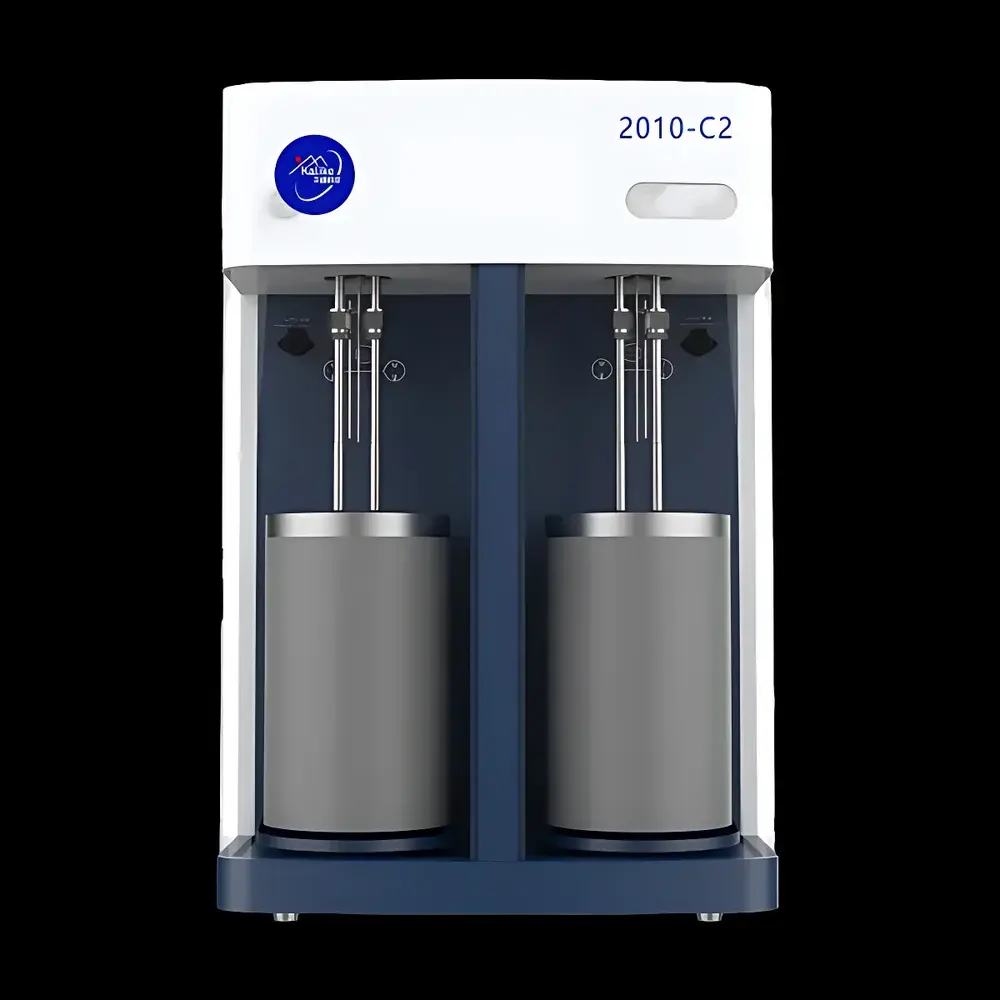
KLA2010-C2 Static Volumetric Specific Surface Area and Pore Size Analyzer
| Brand | KaLiKe |
|---|---|
| Origin | Chongqing, China |
| Model | KLA2010-C2 |
| Analysis Stations | 2 |
| Specific Surface Area Range | 0.0005 m²/g (using Kr) to unlimited |
| Pore Size Range | 0.35 nm – 500 nm (N₂ adsorption, extendable with high-vacuum option) |
| Pressure Range | 0–133 kPa |
| Vacuum System | Dual-stage ultra-high vacuum system (molecular pump + stainless-steel piping), base pressure ≤1×10⁻⁸ Torr |
| Temperature Control Accuracy | ±0.5 °C |
| Sensor Repeatability Error | <±0.1% |
| Detection System | Dual-range capacitive absolute pressure transducers (0–10 Torr & 0–1000 Torr per station), 24-bit AD acquisition |
| Isothermal Jacket | Liquid nitrogen isothermal enclosure for thermal stabilization |
| Sample Capacity | 70-hour unattended operation enabled by large-capacity LN₂ Dewar |
| Compliance | Designed for ASTM D3663, ISO 9277, ISO 15901, and USP <846> compliant workflows |
Overview
The KLA2010-C2 is a fully automated static volumetric specific surface area and pore size analyzer engineered for high-precision gas adsorption analysis under controlled vacuum conditions. Based on the static (volumetric) gas adsorption principle, it quantifies surface area and pore structure by measuring equilibrium gas uptake at precisely regulated pressures and temperatures—primarily using N₂ at 77 K or Kr at 77 K for ultra-low-surface-area materials. Its dual-station architecture enables parallel sample analysis or independent calibration and measurement, supporting rigorous quality control and high-throughput research in materials science laboratories. The instrument operates under ultra-high vacuum (UHV) conditions (≤1×10⁻⁸ Torr), minimizing residual gas interference and ensuring thermodynamic consistency across adsorption isotherms. All operational sequences—including degassing, evacuation, dose control, equilibration, and data acquisition—are executed autonomously via software, eliminating manual intervention and reducing operator-induced variability.
Key Features
- Ultra-high vacuum architecture: Custom-engineered UHV system developed in collaboration with Chinese Academy of Sciences vacuum specialists, featuring all-stainless-steel fluidic pathways, high-integrity electromagnetic valves, and a dual-pump configuration (mechanical + turbomolecular) for rapid pump-down and exceptional long-term vacuum stability.
- High-fidelity pressure metrology: Dual-range capacitive absolute pressure transducers (0–10 Torr and 0–1000 Torr per station) deliver ±0.1% full-scale accuracy; 24-bit analog-to-digital conversion ensures resolution sufficient for sub-monolayer adsorption detection.
- Thermal integrity assurance: Integrated liquid nitrogen isothermal jacket maintains uniform temperature distribution along the sample tube during adsorption/desorption cycles; large-capacity Dewar supports up to 70 hours of continuous unattended operation without refilling.
- Contamination-minimized sample handling: Dedicated P₀ reference tube eliminates cross-contamination during saturation pressure measurement; proprietary gas routing design prevents re-adsorption or atmospheric exposure during transfer from degas station to analysis station.
- Modular scalability: Base configuration supports BET, BJH, and Langmuir analysis; optional hardware and software modules enable t-plot, αs-plot, MP, and non-local density functional theory (NLDFT) modeling for microporous and hierarchical material characterization.
Sample Compatibility & Compliance
The KLA2010-C2 accommodates diverse solid-phase samples including powders (e.g., activated carbons, zeolites, metal–organic frameworks, battery cathode/anode materials), granules, monoliths, fibers, and thin films. Its robust degassing protocol—programmable up to 400 °C with real-time pressure monitoring—ensures complete removal of physisorbed contaminants prior to analysis. The system complies with internationally recognized standards for surface area and porosimetry testing, including ASTM D3663 (BET surface area of catalysts), ISO 9277 (BET method), ISO 15901 (pore size distribution by gas adsorption), and USP <846> (porosity assessment of pharmaceutical excipients). Data audit trails, user access controls, and electronic signature support align with GLP and GMP requirements, while optional 21 CFR Part 11 compliance packages are available for regulated environments.
Software & Data Management
The proprietary KLA-Analyzer software provides an integrated environment for instrument control, real-time isotherm visualization, and standardized data reduction. It implements ISO/ASTM-recommended calculation protocols for single-point and multi-point BET surface area, Langmuir surface area, BJH desorption pore size distribution, total pore volume, and cumulative surface area. Advanced modules support t-plot and αs-plot analysis for micropore volume estimation, MP-method for narrow micropores (<0.7 nm), and NLDFT kernel libraries for carbon, silica, and alumina-based materials. Raw pressure–volume datasets are stored in vendor-neutral ASCII format; metadata (sample ID, degas parameters, calibration history) is embedded and exportable for LIMS integration. Version-controlled software updates ensure traceability and method consistency across instrument fleets.
Applications
The KLA2010-C2 serves critical analytical roles across academia and industry: catalyst development (active site quantification), battery material R&D (electrode porosity optimization), pharmaceutical formulation (excipient surface heterogeneity), environmental science (soil and sediment pore structure), and advanced ceramics (green-body densification prediction). Its Kr-adsorption capability extends reliable surface area measurement to materials below 0.1 m²/g—such as highly sintered oxides or dense polymers—where N₂ fails to yield monolayer coverage. The 0.35 nm lower detection limit (with high-vacuum upgrade) enables characterization of ultramicroporous carbons used in hydrogen storage and CO₂ capture applications.
FAQ
What gases are supported for adsorption analysis?
N₂ at 77 K is standard for meso- and macroporous materials; Kr at 77 K is recommended for ultra-low-surface-area solids (<0.1 m²/g); Ar at 87 K is optionally supported for enhanced resolution in narrow micropores.
Is P₀ measurement automated and isolated from the sample manifold?
Yes—the system employs a dedicated, thermally stabilized P₀ tube with independent pressure sensing, eliminating interference from sample outgassing or manifold contamination.
Can the instrument be upgraded post-purchase?
All KLA2010-C2 units feature modular hardware design: additional vacuum stages, cryogenic temperature controllers, or NLDFT license keys can be installed without factory return.
How is data integrity ensured during long-duration runs?
Real-time sensor diagnostics, automatic zero-drift correction, and periodic P₀ validation cycles are embedded in the acquisition logic; raw data logs include timestamped environmental and operational metadata.
Does the software support batch processing of multiple isotherms?
Yes—batch mode allows sequential analysis of up to 99 isotherms with identical or customized models, generating consolidated reports in PDF or Excel format with customizable templates.



