
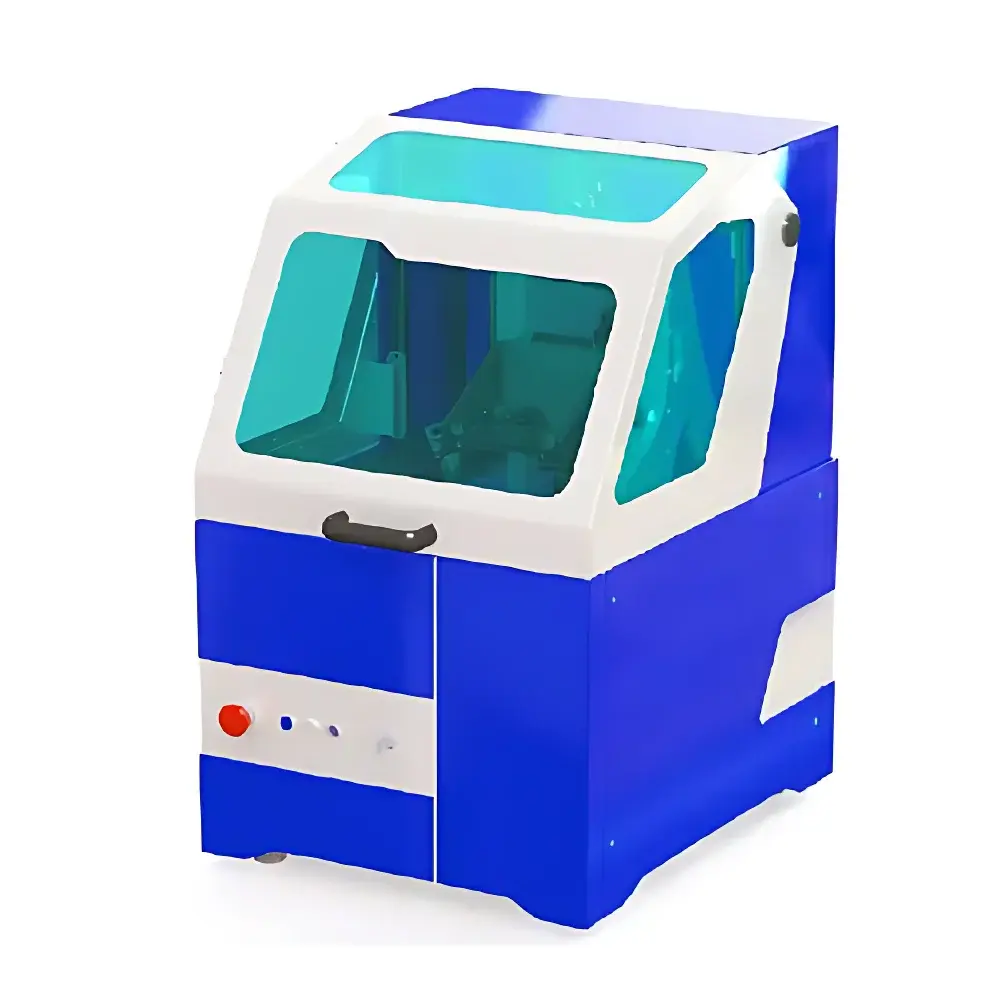
KLOE Dialse 3D Desktop Microscale 3D Printer
| Brand | KLOE |
|---|---|
| Origin | France |
| Manufacturer Type | Authorized Distributor |
| Origin Category | Imported |
| Model | Dialse 3D |
| Pricing | Available Upon Request |
| Laser Wavelengths | 375 nm or 405 nm |
| Spot Size Range | 1–50 µm |
| Maximum Print Area | 100 mm × 100 mm × 50 mm |
| Minimum Layer Step | 100 nm |
| Linear Printing Speed | Up to 50 mm/s |
| Positioning Accuracy & Repeatability | 100 nm |
| Substrate Compatibility | 1–4 inch wafers, thickness 250 µm–10 mm |
| Input File Format | STL |
| Printing Modes | Raster Scan & Vector Direct-Write |
| Depth of Focus | High (enabling vertical wall fidelity) |
| Resolution Capability | Down to 5 µm (customizable) |
Overview
The KLOE Dialse 3D is a compact, high-precision desktop microscale 3D printer engineered for research-grade fabrication of microarchitectured components in academic laboratories, microfabrication facilities, and advanced materials development centers. It employs laser-based direct-write photopolymerization—a variant of two-photon polymerization (2PP) and single-photon lithography—where a focused ultraviolet laser beam selectively cures photosensitive resin layer-by-layer on a solid substrate. Unlike conventional stereolithography (SLA), the Dialse 3D utilizes dynamic beam shaping and high-stability galvanometric scanning to achieve sub-10 µm lateral resolution and nanoscale z-axis control. Its design prioritizes optical stability, mechanical rigidity, and thermal isolation—critical for maintaining dimensional fidelity across multi-hour microprinting campaigns. The system operates within Class 1 laser safety enclosure standards (IEC 60825-1) and is compatible with inert atmosphere integration for oxygen-inhibited resins.
Key Features
- Sub-10 µm native resolution, extendable to 5 µm via optional beam conditioning optics and calibrated calibration protocols
- Large-field capability: 100 mm × 100 mm × 50 mm build volume—uniquely bridging microscale precision with macro-scale throughput
- Dual-wavelength laser source (375 nm and 405 nm) enables broad compatibility with commercial and proprietary photocurable resins, including bio-inks, hybrid sol-gels, and ceramic precursors
- High depth-of-focus optical path ensures consistent feature fidelity across vertical sidewalls up to 50 mm in height—critical for microfluidic channels, microlens arrays, and hierarchical scaffolds
- Nanopositioning stage with 100 nm closed-loop resolution and repeatability, integrated with real-time interferometric feedback
- Modular substrate handling supporting standard semiconductor wafers (1–4 inch), glass slides, silicon nitride membranes, and flexible polymer films
Sample Compatibility & Compliance
The Dialse 3D accommodates a wide spectrum of photosensitive materials—including acrylate-, thiol-ene-, and epoxy-based formulations—as well as biocompatible hydrogels (e.g., GelMA, PEGDA) validated for cell-laden printing under sterile conditions. All material processing workflows are documented per ISO 13485-aligned traceability requirements where applicable. The system supports GLP-compliant operation through configurable audit trails, user access levels, and electronic signature readiness. While not FDA-cleared as a medical device manufacturing tool, its hardware architecture conforms to key elements of 21 CFR Part 11 for electronic records when deployed with validated software configurations. CE marking applies under the Machinery Directive 2006/42/EC and Electromagnetic Compatibility Directive 2014/30/EU.
Software & Data Management
Control and slicing are performed via KLOE’s proprietary DiaPrint Suite—a Windows-based application supporting STL import, adaptive mesh refinement, support structure generation, and exposure parameter mapping per layer. The software implements G-code-compatible output for vector mode and rasterized bitmap projection for scan mode. All print jobs are timestamped, logged with full parameter metadata (laser power, dwell time, scan velocity, focus offset), and exportable in CSV/JSON formats for LIMS integration. Version-controlled firmware updates are delivered through secure HTTPS endpoints, with rollback capability and SHA-256 integrity verification. Optional Python API enables automation of batch printing sequences and integration with in-house image analysis pipelines.
Applications
- Micro-optics: Fabrication of freeform microlenses, diffractive optical elements (DOEs), and waveguide couplers
- Microfluidics: Monolithic 3D microchannels with embedded valves, mixers, and sensor interfaces
- Tissue engineering: Patient-specific scaffolds with controlled pore interconnectivity and anisotropic mechanical gradients
- MEMS prototyping: Functional microstructures with embedded conductive traces and sacrificial layers
- Metamaterials: Unit-cell lattices for acoustic, thermal, or electromagnetic wave manipulation
- Microelectrode fabrication: High-aspect-ratio electrodes for neural probes and electrochemical sensors
FAQ
What laser safety class does the Dialse 3D operate under?
The system is fully enclosed and certified as Class 1 laser product per IEC 60825-1, requiring no additional laser safety training for routine operation.
Can the Dialse 3D print with living cells?
Yes—when configured with biocompatible resins and operated under laminar flow hood conditions, it supports direct bioprinting; however, post-processing sterilization and culture validation remain user-responsible.
Is remote monitoring supported?
Real-time status telemetry (stage position, laser status, temperature, job progress) is available via Ethernet-connected web dashboard; remote control requires on-premise network configuration and IT policy approval.
Does KLOE provide application support for custom resin development?
KLOE offers collaborative resin characterization services—including exposure dose calibration, shrinkage profiling, and mechanical testing—under NDA for qualified research partners.
What maintenance schedule is recommended?
Optical alignment verification every 6 months; galvo mirror cleaning and objective lens inspection quarterly; full calibration suite annually or after 500 operational hours—documented in the included Maintenance Logbook.



