
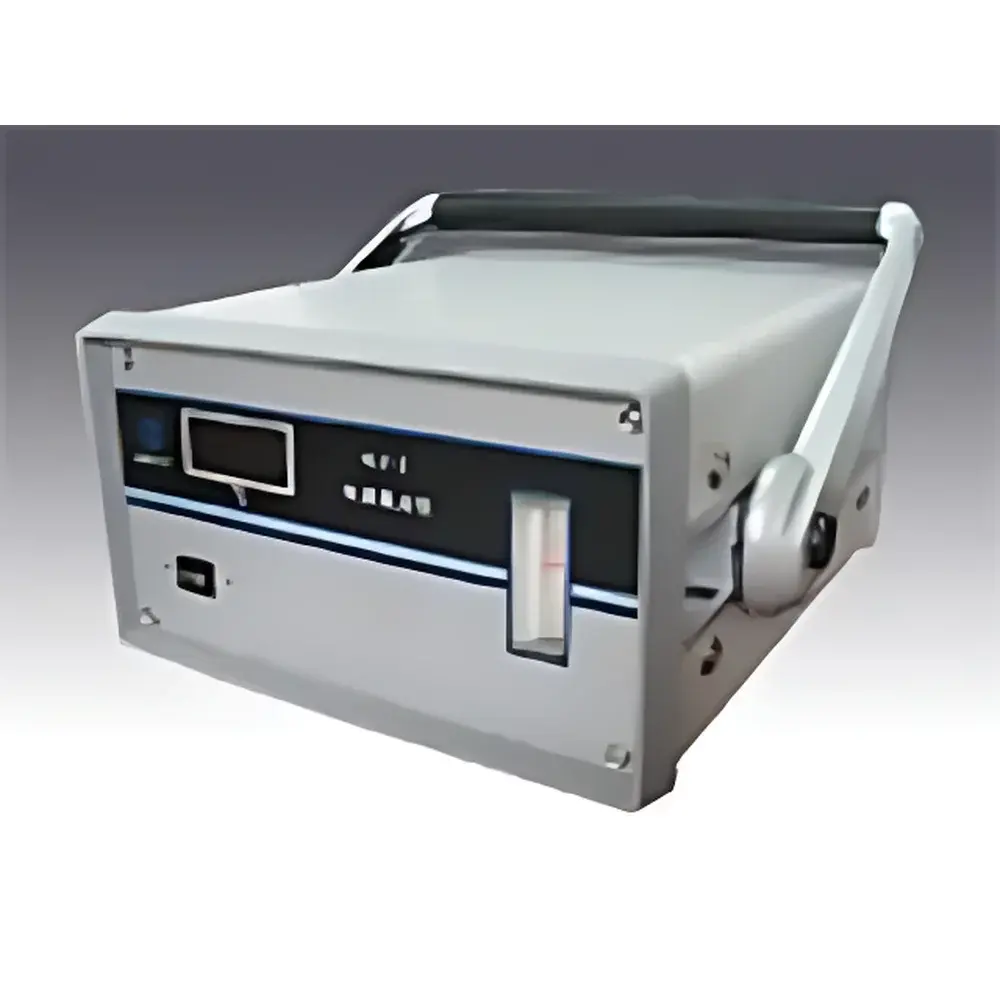
KLY-2 Portable Dew Point Meter
| Origin | Sichuan, China |
|---|---|
| Manufacturer Type | Distributor |
| Origin Category | Domestic |
| Model | KLY-2 |
| Pricing | Upon Request |
| Product Type | Portable Dew Point Meter |
| Measurement Range | –80 to +20 °C dew point (approx. 0.5–23,632 µL/L H₂O) |
| Accuracy | ≤±0.5 °C (at factory calibration) |
| Response Time | <30 s (63%), <60 s (90%) for rise at DP < –40 °C |
| Output Signal | 4–20 mA analog |
| Operating Media Conditions | Gas temperature < +60 °C, pressure < 2 MPa, flow rate 200 mL/min |
| Dimensions | 260 mm × 170 mm × 300 mm (W×H×D) |
Overview
The KLY-2 Portable Dew Point Meter is a precision-engineered instrument designed for rapid, reliable measurement of water vapor concentration in industrial process gases via chilled-mirror–independent capacitive sensing. Unlike absolute methods relying on optical condensation detection, the KLY-2 employs a high-stability polymer-based thin-film capacitive humidity sensor, optimized for dew point derivation under dynamic gas conditions. Its core architecture integrates a thermally regulated gas path, low-drift signal conditioning circuitry, and robust flow control—enabling trace-level moisture quantification across a wide dew point span (–80 to +20 °C), equivalent to volumetric water concentrations from 0.5 to 23,632 µL/L. The device is calibrated against NIST-traceable reference standards and engineered for long-term baseline stability, mitigating typical drift mechanisms associated with hygroscopic polymer sensors through proprietary passivation and thermal compensation algorithms. It is intended for both intermittent laboratory verification and continuous in-line monitoring in non-corrosive, non-condensing gas streams.
Key Features
- Capacitive thin-film sensor with enhanced resistance to dust particulates, oil mist, and common industrial chemical vapors (e.g., CO₂, CH₄, N₂, O₂, dry air, SF₆, natural gas)
- Fast response kinetics: <30 s (63% step rise) and <60 s (90% step rise) at –40 °C dew point; response accelerates with increasing moisture content
- Factory-calibrated accuracy of ≤±0.5 °C dew point; maintains ≤±1 °C uncertainty over two years under specified operating conditions
- Integrated 4–20 mA analog output with HART-compatible signal interface for direct integration into DCS, PLC, or SCADA systems
- Compact portable form factor (260 × 170 × 300 mm) with ruggedized housing suitable for field deployment and benchtop use
- No consumables or moving parts; minimal maintenance requirements beyond periodic zero verification using dry nitrogen or certified dry gas
Sample Compatibility & Compliance
The KLY-2 is validated for use with non-aggressive, non-condensing process gases including compressed air, nitrogen, hydrogen, argon, helium, SF₆, natural gas (dry), and purified synthesis gas. It is not recommended for use with strongly oxidizing gases (e.g., chlorine, ozone), acidic or alkaline vapors (e.g., HCl, NH₃), or saturated hydrocarbon streams without prior filtration. The instrument complies with IEC 61000-6-2 (EMC immunity) and IEC 61000-6-4 (EMC emissions) standards. While not intrinsically safe certified, it may be deployed in Zone 2/Class I, Div 2 environments when installed with appropriate barrier systems. Data integrity aligns with GLP principles; though not FDA 21 CFR Part 11–compliant out-of-the-box, audit trails and electronic signature functionality can be implemented via external data acquisition software meeting ALCOA+ criteria.
Software & Data Management
The KLY-2 operates as a standalone analog transmitter and does not include embedded firmware-based data logging or USB/WiFi connectivity. However, its 4–20 mA output supports seamless integration with third-party SCADA platforms (e.g., Siemens Desigo, Honeywell Experion, Emerson DeltaV) or dedicated data loggers (e.g., Omega OM-DAQPRO, Campbell Scientific CR1000X). For laboratory applications, optional analog-to-digital converters (e.g., National Instruments USB-6009) enable real-time acquisition and trend analysis in LabVIEW or Python-based environments. Calibration records, drift verification logs, and gas flow validation reports are maintained externally per ISO/IEC 17025 documentation practices.
Applications
- Power generation: Monitoring moisture in SF₆ insulation gas for high-voltage switchgear and GIS systems per IEEE C37.122.1
- Petrochemical refining: Verifying dryness of instrument air, purge gas, and feedstock streams prior to catalytic reactors
- Electronics manufacturing: Ensuring sub-–40 °C dew point in nitrogen blanketing lines for semiconductor fabrication and soldering processes
- Heat treatment: Controlling atmosphere moisture in vacuum and controlled-atmosphere furnaces to prevent oxidation or decarburization
- Industrial gas production: Final quality assurance for bottled nitrogen, argon, and oxygen per ISO 8573-3 purity classes
FAQ
What is the recommended calibration frequency for the KLY-2?
Annual calibration is advised for critical applications; biannual verification is acceptable for stable ambient conditions. Zero-point checks with dry nitrogen (<–70 °C dew point) should be performed before each measurement campaign.
Can the KLY-2 measure dew point in compressed natural gas (CNG)?
Yes—provided the gas is filtered to remove liquid hydrocarbons and particulates, and pressure is reduced to <2 MPa upstream of the inlet. Condensable heavier hydrocarbons must be removed to avoid sensor coating.
Does the instrument require temperature or pressure compensation?
No—the KLY-2 outputs dew point temperature directly, independent of sample gas temperature or pressure within its specified operating envelope (<+60 °C, <2 MPa). Compensation is embedded in sensor firmware.
Is the sensor replaceable by the end user?
Sensor modules are field-replaceable but require post-installation recalibration using certified reference gases; replacement is recommended only by authorized service personnel.
What gas flow rate is required for optimal performance?
A stable flow of 200 mL/min is specified. Deviations >±10% may affect response time and accuracy; a laminar flow controller is recommended for unregulated sources.







