
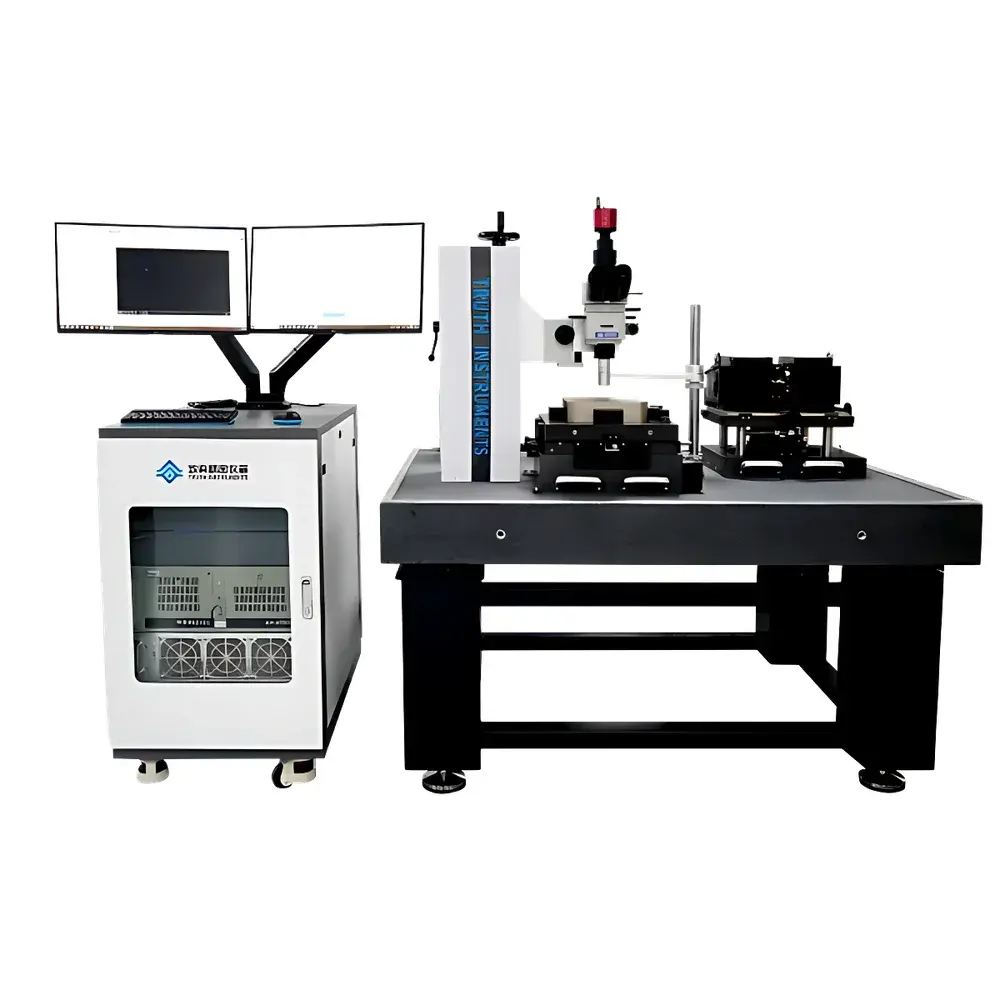
KMPL-PM Permanent Magnet Magneto-Optic Kerr Effect (MOKE) Microscope
| Brand | Truth Instruments Company Limited |
|---|---|
| Origin | Shandong, China |
| Manufacturer Type | Authorized Distributor |
| Country of Origin | China |
| Model | KMPL-PM |
| Pricing | Available Upon Request |
Overview
The KMPL-PM Permanent Magnet Magneto-Optic Kerr Effect (MOKE) Microscope is a high-resolution, laboratory-grade imaging and characterization system engineered for quantitative analysis of surface magnetic domain structures and magnetization dynamics in permanent magnet materials and thin-film ferromagnetic specimens. Based on the magneto-optic Kerr effect—a polarization rotation phenomenon occurring when linearly polarized light reflects from a magnetized surface—the KMPL-PM enables non-contact, sub-micron spatial resolution mapping of local magnetization orientation (polar, longitudinal, or transverse configurations) under ambient or controlled environmental conditions. Unlike bulk magnetometry techniques (e.g., VSM or SQUID), MOKE microscopy provides direct visual evidence of domain wall pinning, nucleation sites, reversal mechanisms, and anisotropy-driven contrast—critical for R&D validation of sintered NdFeB, SmCo, AlNiCo, and bonded magnet grades, as well as exchange-coupled composite structures.
Key Features
- Integrated wide-field MOKE optical path with high-numerical-aperture (NA ≥ 0.7) objective lenses optimized for visible and near-UV illumination (405–660 nm range)
- Dual-mode polarization control: manual and motorized half-wave/quarter-wave plate configuration supporting polar, longitudinal, and transverse MOKE geometries
- High-stability permanent magnet stage with adjustable in-plane and out-of-plane field alignment (±0.5 T range, field homogeneity < 1% over 100 µm FOV)
- Low-noise CMOS camera (12-bit dynamic range, 2048 × 1536 resolution) synchronized with lock-in detection for enhanced signal-to-noise ratio in weak-Kerr-signal regimes
- Vibration-isolated optical breadboard platform compliant with ISO 10816-3 Class A mechanical stability requirements
- Modular design accommodating optional cryogenic sample holder (77 K–300 K) and in situ electrical biasing interface for coupled magneto-transport studies
Sample Compatibility & Compliance
The KMPL-PM accepts standard 10 mm × 10 mm to 25 mm × 25 mm planar samples with thicknesses up to 5 mm, including sintered, hot-pressed, and injection-molded permanent magnet tiles, coated substrates, and multilayer magnet assemblies. Surface roughness ≤ Ra 0.1 µm is recommended for optimal Kerr contrast; polished or lapped surfaces yield reproducible domain imaging. The system complies with IEC 61000-4-3 (radiated immunity) and IEC 61326-1 (EMC for laboratory equipment). All optical components meet RoHS 2011/65/EU directives. Data acquisition protocols support GLP-compliant documentation workflows, with timestamped metadata embedding per image frame (exposure time, field vector, polarization state, temperature if monitored).
Software & Data Management
Control and analysis are performed via the proprietary KerrVision Pro software suite (v3.2+), running on Windows 10/11 64-bit platforms. The software implements real-time background subtraction, differential MOKE contrast enhancement, domain boundary detection using gradient-threshold algorithms, and vector field reconstruction from multi-angle polarimetric sequences. Export formats include TIFF (16-bit), HDF5 (with embedded metadata schema), and CSV for quantitative intensity vs. field hysteresis loops. Audit trail functionality logs all user actions, parameter changes, and calibration events in accordance with FDA 21 CFR Part 11 requirements for electronic records and signatures. Remote operation via secure TLS-encrypted API is supported for integration into centralized lab automation frameworks.
Applications
- Microstructural correlation of grain orientation, phase distribution, and intergranular corrosion with localized coercivity degradation in NdFeB magnets
- Domain wall mobility quantification under applied field sweeps—critical for predicting irreversible flux losses in motor-grade magnets
- Verification of magnetization uniformity across large-area bonded magnet strips used in stepper motors and sensors
- Failure analysis of demagnetized zones induced by thermal aging, mechanical stress, or stray fields
- Validation of micromagnetic simulation outputs (e.g., OOMMF, MuMax3) against experimental domain patterns
- Quality assurance during incoming inspection of magnet suppliers’ lots per ISO 5752 and GB/T 13560 standards
FAQ
What types of permanent magnet materials can be imaged with the KMPL-PM?
The system is validated for NdFeB (N35–N55, EH, UH grades), SmCo (1:5 and 2:17), AlNiCo, ferrite, and isotropic/anisotropic bonded NdFeB. Non-ferromagnetic or diamagnetic samples produce no measurable Kerr signal.
Is cryogenic operation supported as standard?
No—cryogenic capability requires the optional liquid nitrogen-compatible sample stage and vacuum chamber add-on kit (KMPL-Cryo Option). Base configuration operates at ambient temperature (15–30 °C) with ±0.5 °C stability.
Can the KMPL-PM perform quantitative hysteresis loop measurements?
Yes—via pixel-wise intensity integration over user-defined regions of interest (ROIs), generating local M(H) curves with field step resolution down to 1 mT and temporal resolution of 50 ms per point.
Does the system meet ISO/IEC 17025 traceability requirements?
Field calibration is traceable to NIM (National Institute of Metrology, China) standards via certified Helmholtz coil verification reports. Optical alignment and contrast sensitivity are verified annually using NIST-traceable reference samples (SRM 2893).
What training and documentation are provided?
Includes on-site installation commissioning, 2-day operator training, English-language hardware/software manuals, SOP templates for ISO 9001 audits, and access to the online Knowledge Base with application notes and troubleshooting guides.
Related Products



