
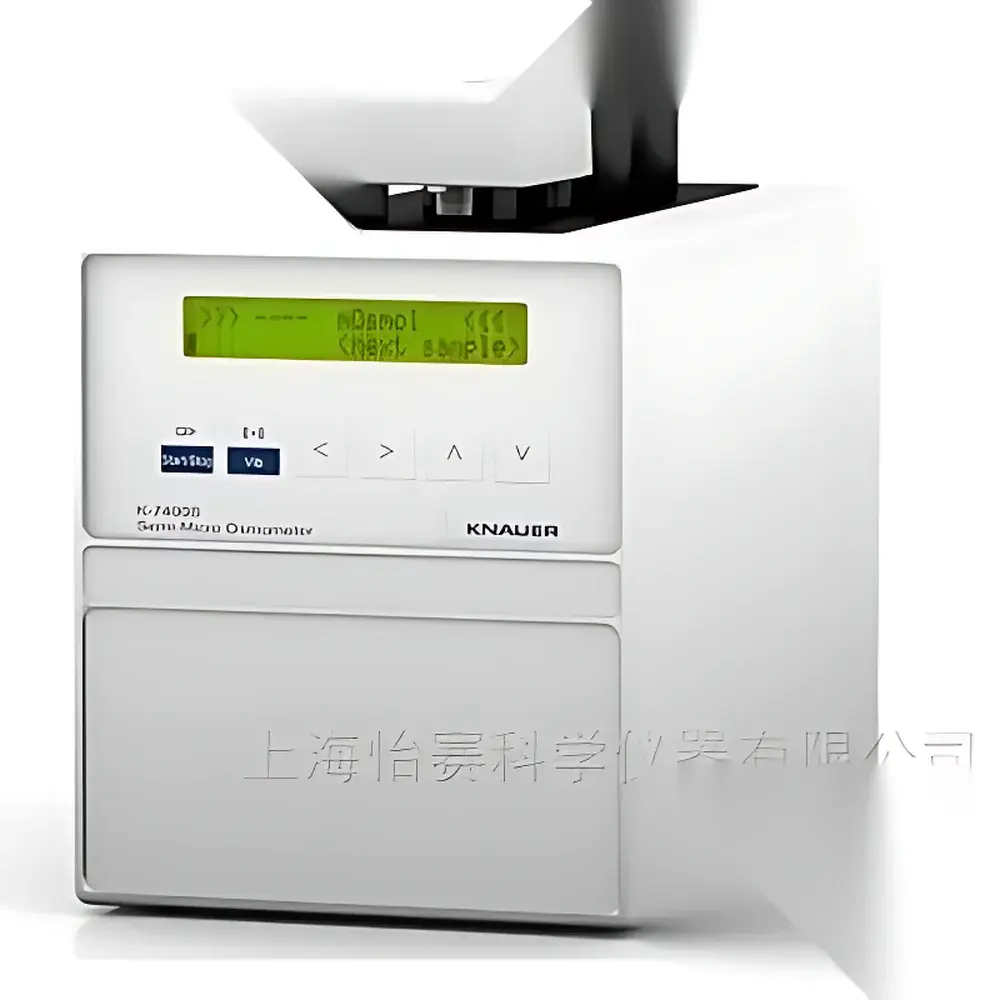
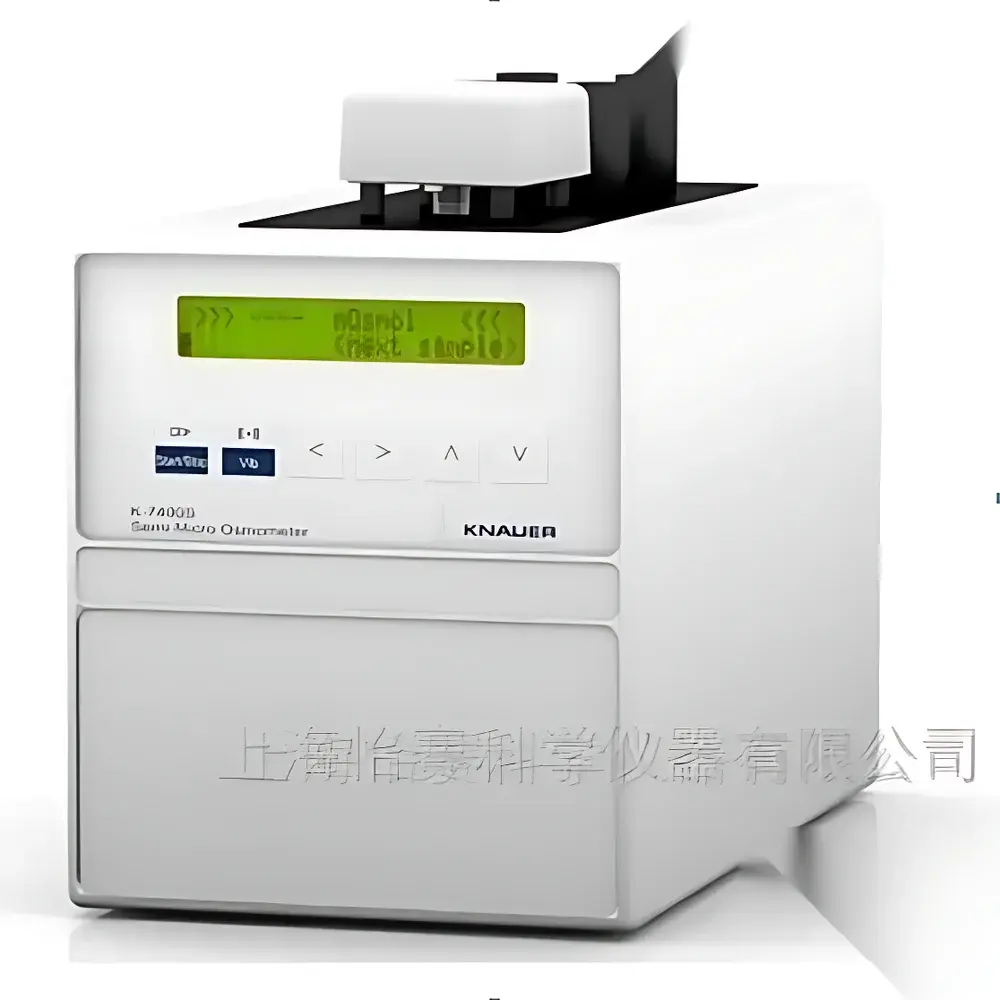
KNAUER K-7400S Cryoscopic Osmometer
| Brand | KNAUER |
|---|---|
| Origin | Germany |
| Model | K-7400S |
| Measurement Principle | Cryoscopic Depression (Freezing Point Depression) |
| Sample Volume | 50–150 µL |
| Measurement Time | ~2 min per sample |
| Compliance | Ph. Eur. 2.2.35 (01/2012), USP <785>, ChP 2015 Edition, ISO/IEC 17025 applicable |
| Software | EuroOsmo-CN (21 CFR Part 11 compliant with audit trail, electronic signature, role-based access control) |
| Cooling System | Peltier-based thermoelectric cooling |
| Data Export Formats | PDF, Excel (.xlsx), CSV, TXT |
| Optional | Thermal printer integration |
| Validation Support | IQ/OQ documentation available |
Overview
The KNAUER K-7400S Cryoscopic Osmometer is a precision-engineered analytical instrument designed for the accurate and reproducible determination of osmolality in aqueous solutions via freezing point depression—a thermodynamically grounded colligative property measurement. Based on the well-established cryoscopic principle, the instrument measures the extent to which solute particles depress the freezing point of water, enabling direct calculation of osmotic concentration (in mOsm/kg H₂O) without reliance on calibration curves or reference standards for each matrix. This method is universally accepted across pharmacopeial frameworks and provides inherent traceability to SI units through temperature measurement accuracy. The K-7400S integrates a high-stability Peltier cooling module and a calibrated platinum resistance thermometer (Pt100) for sub-millikelvin thermal resolution, ensuring robust performance in regulated laboratory environments—particularly where batch release testing, formulation development, and stability studies demand strict adherence to data integrity requirements.
Key Features
- High-precision cryoscopic detection with ±0.5 mOsm/kg typical repeatability (n=6, 300 mOsm/kg standard)
- Minimal sample requirement: 50–150 µL per measurement, reducing reagent consumption and enabling analysis of precious biological or clinical specimens
- Automated measurement cycle (~120 seconds), including controlled supercooling, nucleation induction, and equilibrium phase transition detection
- Dedicated EuroOsmo-CN software with full 21 CFR Part 11 compliance: electronic signatures, immutable audit trails, and role-based user management (Administrator, Analyst, Auditor)
- Hardware-level data protection: write-protected storage, cryptographic hashing of raw measurement files, and prohibition of manual file modification, deletion, renaming, or overwriting
- Real-time temperature curve visualization during each assay, allowing visual verification of nucleation event and thermal stabilization
- Optional barcode scanner integration for automated sample ID capture, minimizing transcription errors and supporting ALCOA+ data governance principles
Sample Compatibility & Compliance
The K-7400S is validated for use with a broad range of low-viscosity aqueous matrices, including parenteral drug products (IV infusions, ophthalmic solutions, nasal sprays), biologics formulations, cell culture media, nutritional supplements, dairy products (e.g., milk, whey), isotonic beverages, and plant or insect-derived biological fluids. It meets the technical and procedural requirements of multiple pharmacopeias: Ph. Eur. 2.2.35 (Cryoscopic Osmometry), USP <785> (Osmolality), and ChP 2015 General Chapter 0632. Instrument qualification packages—including Installation Qualification (IQ) and Operational Qualification (OQ)—are available upon request and align with ISO/IEC 17025 and GMP Annex 11 expectations for computerized system validation.
Software & Data Management
EuroOsmo-CN is a purpose-built, regulatory-grade software platform developed specifically for the K-7400S. It implements granular access control, time-stamped audit logging of all system events (login/logout, parameter changes, result generation, report export), and digital signature workflows compliant with FDA 21 CFR Part 11 and EU Annex 11. All raw data files are cryptographically sealed upon acquisition and stored in a proprietary binary format that cannot be opened or altered by third-party applications. Reports are auto-generated with embedded metadata: sample ID, operator, timestamp, instrument serial number, calibration status, and full thermographic trace. Export options include PDF (with embedded digital signature), Excel (.xlsx), CSV, and plain-text formats—ensuring compatibility with LIMS and long-term archival systems.
Applications
- Pharmaceutical Quality Control: Release testing of injectables, ophthalmic preparations, and inhalation solutions per compendial monographs; stability-indicating assays for lyophilized formulations
- Biotechnology: Monitoring osmolality shifts during upstream bioprocessing and downstream purification; assessing cryoprotectant efficacy in cell banking
- Food & Beverage: Verification of isotonicity in sports drinks; quality assessment of dairy-based liquids and fermented beverages (e.g., beer, kefir)
- Clinical & Research Laboratories: Osmolality profiling of urine, serum, cerebrospinal fluid, and plant xylem sap; optimization of insect hemolymph collection protocols
- Academic & Method Development: Teaching cryoscopic theory and colligative properties; validating alternative osmometry methods against primary reference instrumentation
FAQ
What regulatory standards does the K-7400S comply with?
The instrument and its EuroOsmo-CN software meet Ph. Eur. 2.2.35, USP <785>, ChP 2015 General Chapter 0632, and support compliance with 21 CFR Part 11, EU Annex 11, and ISO/IEC 17025.
Is IQ/OQ documentation provided with the system?
Yes—comprehensive IQ and OQ protocols, along with executed reports and evidence templates, are available as optional deliverables upon order confirmation.
Can the K-7400S measure viscous or protein-rich samples?
It is optimized for low-viscosity aqueous solutions (<5 cP); highly viscous or particulate-laden samples may require dilution or filtration prior to analysis to ensure reliable nucleation and thermal equilibration.
How is data integrity enforced at the hardware level?
Raw measurement files are generated with SHA-256 hash signatures, stored in read-only memory partitions, and inaccessible to external editing tools—ensuring demonstrable data provenance and immutability.
Does the system support multi-user environments with segregated responsibilities?
Yes—the three-tier permission model (Administrator, Analyst, Auditor) enforces separation of duties, with configurable password policies, session timeouts, and mandatory electronic signatures for critical actions.
Related Products





