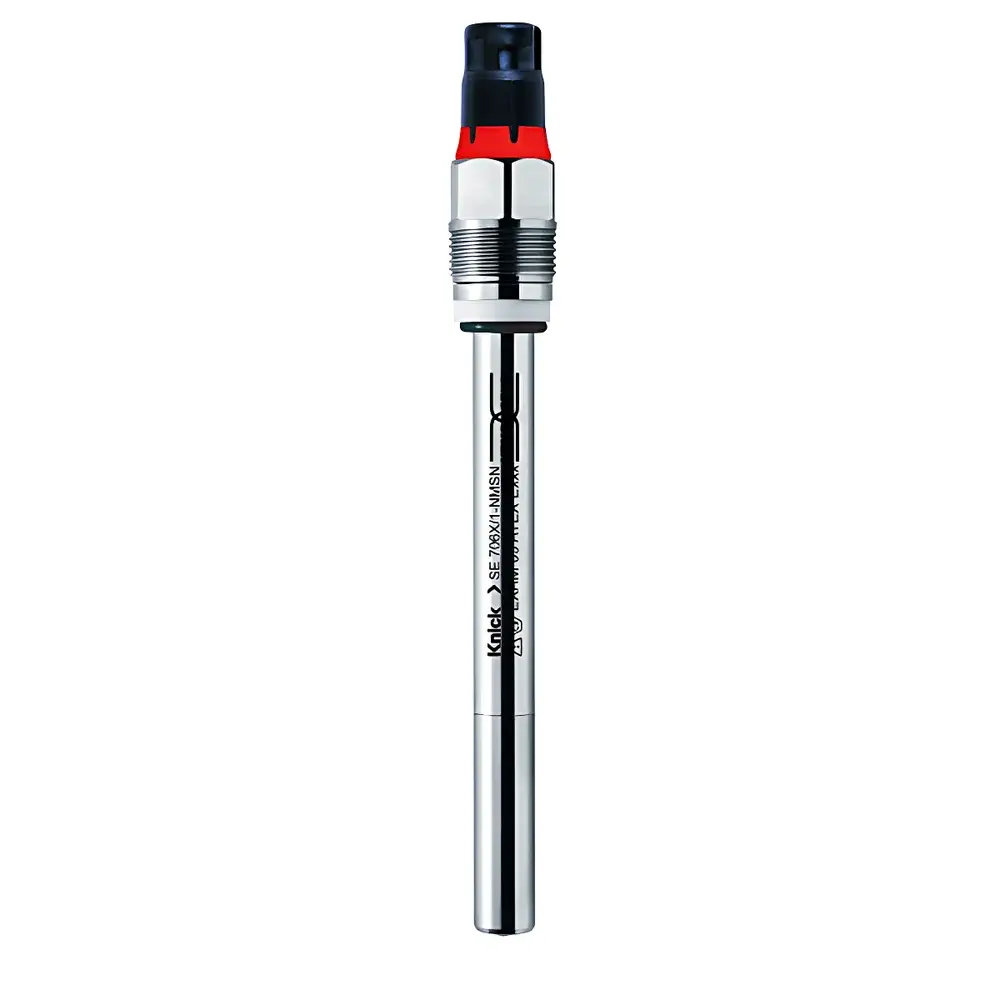
Knick Memosens Digital Dissolved Oxygen Sensor SE706
| Brand | Knick |
|---|---|
| Origin | Germany |
| Manufacturer Type | Manufacturer |
| Origin Category | Imported |
| Model | SE 706X/1-NMSN |
| Price | Upon Request |
| Resolution | 1% + 4 ppb |
| Measurement Range | 0.00–20.00 mg/L |
| Repeatability | 1% + 4 ppb |
| Stability | ±1% of reading per month |
| Temperature Compensation Range | –5 to +135 °C |
| Communication Interface | Memosens digital interface |
| Dimensions | Ø12 × 120 mm |
| Ambient Operating Temperature | 0–80 °C |
Overview
The Knick Memosens Digital Dissolved Oxygen Sensor SE706 is a high-integrity, digitally enabled electrochemical sensor engineered for continuous, trace-level dissolved oxygen (DO) monitoring in demanding hygienic and sterile process environments. Based on galvanic cell technology with an integrated optical sensing layer (luminescence-quenching principle), the SE706 delivers stable, drift-resistant measurements without internal electrolyte consumption or polarization delay. Its design complies with core requirements for biopharmaceutical upstream and downstream processing—including steam-in-place (SIP), clean-in-place (CIP), and autoclave compatibility up to 135 °C. The sensor operates across full physiological and industrial DO ranges (0.00–20.00 mg/L), supporting precise control of aerobic fermentation, cell culture, buffer preparation, and purified water distribution systems.
Key Features
- True digital architecture via Memosens 2.0 interface—enabling galvanic isolation, automatic sensor identification, and bidirectional data exchange with compatible transmitters (e.g., PhoBox, ConduCell, or third-party PLCs with Memosens support)
- Hygienic stainless-steel (1.4435 / SS316L) body with electropolished surface finish (Ra ≤ 0.4 µm), meeting ASME BPE-2022 and EHEDG Doc. 8 surface criteria
- Replaceable luminescent sensing membrane with integrated stainless-steel mesh and hydrophobic PTFE coating—resistant to fouling, chemical attack, and mechanical abrasion
- Factory pre-calibrated with NIST-traceable standards; calibration data stored permanently in sensor memory, including date, offset, slope, and diagnostic history
- Integrated diagnostics: real-time status reporting for membrane integrity, temperature drift, signal noise, and electrode aging—accessible via transmitter display or asset management software
- ATEX II 1/2 G Ex ia IIC T6 Ga and IECEx certified for use in Zone 0/1 hazardous areas; also compliant with UL/cUL Class I, Div 1, Groups A–D
Sample Compatibility & Compliance
The SE706 is validated for use in non-corrosive aqueous media across pH 2–12 and conductivity ≥ 50 µS/cm. It exhibits negligible cross-sensitivity to chloride (< 0.1% signal shift at 10 g/L NaCl), CO₂, and common bioprocess gases (N₂, O₂, air, CO₂). Regulatory alignment includes adherence to FDA 21 CFR Part 11 (via compatible Knick transmitters with audit trail and electronic signature capability), EU Annex 1 (sterile manufacturing), and ISO 13485–certified production. All materials comply with USP <661.1>, EP 3.1.1, and EC 1935/2004 for food contact. Sterilization validation covers 30+ cycles of saturated steam at 121 °C (15 psi) and 135 °C (30 psi), as well as gamma irradiation up to 25 kGy.
Software & Data Management
Memosens protocol embeds encrypted sensor metadata (serial number, firmware version, calibration certificate ID, service life counter) into every data packet. When paired with Knick’s PhoBox 2.0 or ConduCell 4.0 transmitters, users gain access to configurable alarm thresholds, trend logging (≥ 30 days at 1-second intervals), and CSV export via USB or Ethernet. Integration with DeltaV, PCS7, and Emerson DeltaV DCS is supported through native Memosens device description (GSDML) files. Full GLP/GMP compliance is achievable using Knick’s optional Data Integrity Package, which provides time-stamped audit trails, user role-based access control, and electronic signature workflows aligned with ALCOA+ principles.
Applications
- Real-time DO control in mammalian and microbial bioreactors (5–20,000 L scale)
- In-line monitoring of purified water (PW) and water-for-injection (WFI) loops per USP <1231> and EU Ph. Eur. 2.2.48
- CIP rinse validation via rapid DO decay profiling
- Sterile filtration integrity verification through post-filter DO spike detection
- Environmental monitoring in anaerobic digestion and wastewater treatment plants requiring explosion-proof operation
- Lab-scale process development where sensor interchangeability and metrological traceability are critical
FAQ
Is the SE706 suitable for autoclave sterilization?
Yes—the sensor housing and membrane assembly are rated for repeated autoclaving at 135 °C / 30 psi, with documented performance stability over ≥30 cycles.
Does it require zero-point calibration in the field?
No—factory calibration is stable for ≥6 months under typical bioprocess conditions; only span verification (e.g., air-saturation check) is recommended per SOP.
Can it be used in viscous or particulate-laden media?
Yes—its robust PTFE-coated membrane and flush-mount geometry minimize clogging; optional flow-through housings (e.g., FT-HYGI) are available for high-solids applications.
How is sensor lifetime tracked?
Internal EEPROM records cumulative exposure time at elevated temperatures (>80 °C) and total operational hours; this data is readable via any Memosens-capable transmitter.
Is Memosens backward compatible with legacy Knick analog systems?
No—Memosens requires a digital-capable transmitter; however, Knick offers retrofit kits (e.g., PhoBox 2.0 + adapter cable) for seamless migration from analog SE 555/SE 655 platforms.