
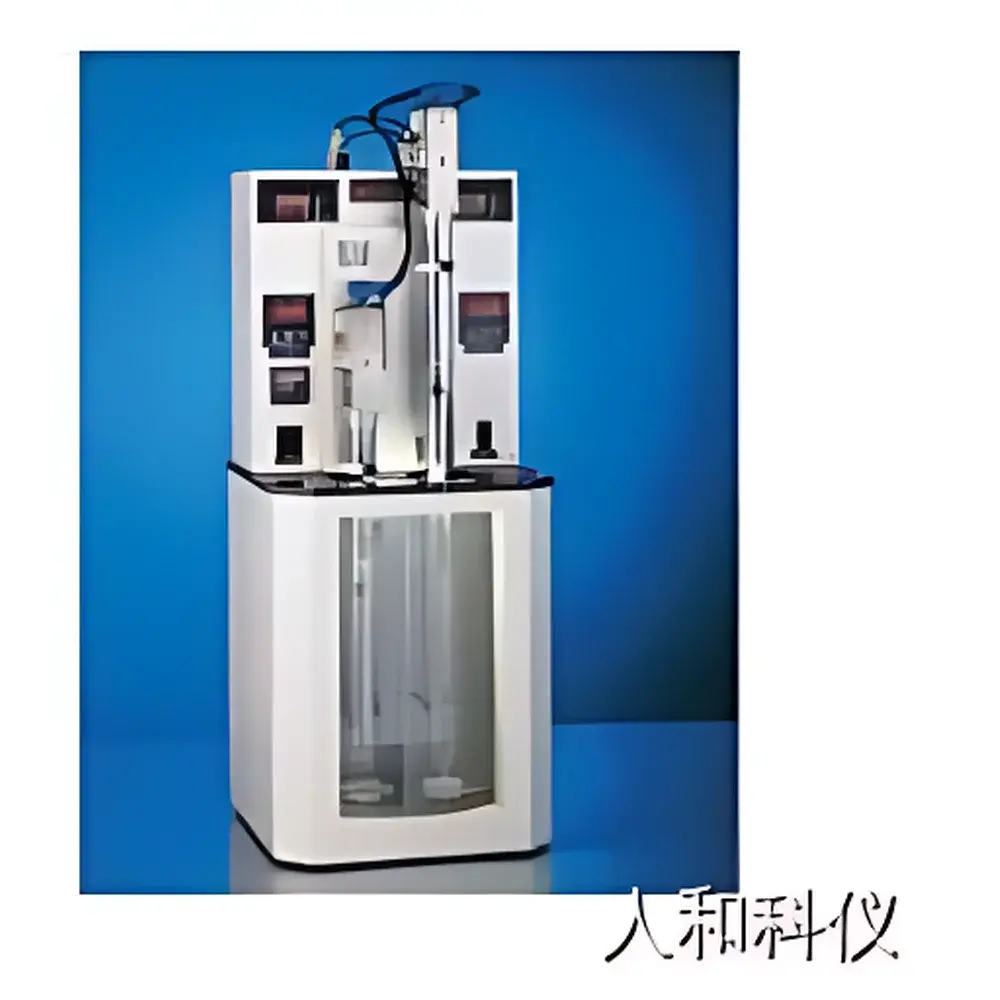
Koehler FK39199 Lubricating Oil Emulsion Resistance Tester
| Brand | Koehler |
|---|---|
| Origin | USA |
| Model | FK39199 |
| Temperature Range | Up to 100 °C |
| Bath Capacity | 38.5 L (water) |
| Power Supply | 220–240 V, 50/60 Hz |
| Dimensions | 52.7 × 38.75 × 74.9 cm |
| Construction | Stainless steel wetted parts |
| Standards Compliance | ASTM D2711, DIN 51353, ASTM D1401 (via configuration) |
| Control System | Microprocessor-based LED digital temperature controller with dual independent stirrer speed control and digital RPM display |
| Illumination | Integrated LED lighting with transparent front viewport |
Overview
The Koehler FK39199 Lubricating Oil Emulsion Resistance Tester is a precision-engineered laboratory instrument designed to quantify the ability of medium- to high-viscosity lubricating oils to separate from water under controlled thermal and mechanical agitation conditions. Based on the fundamental principle of phase separation kinetics in immiscible liquid systems, the instrument implements standardized test protocols defined in ASTM D2711 and DIN 51353—both of which specify procedures for evaluating emulsion resistance through timed, temperature-regulated mixing and subsequent visual or volumetric assessment of water separation. The system operates by homogenizing a defined volume of oil sample with distilled water in calibrated separatory funnels, agitating the mixture at a specified rotational speed for exactly five minutes within a thermally stabilized bath, then allowing quiescent settling for prescribed durations (e.g., 30, 60, or 120 minutes). Final evaluation involves measuring either the volume of free water separated at the bottom layer or calculating the residual water content as a percentage of the total mixture—providing objective, repeatable data essential for quality assurance, formulation development, and oxidative stability assessment in turbine, hydraulic, and circulating lubricants.
Key Features
- Dual-test capability: Simultaneous operation of two independent stirring assemblies, each equipped with a vertically mounted, high-torque DC motor and precision-adjustable speed control (0–1500 rpm range, calibrated via integrated tachometer disc).
- Stainless steel wetted components: All surfaces contacting test fluids—including stirrer shafts, funnels, clamps, and bath interior—are fabricated from corrosion-resistant 316 stainless steel to ensure long-term integrity and eliminate contamination risks.
- Microprocessor-controlled thermostatic bath: Maintains setpoint accuracy within ±0.2 °C across the full operating range (ambient to 100 °C), with real-time LED display of both set and actual bath temperature.
- Optimized operator interface: Front-mounted transparent acrylic viewport with integrated LED illumination enables unobstructed visual monitoring of phase separation dynamics during settling without opening the bath chamber.
- Modular funnel support system: Accommodates standard 100 mL or 200 mL calibrated glass separatory funnels; quick-release clamps allow rapid setup and cleaning between tests.
Sample Compatibility & Compliance
The FK39199 is validated for use with mineral-based, synthetic, and semi-synthetic lubricants, including turbine oils, hydraulic fluids, gear oils, and compressor lubricants. It supports both ASTM D2711/DIN 51353 (for medium- to high-viscosity oils) and ASTM D1401 (with appropriate funnel geometry and lower agitation speeds) for lighter formulations such as aviation oils and certain ester-based synthetics. All test procedures are fully aligned with ISO/IEC 17025 requirements for method validation, and the instrument’s digital controls and stable thermal performance facilitate adherence to GLP documentation standards. Traceable calibration records for temperature and rotational speed are recommended for audit readiness in regulated environments (e.g., power generation facilities, OEM lubricant qualification labs).
Software & Data Management
While the FK39199 operates as a standalone benchtop instrument without embedded PC software, its analog-digital hybrid architecture ensures compatibility with external laboratory information management systems (LIMS). Temperature setpoints, agitation duration, and stirrer speeds are manually entered and retained via non-volatile memory. For digital data capture, users may integrate external USB-connected data loggers or industrial PLCs to record time-stamped bath temperature, RPM, and operator annotations. The instrument meets the foundational hardware requirements for FDA 21 CFR Part 11 compliance when paired with validated electronic lab notebooks (ELN) that enforce user authentication, audit trails, and electronic signatures during result entry and reporting.
Applications
- Quality control of new and in-service turbine oils in power generation plants.
- Evaluation of additive package efficacy—particularly demulsifiers—in formulated lubricants.
- Monitoring hydrolytic degradation in ester-based synthetic lubricants exposed to moisture ingress.
- Comparative testing of base oil types (Group I–V) for inherent water separation behavior.
- Supporting root-cause analysis of bearing failures linked to emulsion-induced film breakdown.
- Validation of filtration and dehydration system performance in closed-loop lubrication circuits.
FAQ
What standards does the FK39199 directly support?
ASTM D2711 and DIN 51353 are natively supported; ASTM D1401 can be implemented with minor procedural adjustments and appropriate funnel selection.
Can the unit operate continuously at 100 °C?
Yes—the bath is rated for sustained operation at 100 °C using deionized or distilled water as the heat transfer medium; periodic replenishment is required to compensate for evaporation.
Is calibration certification included with purchase?
Factory calibration verification is provided; NIST-traceable temperature and speed calibration certificates are available as optional add-ons upon request.
How is maintenance performed on the stirring mechanism?
Stirrer motors require no scheduled lubrication; stainless steel shafts and bearings are sealed and designed for immersion duty—routine cleaning with mild detergent and inspection for shaft runout are sufficient.
Does the instrument meet electrical safety standards for international use?
The unit complies with IEC 61010-1 for laboratory electrical equipment and carries CE marking; voltage/frequency variants are configured per regional specifications prior to shipment.






