
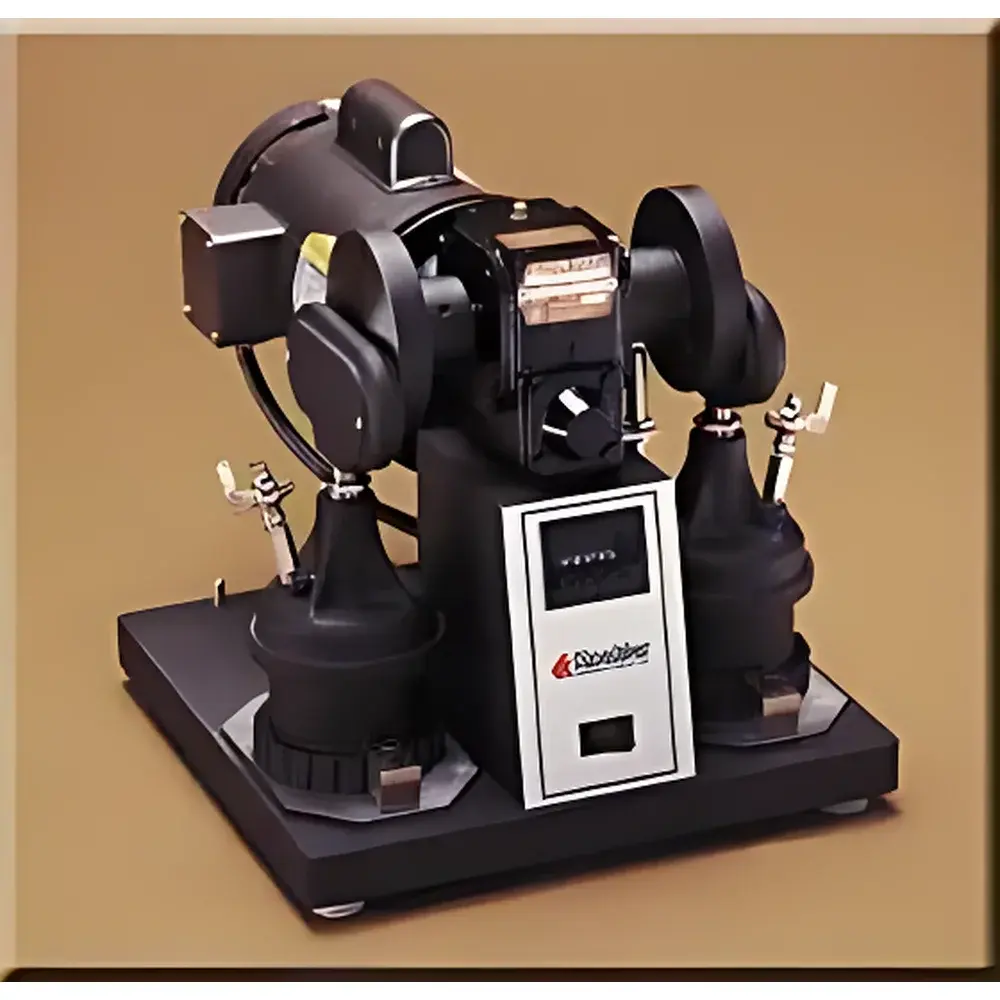
Koehler K18110 / K18191 / K18000 Manual and Motorized Grease Workers
| Brand | Koehler |
|---|---|
| Origin | USA |
| Model Numbers | K18110 (Motorized Single-Unit), K18191 (Motorized Single-Unit, Alternate Configuration), K18000 (Manual Unit) |
| Compliance | ASTM D217, ASTM D1403, ASTM D7176 |
| Operating Speed | 60 ± 10 strokes/min |
| Stroke Length | 67–71 mm |
| Motor Type | Air-Cooled Gearmotor (Single-Unit: 1/3 HP |
| Dual-Unit | 1/2 HP) |
| Power Supply | 220–240 V, 50 Hz, Single-Phase, 1.5 A |
| Dimensions & Weight | K18110/K18191 — 25 × 34 × 37 cm, 48.1 kg |
| Construction | Precision-Machined Steel Body, Stainless Steel Cup & Cover, Hardened Steel Perforated Plate |
Overview
The Koehler K18110, K18191, and K18000 Grease Workers are precision-engineered laboratory instruments designed to perform standardized mechanical working of lubricating greases in accordance with ASTM D217 (Standard Test Method for Cone Penetration of Lubricating Grease), ASTM D1403 (Standard Test Methods for Cone Penetration of Lubricating Grease After Rolling), and ASTM D7176 (Standard Test Method for Extended Working of Lubricating Grease). These units replicate the shear history imposed on grease during service by subjecting a defined sample volume to controlled reciprocating motion within a standardized cup. The working process alters grease structure—particularly the fibrous network of thickeners—and directly influences subsequent penetration measurements, making these instruments essential for quality control, formulation development, and regulatory compliance in petroleum refining, additive manufacturing, and OEM lubricant specification laboratories.
Key Features
- ASTM-compliant stroke length (67–71 mm) and operating frequency (60 ± 10 strokes per minute), validated via traceable calibration protocols
- Dual operational modes: motorized (K18110/K18191) for high-throughput, repeatable testing; manual (K18000) for rapid screening or low-volume validation studies
- Robust steel construction with hardened stainless-steel grease cup, cover, and perforated plate ensures dimensional stability and resistance to corrosion from hydrocarbon-based formulations
- Integrated electronic stroke counter with programmable stop function—prevents overworking and supports GLP-aligned documentation of test parameters
- Modular mounting system enables quick installation and removal of ASTM-standard grease cups without tools or realignment
- Motorized variants feature air-cooled gearmotors delivering consistent torque across extended duty cycles; single-unit (1/3 HP) and dual-unit (1/2 HP) configurations accommodate varying throughput requirements
Sample Compatibility & Compliance
These grease workers accept standard ASTM D217 grease cups (60.3 mm diameter × 57.2 mm height) and are compatible with NLGI Grades 000 through 6, including lithium-, calcium-, aluminum-, polyurea-, and clay-thickened greases. All models support both “worked penetration” (60 strokes) and “extended worked penetration” (100,000 strokes per ASTM D1403 Annex A1) protocols when used with appropriate accessories and timing controls. Units are supplied with full traceable conformance documentation to ASTM D217 and ISO/IEC 17025–accredited calibration procedures. Optional NIST-traceable verification kits are available for in-house periodic performance checks.
Software & Data Management
While the K18110/K18191 models operate via hardware-based electronic counters (no embedded software), their design facilitates integration into LIMS and ELN environments via external digital loggers or programmable logic controllers (PLCs). Each unit includes a dedicated RS-232 or USB interface port (optional accessory) enabling automated stroke logging, timestamped event capture, and audit-trail generation compliant with FDA 21 CFR Part 11 requirements. Calibration records, operator IDs, batch numbers, and environmental conditions (e.g., lab temperature per ASTM D217 Section 7.1) can be appended to raw stroke data for full traceability in GMP or ISO 9001-certified facilities.
Applications
- Quality assurance of finished grease products prior to release, verifying consistency in structural stability after mechanical working
- R&D evaluation of thickener efficiency, base oil compatibility, and additive interactions under shear stress
- Supporting ASTM D6694 (Evaluation of Grease Consistency Loss Under Shear) and DIN 51818 (Grease Stability Testing)
- Calibration verification of cone penetrometers using pre-worked reference samples
- Training laboratories requiring hands-on instruction in standardized grease rheology protocols
- Third-party testing labs performing contract analyses for API, SAE, or OEM specifications (e.g., GM 6039-M, Ford WSS-M2C949-A)
FAQ
What is the difference between the K18110 and K18191 models?
Both are motorized single-unit grease workers meeting identical ASTM D217 specifications; K18191 denotes a configuration optimized for integration with Koehler’s automated penetration testing platforms, featuring modified mounting interfaces and enhanced signal synchronization.
Can the K18000 manual unit be upgraded to motorized operation?
No—K18000 is a mechanically distinct platform with a dedicated hand-lever mechanism and non-motorized base; retrofitting is not supported due to structural and safety certification constraints.
Is routine calibration required, and how often?
Yes—per ASTM D217 Section 6.2, stroke length and frequency must be verified at least daily before use or after any maintenance; annual third-party calibration is recommended for ISO/IEC 17025 compliance.
Are replacement grease cups and perforated plates available as spare parts?
Yes—Koehler supplies certified replacement components (P/N K18110-CUP, K18110-PLATE) manufactured to ASTM D217 dimensional tolerances and individually serialized for traceability.
Does the instrument meet electrical safety standards for international use?
All motorized units comply with UL 61010-1 and CE EN 61010-1 for laboratory equipment; voltage/frequency variants are available for 115 V / 60 Hz (North America) and 230 V / 50 Hz (EU/Asia) markets upon order.






