
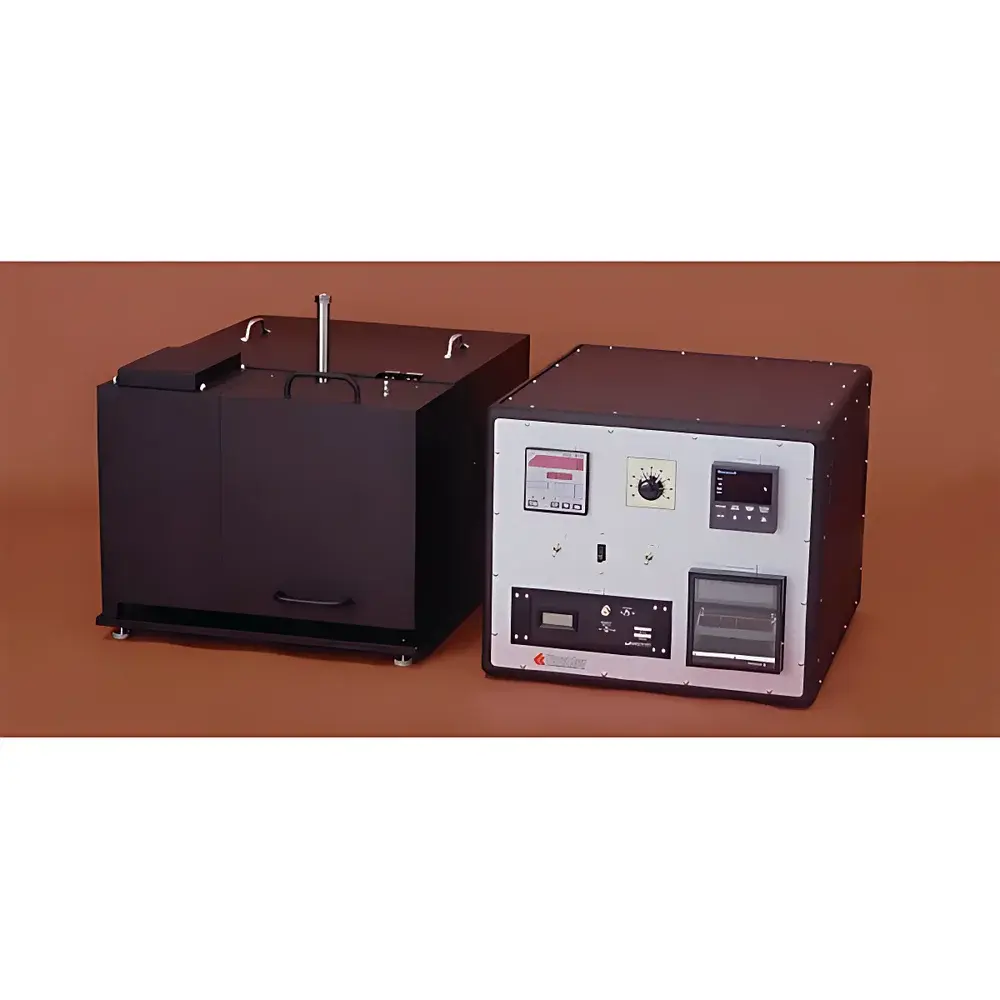
Koehler K18650 Thermal Oxidation Stability Tester for Automotive Gear Oils
| Brand | Koehler |
|---|---|
| Origin | USA |
| Model | K18650 |
| Standard Compliance | ASTM D5074, STP512A L-60-1 (formerly CRC L-60), FTM 791-2504 |
| Test Temperature | 162.8 ± 0.6 °C |
| Air Flow Rate | 1.1 L/h |
| Drive Speed | 1725 rpm |
| Load | 128 W |
| Power Supply | 220–240 V, 50 Hz, single-phase, 15 A |
| Dimensions (Test Chamber) | 61 × 61 × 37 cm |
| Dimensions (Control Cabinet) | 60 × 60 × 44 cm |
| Weight | 149.7 kg |
Overview
The Koehler K18650 Thermal Oxidation Stability Tester is a purpose-built laboratory instrument engineered to evaluate the thermal-oxidative degradation resistance of automotive gear lubricants under accelerated, controlled conditions. It implements the standardized mechanical-thermal oxidation protocol defined in ASTM D5074 and STP512A L-60-1 — a method originally developed by the Coordinating Research Council (CRC) as L-60 and widely adopted for its strong correlation with real-world field performance. Unlike static oven-based oxidation tests, the K18650 subjects lubricants to simultaneous mechanical shear, catalytic copper surface exposure, continuous air sparging, and precise high-temperature maintenance (162.8 ± 0.6 °C), thereby replicating the synergistic stress factors encountered in heavily loaded gear systems. The test duration is fixed at 50 hours, during which oxidation-induced viscosity increase, deposit formation (carbonaceous sludge, varnish, and insoluble sediments), and gear surface degradation are quantitatively and qualitatively assessed per standard evaluation criteria.
Key Features
- Integrated stainless-steel test chamber housing a precision-machined pair of spur gears and a dedicated test bearing, all enclosed within a transparent, heat-resistant viewport for real-time visual monitoring.
- High-torque AC motor (45 A generator-loaded) coupled via rigid shaft to the input gear, delivering stable 1725 rpm rotation under constant 128 W mechanical load — replicating typical gear meshing energy dissipation.
- Platinum resistance temperature detector (PT-RTD) feedback loop with digital PID controller ensures temperature stability within ±0.6 °C at 162.8 °C, validated per ASTM E77 calibration requirements.
- Microprocessor-controlled mass flow regulator maintains air delivery at 1.1 L/h ± 0.05 L/h, independent of inlet pressure or ambient temperature fluctuations; includes automatic self-calibration routine.
- Dual-cabinet architecture: thermally isolated test enclosure (61 × 61 × 37 cm) and separate control cabinet (60 × 60 × 44 cm) with integrated programmable strip-chart recorder, digital display (°C/°F), and real-time data logging capability.
- Robust safety architecture including redundant PT-RTD overheat protection, corrosion-resistant polyurethane enamel coating on all external surfaces, and grounded electrical design compliant with IEC 61010-1 for laboratory equipment.
Sample Compatibility & Compliance
The K18650 is optimized for testing SAE 75W–90 through 140 grade automotive gear oils, including conventional mineral, semi-synthetic, and full-synthetic formulations containing sulfur-phosphorus extreme-pressure (EP) additives. It accommodates 1.0 L sample volume per test cycle and supports sequential evaluation of multiple batches without recalibration. The system fully conforms to ASTM D5074 “Standard Test Method for Thermal-Oxidative Stability of Automotive Gear Lubricants” and STP512A L-60-1 “Performance Test for Gear Oils”, including mandatory requirements for gear geometry, load application, airflow uniformity, and post-test inspection methodology. All critical parameters — temperature, airflow, rotational speed, and load — are traceable to NIST-certified references and support GLP-compliant audit trails when paired with Koehler’s optional 21 CFR Part 11–enabled software module.
Software & Data Management
While the base K18650 operates via embedded microprocessor controls with analog strip-chart recording, it is compatible with Koehler’s optional K-Link™ Data Acquisition Suite. This Windows-based application enables time-stamped acquisition of temperature, airflow, RPM, and load voltage/current signals at 1 Hz resolution. Data exports to CSV or ASTM E1461-compliant XML formats for integration into LIMS environments. Audit logs record user actions, parameter changes, and calibration events with electronic signatures. Optional validation packages support IQ/OQ/PQ documentation for GMP-regulated laboratories conducting lubricant qualification per OEM specifications (e.g., GM GMW16038, Ford WSS-M2C200-D).
Applications
- Formulation development and screening of new gear oil base stocks and additive packages for extended drain intervals.
- Quality control release testing of production batches against OEM or industry specification limits (e.g., viscosity increase ≤ 150%, no severe pitting or scoring observed).
- Comparative oxidative stability benchmarking across competing commercial gear oils under identical test conditions.
- Root cause analysis of field failures linked to premature sludge formation or viscosity runaway in rear axles and transfer cases.
- Supporting regulatory submissions requiring documented thermal-oxidative performance data per API GL-5, MIL-PRF-2105E, or JASO M323 standards.
FAQ
What standards does the K18650 specifically validate against?
ASTM D5074, STP512A L-60-1 (formerly CRC L-60), and FTM 791-2504 — with full adherence to gear geometry, temperature tolerance, airflow accuracy, and load application requirements.
Is the system suitable for testing synthetic gear oils with high-temperature additives?
Yes; the K18650’s calibrated thermal and mechanical stress profile is representative of service conditions experienced by PAO- and ester-based synthetics in heavy-duty differentials.
Can test data be exported for regulatory reporting?
When equipped with K-Link™ software, all raw and processed data meet ASTM E2500 and FDA 21 CFR Part 11 requirements for electronic records and signatures.
What maintenance is required between test cycles?
Routine cleaning of the gear set and chamber interior with solvent; verification of airflow calibration using a NIST-traceable rotameter; annual PT-RTD sensor calibration.
Does the system include provisions for third-party verification or certification?
Yes — Koehler provides factory calibration certificates traceable to NIST, and the system is preconfigured for ISO/IEC 17025 accreditation audits when operated under documented SOPs.





