
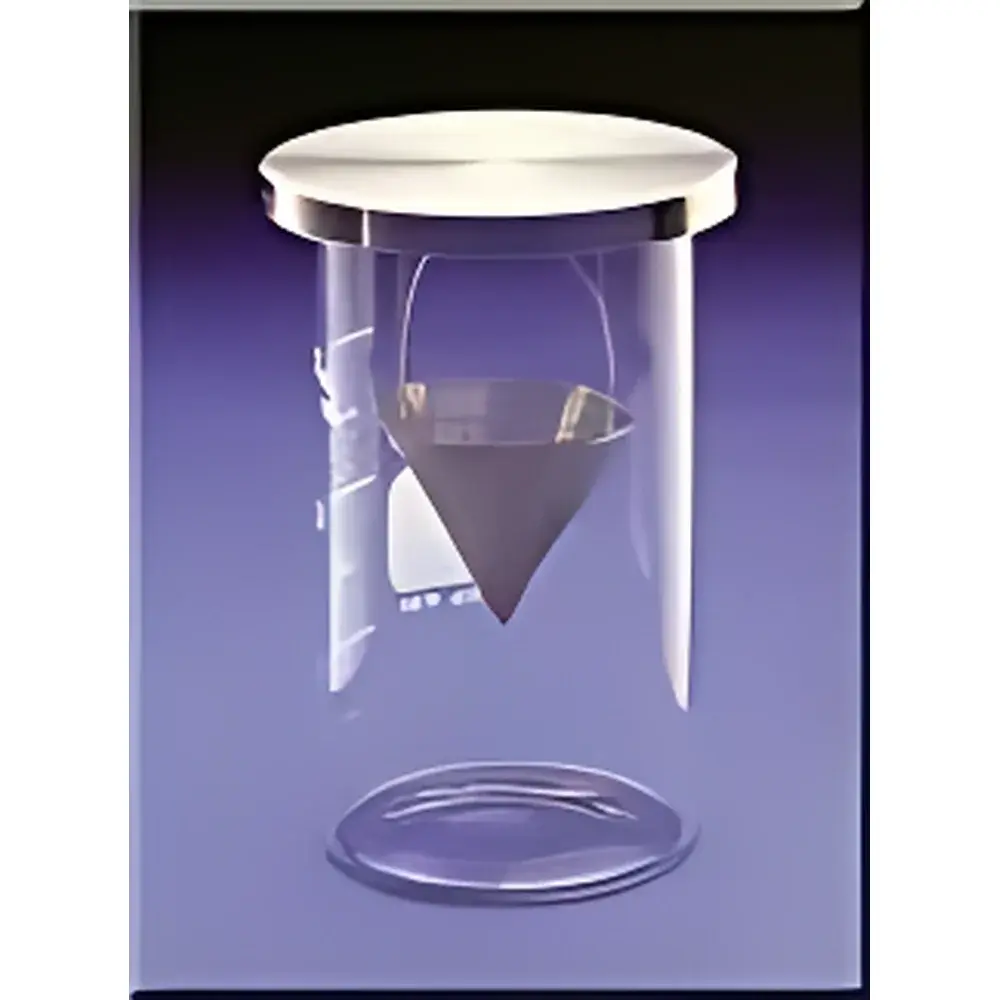
Koehler K19000 Oil Separation Tester (ASTM D6184 Compliant)
| Brand | Koehler |
|---|---|
| Origin | USA |
| Model | K19000 |
| Standard Compliance | ASTM D6184, FTM 791-321 |
| Test Temperature Range | Up to 482°C |
| Sieve Specification | 60-mesh conical wire mesh funnel with metal handle |
| Receptacle | 200 mL covered beaker |
| Net Weight | 0.2 kg |
Overview
The Koehler K19000 Oil Separation Tester is a precision-engineered apparatus designed to quantify the tendency of lubricating greases to release oil under elevated temperature conditions—a critical parameter in grease stability and service life prediction. It implements the standardized cone-sieve method specified in ASTM D6184, “Standard Test Method for Oil Separation from Lubricating Grease (Cone Sieve Method),” and is also compliant with U.S. Department of Defense test method FTM 791-321. The instrument operates on a gravimetric principle: a defined mass of grease is placed onto a preheated 60-mesh conical wire mesh funnel; upon exposure to controlled high-temperature conditions (up to 482°C), free oil drains through the mesh into a calibrated 200 mL covered receptacle. The mass of separated oil is then determined by weighing, enabling calculation of oil separation percentage—expressed as weight percent of oil expelled relative to original grease mass. This measurement directly informs formulation robustness, thickener efficiency, and long-term performance in high-temperature applications such as wheel bearings, industrial gearboxes, and aviation systems.
Key Features
- Designed and manufactured to meet the dimensional, thermal, and mechanical requirements of ASTM D6184 and FTM 791-321 test protocols.
- Stainless steel 60-mesh conical sieve funnel with integrated heat-resistant metal lifting handle—ensures consistent geometry, thermal stability, and safe handling during hot operation.
- Dedicated 200 mL borosilicate glass beaker with tight-fitting lid—minimizes evaporation loss and contamination during extended thermal exposure.
- Compact, lightweight architecture (net weight: 0.2 kg) optimized for benchtop use in QC laboratories, R&D facilities, and third-party testing labs.
- No active electronics or power supply required—operates as a passive thermal test fixture, eliminating calibration drift, software dependencies, or electromagnetic interference concerns.
- Compatible with standard laboratory ovens capable of maintaining stable temperatures up to 482°C; no proprietary heating module required.
Sample Compatibility & Compliance
The K19000 is validated for use with all NLGI grade lubricating greases—including lithium, calcium, aluminum complex, polyurea, and clay-thickened formulations—as well as specialty greases containing synthetic base oils (e.g., PAO, ester, silicone). Its physical configuration ensures reproducible sample loading volume and surface area exposure per ASTM D6184 Section 7. The 60-mesh aperture (250 µm nominal opening) provides standardized flow resistance, while the conical geometry promotes uniform radial drainage and minimizes channeling effects. As a reference-standard test fixture, the K19000 supports GLP-compliant workflows when used within documented SOPs, traceable balance calibration, and temperature-controlled oven validation (per ISO/IEC 17025 Clause 5.4.2). It does not require regulatory certification itself but serves as an essential component in methods subject to FDA, API, or OEM audit requirements for grease qualification.
Software & Data Management
The K19000 is a hardware-only test fixture with no embedded firmware, connectivity, or onboard data logging capabilities. All measurements are performed manually using external analytical balances (recommended readability: 0.1 mg) and calibrated temperature monitoring devices (e.g., NIST-traceable thermocouples or RTDs). Data recording, statistical analysis (e.g., mean oil separation %, standard deviation across triplicate runs), and report generation are conducted externally via LIMS platforms, Excel-based templates, or validated laboratory informatics systems. When integrated into 21 CFR Part 11–compliant environments, users implement electronic signatures, audit trails, and version-controlled SOPs for the full test sequence—including sample preparation, oven equilibration, timing control, and gravimetric determination—to ensure data integrity and regulatory defensibility.
Applications
- Quality control of incoming grease batches against OEM or internal specifications.
- Formulation development for high-temperature greases used in electric motor bearings and wind turbine pitch systems.
- Comparative evaluation of thickener systems (e.g., lithium vs. lithium-complex vs. polyurea) under identical thermal stress conditions.
- Stability assessment of biodegradable greases exposed to elevated operating temperatures in marine and agricultural equipment.
- Supporting failure analysis investigations where excessive oil bleed correlates with premature bearing wear or seal extrusion.
- Preparation of data packages for ISO 6743-9 (lubricant classification) and DIN 51825 (grease specification) compliance documentation.
FAQ
Does the K19000 include a heating source?
No—the K19000 is a passive test fixture. Users must supply a temperature-stable laboratory oven capable of reaching and holding 482°C with ±2°C uniformity.
Is calibration required for the K19000 itself?
No calibration certificate is issued for the K19000, as it contains no measuring transducers. However, the 60-mesh sieve must be verified for mesh count and aperture conformity per ASTM E11 prior to first use and at scheduled intervals.
Can the K19000 be used for non-grease samples such as pastes or gels?
ASTM D6184 applies exclusively to lubricating greases. Use with other materials is not standardized and may yield non-comparable or non-reproducible results.
What is the recommended sample mass for testing?
Per ASTM D6184 Section 7.2, a nominal 5.0 g ± 0.1 g sample is placed centrally on the dry, preheated funnel prior to oven insertion.
How often should the conical sieve be cleaned or replaced?
The stainless steel funnel must be thoroughly cleaned with solvent (e.g., naphtha or xylene) and dried after each test. Visual inspection for wire deformation or clogging is required before reuse; replacement is advised if mesh integrity is compromised.






