
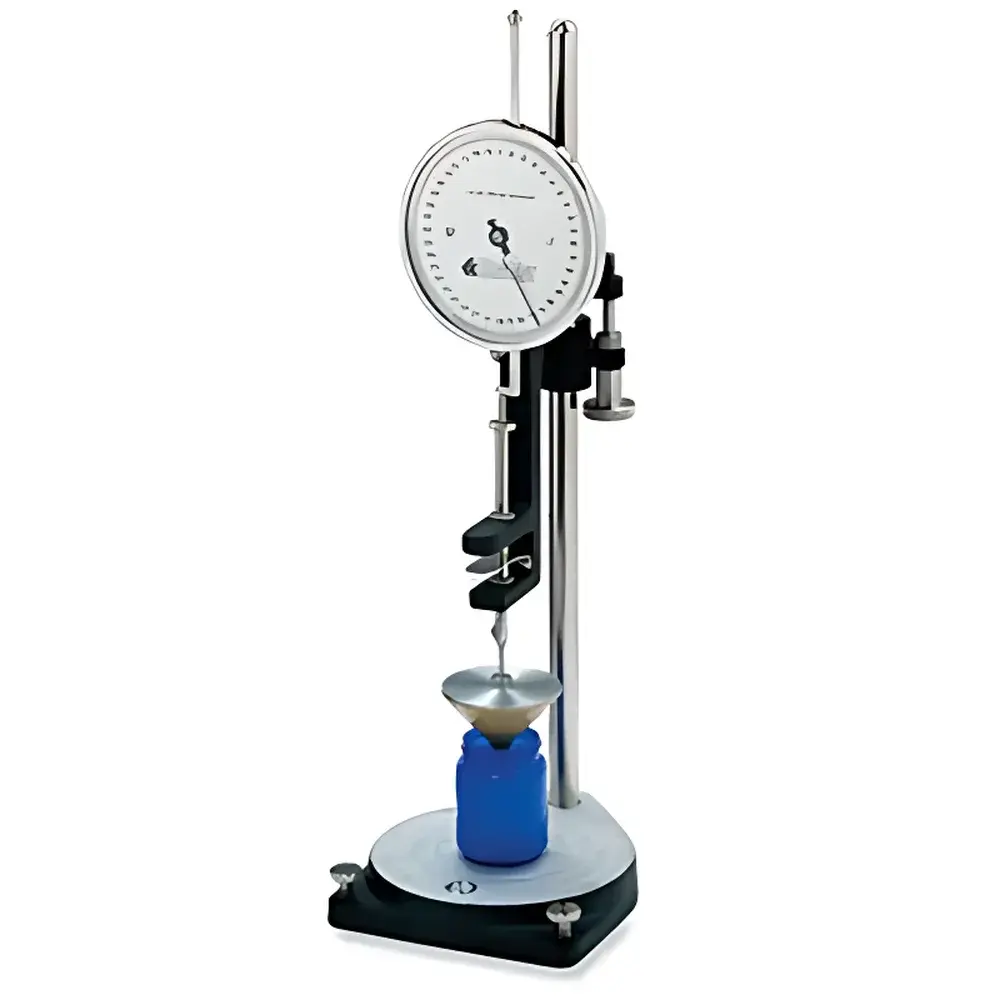
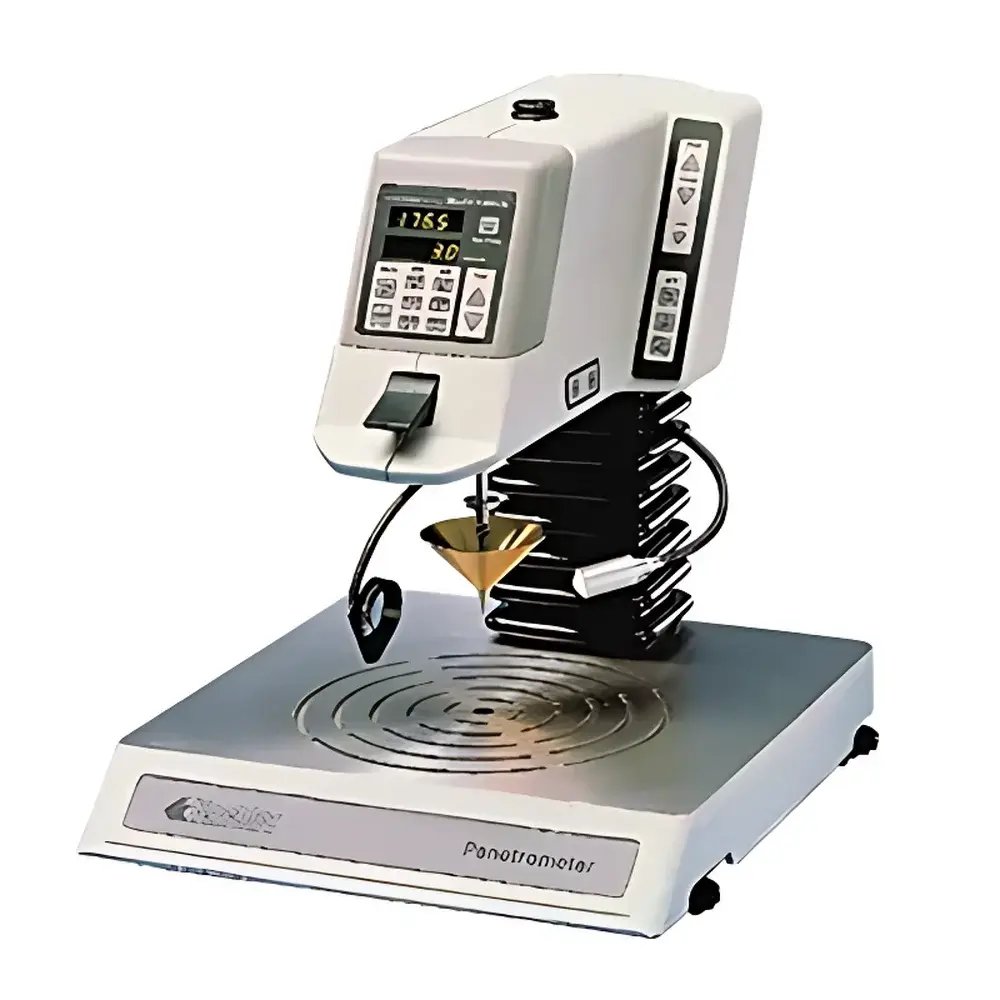
Koehler K19500 Manual Penetration Tester
| Origin | USA |
|---|---|
| Manufacturer Type | Authorized Distributor |
| Origin Category | Imported |
| Model | K19500 |
| Pricing | Upon Request |
Overview
The Koehler K19500 Manual Penetration Tester is a precision-engineered instrument designed for determining the consistency of semi-solid petroleum products—including greases, asphalt binders, waxes, and bituminous materials—according to standardized mechanical penetration principles. It operates on the fundamental ASTM D5, D217, D937, and D1321 test methodologies, where a standardized needle or cone is allowed to descend under controlled static load and time into a conditioned sample at specified temperature (typically 25 °C unless otherwise prescribed). The depth of penetration—measured in tenths of a millimeter (0.1 mm)—serves as the primary quantitative indicator of material hardness or softness. Unlike fully automated systems, the K19500 emphasizes operator-controlled repeatability, mechanical stability, and field-deployable robustness while maintaining full compliance with international standardization requirements for routine QC and specification verification.
Key Features
- Heavy-duty cast iron base with adjustable leveling screws and integrated bubble level for precise horizontal alignment during testing—critical for minimizing gravitational vector error.
- Manually operated, spring-balanced top assembly with fine-thread vertical adjustment enables reproducible positioning of the penetrometer needle or cone directly above the sample surface.
- Included standard weights: 47.5 g plunger, plus 50 g and 100 g auxiliary masses—compatible with ASTM-defined total loads (e.g., 150 g for grease, 100 g for asphalt).
- Optional detachable base configuration allows mounting of the top assembly onto water baths or custom fixtures—ideal for irregularly shaped sample containers or temperature-controlled immersion setups.
- Integrated 12 V rechargeable battery backup ensures uninterrupted operation during field use or AC power failure; data retention is maintained during power cycling.
- Ergonomic manual controls include coarse and fine vertical positioning knobs, flexible-arm LED illumination, and a removable magnifier for visual confirmation of needle-sample contact.
Sample Compatibility & Compliance
The K19500 supports a broad range of petroleum-derived semi-solids requiring penetration-based consistency assessment. It accommodates standard ASTM sample cups (e.g., 35-mm-diameter grease cups per D217, 55-mm asphalt pans per D5) and accepts interchangeable ASTM-compliant needles (e.g., 2.5-mm-diameter, 50-mm-length steel needle per D217; 30° conical tip per D5 for asphalt). All mechanical components—including plunger mass, needle geometry, and drop height—are dimensionally traceable to NIST-certified reference standards. The instrument satisfies essential metrological criteria for GLP-compliant laboratories and meets the physical instrumentation requirements outlined in ASTM D5, D217, D937, D1321, and ISO 2137. While not a digital data-logging system by default, its mechanical design ensures long-term calibration stability and audit-ready repeatability under routine QA/QC protocols.
Software & Data Management
The K19500 Manual Penetration Tester does not incorporate embedded firmware or onboard software. As a purely electromechanical instrument, it relies on external documentation and manual recording of results—making it inherently compliant with environments where software validation (e.g., FDA 21 CFR Part 11) is either unnecessary or deliberately avoided. However, when used in conjunction with optional third-party digital calipers or depth gauges (e.g., calibrated dial indicators with RS-232 output), raw penetration values may be exported for integration into LIMS or Excel-based reporting workflows. Its analog architecture eliminates cybersecurity concerns associated with connected instruments and supports straightforward revalidation through periodic mechanical inspection and weight calibration—fully aligned with ISO/IEC 17025 Clause 6.4 and ASTM E74 practices.
Applications
- Quality control of lubricating greases in manufacturing and refinery settings (ASTM D217).
- Consistency grading of paving and roofing asphalts (ASTM D5, D36).
- Hardness evaluation of paraffin and microcrystalline waxes (ASTM D1321).
- Field verification of bituminous materials during road construction projects.
- Teaching and method development in university-level petroleum engineering labs.
- Regulatory submission support for product specifications requiring ASTM-conforming penetration data.
FAQ
What ASTM standards does the K19500 support?
It is mechanically configured to meet ASTM D5 (asphalt), D217 (grease), D937 (petroleum wax), and D1321 (paraffin wax) requirements for needle geometry, load application, timing, and measurement resolution.
Is the instrument supplied with a needle or cone?
No—needles and cones must be purchased separately to match the applicable ASTM standard and sample type. Refer to ASTM Annexes for dimensional specifications.
Can the K19500 be used outside the laboratory?
Yes—the cast iron base, battery-backed leveling system, and portable form factor make it suitable for field deployment, including on-site asphalt testing at paving sites.
How is calibration verified?
Calibration is performed using certified reference weights (NIST-traceable) and mechanical depth gauges; annual verification against ASTM E74 guidelines is recommended.
Does the K19500 require electrical power to operate?
Mechanical operation is fully manual and requires no power. The 12 V battery only powers the optional LED lamp and leveling indicators—not the penetration mechanism itself.





