
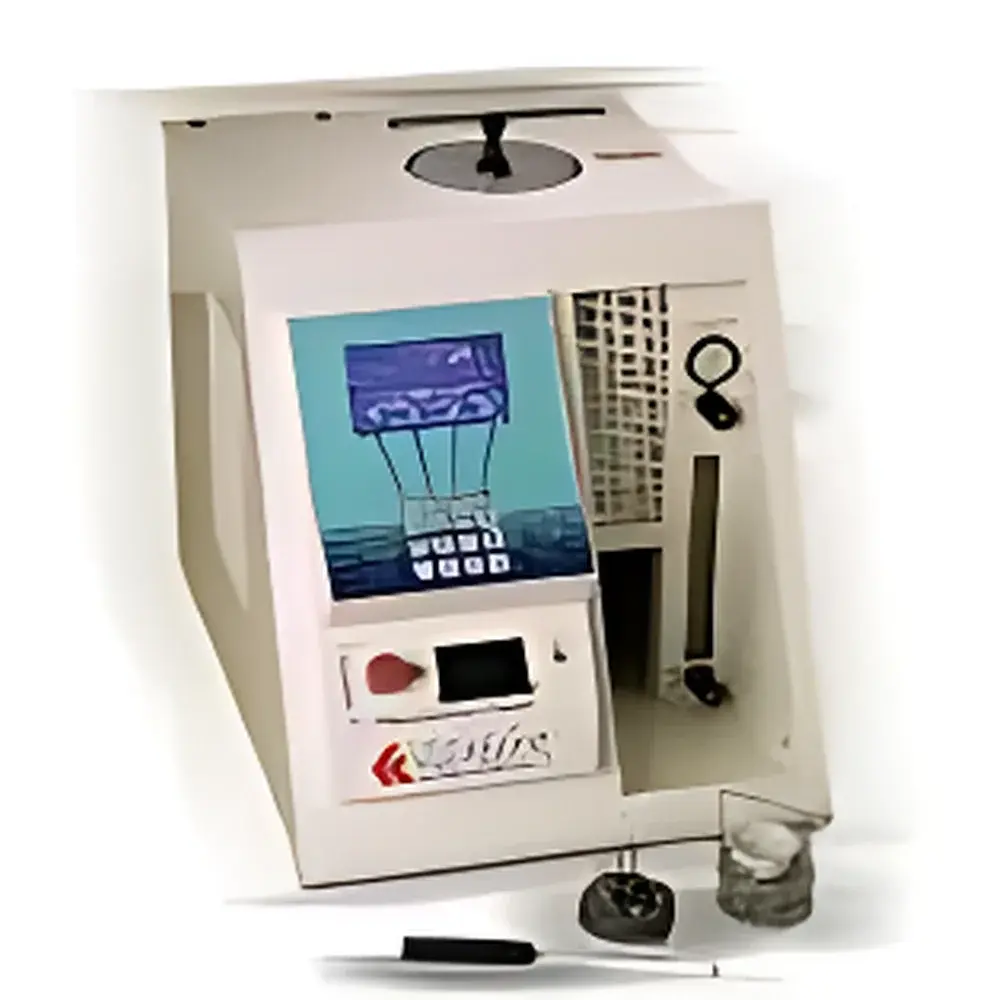
Koehler K41090 Automated Micro Carbon Residue and Ash Content Analyzer
| Brand | Koehler |
|---|---|
| Origin | USA |
| Model | K41090 |
| Standards Compliance | ASTM D4530, D482, D189 |
| Max Temperature | 800 °C |
| Data Storage | 200 test records |
| Power Supply | 230 V, 50–60 Hz |
| Dimensions | 63 × 43 × 48 cm |
| Weight | 35 kg |
| Interface | RS232 |
Overview
The Koehler K41090 Automated Micro Carbon Residue and Ash Content Analyzer is a precision thermal gravimetric instrument engineered for standardized determination of carbon residue and ash content in petroleum products and related hydrocarbon-based materials. It operates on the principle of controlled pyrolysis under inert (nitrogen) or oxidizing (air/oxygen) atmospheres, following thermogravimetric protocols defined in ASTM D4530 (micro carbon residue), ASTM D482 (ash content), and ASTM D189 (conradson carbon residue—adapted for micro-scale). The system precisely regulates heating profiles across up to four programmable temperature segments, enabling reproducible thermal decomposition of samples in crucibles within a high-stability furnace chamber. Designed for routine QC/QA laboratories in refineries, lubricant manufacturers, and independent testing facilities, the K41090 delivers trace-level residue quantification with high inter-laboratory reproducibility—critical for assessing coke-forming tendency, additive stability, and oxidation resistance of fuels, base oils, and distillates.
Key Features
- Automated dual-mode operation: seamless switching between micro carbon residue (ASTM D4530) and ash content (ASTM D482) test protocols without hardware reconfiguration
- Programmable multi-segment heating profile: supports up to four independent ramp/soak stages, with precise temperature control from ambient to 800 °C ±1 °C
- Integrated gas management system: automatic switching and flow regulation of nitrogen (for carbon residue) and air (for ash) with built-in pressure monitoring and fail-safe shutoff
- User-accessible calibration interface: password-protected access to calibration constants, sensor offsets, and diagnostic routines—fully traceable per GLP requirements
- Large backlit LCD display with intuitive icon-driven navigation: real-time temperature curve, weight loss kinetics, and status alerts displayed during run execution
- Dedicated maintenance design: modular furnace assembly, removable crucible support tray, and tool-free access to thermocouples and gas lines—minimizing downtime and technician training burden
- RS232 serial interface compliant with ASTM E1382 data formatting: enables direct integration with LIMS, ELN, or laboratory automation platforms supporting ASCII-based instrument communication
Sample Compatibility & Compliance
The K41090 accepts standard 15 mL porcelain or platinum crucibles (per ASTM D4530 Annex A1) and accommodates sample masses ranging from 0.5 to 10.0 g, depending on expected residue yield and matrix volatility. It is validated for use with distillate fuels (diesel, jet fuel), residual oils, lubricating oils, bitumens, and biofuel blends. Regulatory alignment includes full conformance to ASTM D4530 (2023), D482 (2022), and D189 (2021); IP 398 (2020); ISO 10370:2018 (petroleum products — determination of micro carbon residue); ISO 6615:2017 (petroleum products — determination of ash); and DIN 51551:2019 (crude oil and petroleum products — carbon residue). Instrument firmware and audit trail logs support 21 CFR Part 11-compliant environments when paired with validated LIMS software.
Software & Data Management
No proprietary PC software is required for basic operation—the K41090 functions as a fully autonomous benchtop analyzer with on-device method storage (18 user-defined methods plus two factory presets). All measurement data—including initial mass, final residue mass, % carbon residue, % ash, time-temperature-weight logs, and operator ID—are timestamped and stored locally in non-volatile memory (200-test capacity). Data export via RS232 follows fixed-field ASCII format compatible with spreadsheet import or custom parsing scripts. Optional Koehler DataLink™ middleware (sold separately) provides automated report generation (PDF/CSV), electronic signature capture, and secure database archiving aligned with ISO/IEC 17025 documentation requirements.
Applications
- Refinery process control: monitoring coking propensity of vacuum residuum and FCC feedstocks
- Lubricant formulation QA: verifying ash content compliance for low-SAPS (sulfated ash, phosphorus, sulfur) engine oils
- Fuel specification verification: certifying diesel and marine fuel against ISO 8217 residual limits
- Research on alternative fuels: evaluating thermal stability and inorganic deposit formation in biodiesel and synthetic hydrocarbons
- Contract testing laboratories: delivering accredited results for ISO/IEC 17025 scope under ASTM and ISO methodologies
FAQ
What standards does the K41090 fully support out-of-the-box?
ASTM D4530, D482, D189; IP 398; ISO 10370 and ISO 6615; DIN 51551—all verified during factory calibration and documented in the Certificate of Conformance.
Can the instrument perform both carbon residue and ash tests on the same sample?
No—carbon residue requires inert atmosphere pyrolysis; ash determination requires oxidative combustion. Separate aliquots must be used per standard requirements.
Is method validation documentation available for regulatory submissions?
Yes—Koehler provides IQ/OQ protocols, traceable calibration certificates (NIST-traceable thermocouples and analytical balances), and performance qualification reports upon request.
How is data integrity ensured during power interruption?
All active test data are written to non-volatile memory at each temperature step; interrupted runs can be resumed from the last stable soak point upon restart.
What maintenance intervals are recommended for routine operation?
Crucible cleaning after each test; furnace chamber inspection every 100 cycles; thermocouple verification annually or per 2,000 operating hours—detailed in the Maintenance Log section of the Operator Manual.




