
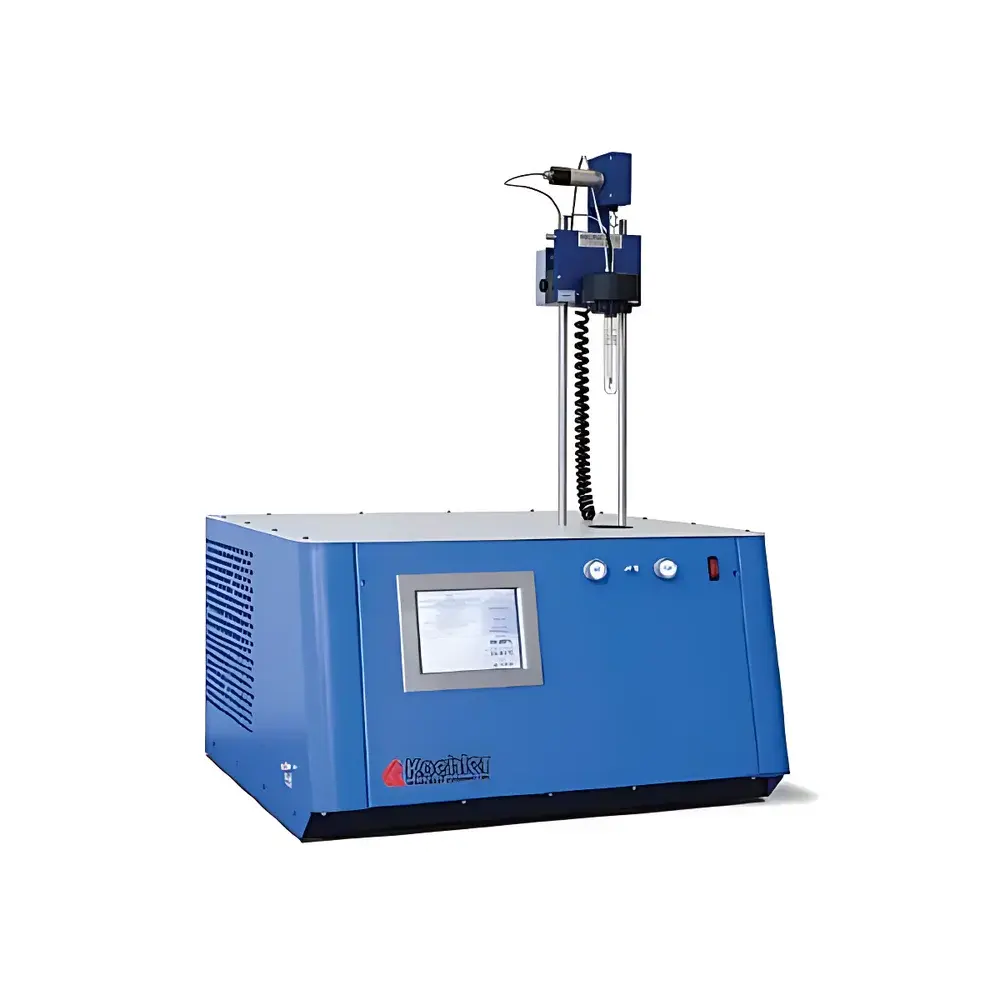
Koehler KLA-1/2/3-TS Automated Cloud Point and Pour Point Analyzer
| Brand | Koehler |
|---|---|
| Origin | USA |
| Model | KLA-1-TS / KLA-2-TS / KLA-3-TS |
| Temperature Range | +80 °C to –80 °C |
| Resolution | 0.06 °C |
| Accuracy | ±0.1 °C |
| Repeatability | Compliant with or better than ASTM D2500, D97, D5771–D5773, D5853, D5950 |
| Cooling System | Dual-stage thermoelectric (Stage 1: –40 °C |
| Stage 2 | –80 °C) |
| Display | 6.4″ TFT/LCD touchscreen (640 × 480, 262K color) |
| Data Storage | >60,000 test records in Microsoft Excel-compatible format |
| Compliance | ASTM, ISO, DIN, IP standards per model configuration |
| Sample Detection Method | Coaxial fiber-optic pulse photometry (cloud point) |
| Max. Test Heads | 6 |
| Power Supply | 220 V ±15%, 50–60 Hz |
| Dimensions | 66 × 60 × 80 cm |
| Weight | 80 kg |
Overview
The Koehler KLA-1/2/3-TS Automated Cloud Point and Pour Point Analyzer is a fully integrated, benchtop petroleum testing instrument engineered for precision, regulatory compliance, and operational autonomy in lubricating oil, diesel fuel, biodiesel blends, and base stock characterization. It employs two distinct physical measurement principles: cloud point determination via coaxial fiber-optic photometric pulse detection, and pour point assessment through controlled thermal descent combined with automated mechanical tilt sequencing and flow cessation monitoring. Unlike solvent-dependent bath systems, the KLA series utilizes solid-state thermoelectric cooling—eliminating hazardous cryogenic solvents while delivering stable, uniform temperature gradients across the full operational range of +80 °C to –80 °C. Its architecture supports single- or dual-stage cooling configurations, enabling laboratories to align hardware capability with specific ASTM, ISO, IP, and DIN method requirements without external infrastructure.
Key Features
- Integrated 6.4″ high-resolution TFT/LCD touchscreen PC with intuitive graphical interface—no external computer required
- Dual-stage thermoelectric cooling system: Stage 1 achieves –40 °C; Stage 2 extends to –80 °C in approximately 15 minutes, with uniform thermal distribution ensuring method reproducibility
- Optical cloud point detection using coaxial fiber-optic probe: emits discrete light pulses at 1 °C intervals; real-time analysis of scattered/reflected intensity enables unambiguous identification of wax crystal onset, independent of sample color or fluorescence
- Pour point determination via programmable 3 °C interval cooling steps, followed by automatic 90° bottle tilt and flow observation; final result calculated as the temperature at which no movement is detected within 5 seconds, plus 3 °C correction per ASTM D97
- Modular test head design: up to six independent analyzers can be mounted on a single chassis, supporting concurrent or staggered analysis of cloud point, pour point, cold filter plugging point (CFPP), and freezing point
- Embedded diagnostics and self-monitoring software: continuously logs sensor performance, compressor load, thermal stability, and actuator response—critical for GLP/GMP audit readiness
Sample Compatibility & Compliance
The KLA-1/2/3-TS accommodates all transparent to lightly hued petroleum distillates and lubricants—including mineral oils, synthetic esters, hydrogenated vegetable oils, and low-sulfur diesel fuels—without optical interference. Its detection methodology excludes reliance on visual inspection or subjective endpoint interpretation, thereby meeting the objectivity requirements of ASTM D2500 (cloud point) and ASTM D97 (pour point). The system is pre-configured to execute standardized test sequences aligned with multiple international specifications: KLA-1-TS covers ASTM D2500, D5771–D5773, ISO 3015, DIN 51597, and IP 219/444–446; KLA-2-TS adds ASTM D97, D5853, D5950, ISO 3016, and IP 15/441; KLA-3-TS integrates full cross-method compatibility across both domains. All firmware and calibration routines are traceable to NIST-certified reference materials, and data export formats comply with FDA 21 CFR Part 11 requirements for electronic records and signatures when paired with Koehler’s validated software package.
Software & Data Management
The onboard Windows-based operating system hosts Koehler’s proprietary analytical suite, providing real-time graphical display of temperature vs. time curves, optical signal amplitude trends, and mechanical event timestamps. Each test generates a structured metadata file containing operator ID, sample ID, method version, environmental conditions, and raw sensor outputs. Over 60,000 complete analyses—including full waveform data and annotated decision points—are retained locally in native Microsoft Excel (.xlsx) format, facilitating seamless integration into LIMS environments. Audit trail functionality records all user actions, parameter modifications, calibration events, and system alerts with timestamped, immutable entries. Optional network connectivity enables remote monitoring and centralized database synchronization—supporting multi-site quality control programs under ISO/IEC 17025 accreditation frameworks.
Applications
This analyzer serves critical roles in refinery QC labs, lubricant formulation centers, third-party testing facilities, and OEM engine development programs. Typical use cases include: verification of winter-grade diesel compliance (EN 590, ASTM D975); cold-flow performance validation of aviation turbine fuels (ASTM D1655 Annex A2); specification conformance testing of biolubricants per ISO 6743-9; batch release testing of gear oils against OEM cold-start requirements; and R&D screening of wax inhibitors and pour point depressants. Its ability to run cloud point and pour point sequentially—or in parallel across multiple heads—reduces turnaround time for comprehensive low-temperature behavior profiling, directly supporting product certification under API, ACEA, and SAE service categories.
FAQ
Does the KLA series require liquid nitrogen or refrigerant baths?
No. It uses maintenance-free thermoelectric cooling modules—eliminating solvent handling, disposal costs, and operator exposure risks.
Can the same test cell be used for both cloud point and pour point measurements?
Yes. Each test head is functionally agnostic; configuration is software-defined per ASTM method selection.
How is measurement traceability ensured?
All temperature sensors are factory-calibrated against NIST-traceable references; calibration certificates and uncertainty budgets are provided with each unit.
Is remote software update supported?
Yes—via secure HTTPS connection to Koehler’s customer portal, with version-controlled firmware and method updates compliant with IEC 62304 medical device software standards.
What safety mechanisms prevent thermal runaway or mechanical failure?
Dual-redundant thermal cutoffs, compressor overload protection, real-time pressure regulation, and audible/visual fault alerts with contextual diagnostic codes are embedded at the hardware level.




