
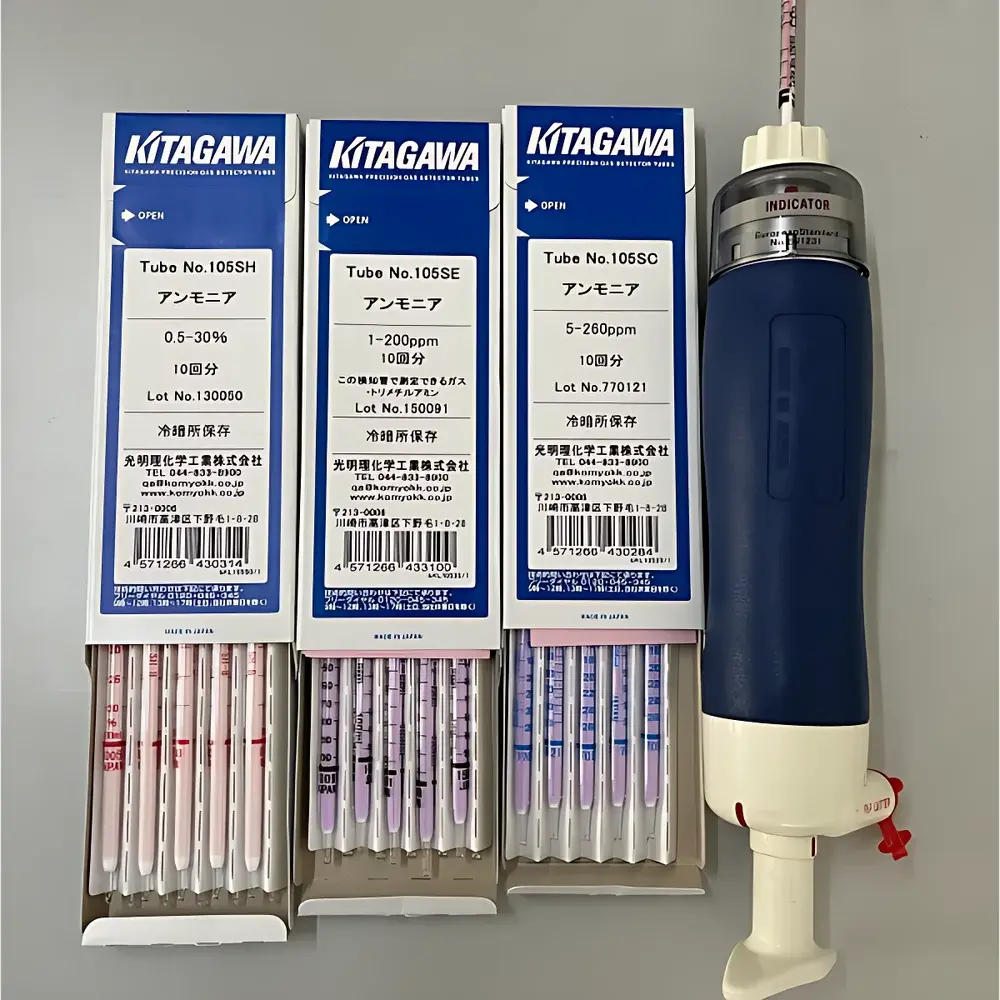
KOMYO RIKAGAKU Kita-Kawa Style Acetonitrile / Acrylonitrile Gas Detection Tubes
| Brand | KOMYO RIKAGAKU |
|---|---|
| Origin | Japan |
| Model Numbers | 128SA, 128SB, 128SC, 128SD |
| Detection Principle | Colorimetric Reaction with Pre-Loaded Reagent |
| Measurement Range | Multiple Scales (Typical Ranges: 0.5–50 ppm for Acetonitrile |
| Accuracy | ±25% of Full Scale (Per JIS K 0321 & ISO 8573-5) |
| Tube Length | 100 mm |
| Inner Diameter | 4.0 mm |
| Shelf Life | 24 months from manufacture date (unopened, stored at ≤30°C, dry, dark) |
| Required Pump | AP-20 Hand-Pump (100 mL stroke volume, calibrated to ±5% accuracy) |
| Compliance | JIS K 0321, ISO 8573-5, OSHA Method ID-130 (for acrylonitrile), NIOSH Method 2501 (for acetonitrile) |
Overview
The KOMYO RIKAGAKU Kita-Kawa Style Acetonitrile / Acrylonitrile Gas Detection Tubes are precision-engineered colorimetric devices designed for rapid, on-site quantification of acetonitrile (CH₃CN) and acrylonitrile (C₃H₃N) vapors in ambient air or workplace atmospheres. Developed under the legacy of Dr. Kita-Kawa’s foundational work in gas detection chemistry since 1947, these tubes employ a diffusion-controlled, stoichiometric reaction between target analytes and immobilized reagents—typically palladium(II) chloride-based catalysts for acrylonitrile and copper(II) sulfate–sulfanilic acid systems for acetonitrile—resulting in discrete, linear color fronts proportional to concentration. Each tube is calibrated against gravimetrically prepared standard gas mixtures traceable to NMIJ (National Metrology Institute of Japan) reference materials. The measurement principle adheres strictly to the capillary diffusion and reaction kinetics framework defined in JIS K 0321 and ISO 8573-5, ensuring reproducibility across environmental, industrial hygiene, and emergency response settings.
Key Features
- Single-tube dual-analyte capability: Models 128SA (acetonitrile), 128SB (acrylonitrile), 128SC (dual-scale acetonitrile), and 128SD (dual-scale acrylonitrile) provide optimized sensitivity for distinct exposure thresholds (e.g., OELs per ACGIH TLV® and EU-OEL).
- Pre-calibrated linear color scales with engraved glass graduations—readable without magnification—enabling direct visual interpretation within ±25% full-scale accuracy under controlled temperature (15–30°C) and humidity (<80% RH).
- Robust borosilicate glass construction (100 mm × 4.0 mm OD) with hermetically sealed ends, certified for transport under UN 3314 (Class 6.1, Packing Group III) and compliant with IATA/IMDG hazardous material handling protocols.
- Integrated lot-specific calibration certificates supplied with each box of 10 tubes, including batch number, expiration date, reference method documentation, and uncertainty budget per ISO/IEC 17025 requirements.
- Full compatibility with the AP-20 dual-stroke hand pump (100 mL ±5% volumetric accuracy), featuring ergonomic lever action, built-in stroke counter, and leak-tested sealing mechanism meeting ASTM D5403 specifications.
Sample Compatibility & Compliance
These detection tubes are validated for use in undiluted ambient air, indoor workplace sampling (personal and area monitoring), confined space entry verification, and post-spill vapor screening. Interference testing confirms minimal cross-sensitivity to common co-contaminants including acetone, methanol, ethyl acetate, and hydrogen cyanide (<5% signal deviation at 10× threshold concentrations). All models comply with Japanese Industrial Standards JIS K 0321 (Gas detection tubes — General rules), ISO 8573-5 (Compressed air — Part 5: Test methods for oil vapor and organic solvents), and align with analytical validation criteria outlined in OSHA Instruction CPL 2-2.69 and NIOSH Manual of Analytical Methods (NMAM) Chapters 2501 and 130. Certificates of Conformance include traceability statements to national standards and are auditable under GLP frameworks.
Software & Data Management
While inherently analog, the Kita-Kawa system supports digital integration via optional accessories: the AP-20 pump may be paired with the KOMYO Digital Reader DR-100 (sold separately), which captures high-resolution tube images, applies AI-assisted color-front recognition, and exports CSV/Excel reports with timestamp, operator ID, location metadata, and audit trail logs compliant with FDA 21 CFR Part 11 Annex 11 requirements. Calibration data and usage history are synchronized to cloud-based EHS platforms (e.g., Intelex, ETQ Reliance) through secure REST API endpoints. All firmware and software updates undergo rigorous version control and are validated per IEC 62304 for medical-device-grade reliability.
Applications
- Emergency response: Rapid assessment of acrylonitrile leaks during chemical transportation incidents or reactor over-pressurization events.
- Pharmaceutical manufacturing: Verification of residual acetonitrile in lyophilized product chambers and solvent recovery lines per ICH Q3C guidelines.
- Acrylic fiber production: Routine monitoring of acrylonitrile monomer exposure near polymerization reactors and spinning baths.
- Environmental site assessment: Screening of soil vapor intrusion pathways at brownfield sites contaminated with nitrile-based solvents.
- Regulatory compliance: Documentation of short-term exposure limit (STEL) and time-weighted average (TWA) adherence during OSHA or HSE inspections.
FAQ
What is the shelf life of unopened Kita-Kawa detection tubes?
Unopened tubes retain calibration integrity for 24 months from the date of manufacture when stored at ≤30°C in dry, light-protected conditions. Lot-specific expiration dates are laser-etched on each tube and printed on the packaging.
Can these tubes be used in high-humidity environments?
Yes—performance remains stable up to 80% relative humidity; above this level, pre-conditioning with a silica-gel desiccant cartridge (optional accessory) is recommended to minimize water vapor interference.
Is the AP-20 pump required, or can other pumps be substituted?
Only the AP-20 (or its certified equivalents listed in KOMYO Technical Bulletin TB-AP20-Rev.4) ensures precise 100 mL draw volume and consistent flow rate (100 mL/10 s), which is essential for kinetic reaction fidelity and scale linearity.
Do these tubes meet GLP or GMP documentation requirements?
Yes—each box includes a Certificate of Analysis with metrological traceability, and digital reporting via DR-100 provides full ALCOA+ compliant audit trails (Attributable, Legible, Contemporaneous, Original, Accurate, Complete, Consistent, Enduring, Available).
How are measurement uncertainties determined for these tubes?
Uncertainty budgets are derived per GUM (JCGM 100:2008) and incorporate contributions from reagent lot variability, pump volume error, observer endpoint judgment (±0.5 scale division), and environmental parameter deviations—published in the accompanying Technical Data Sheet for each model.
Related Products







