
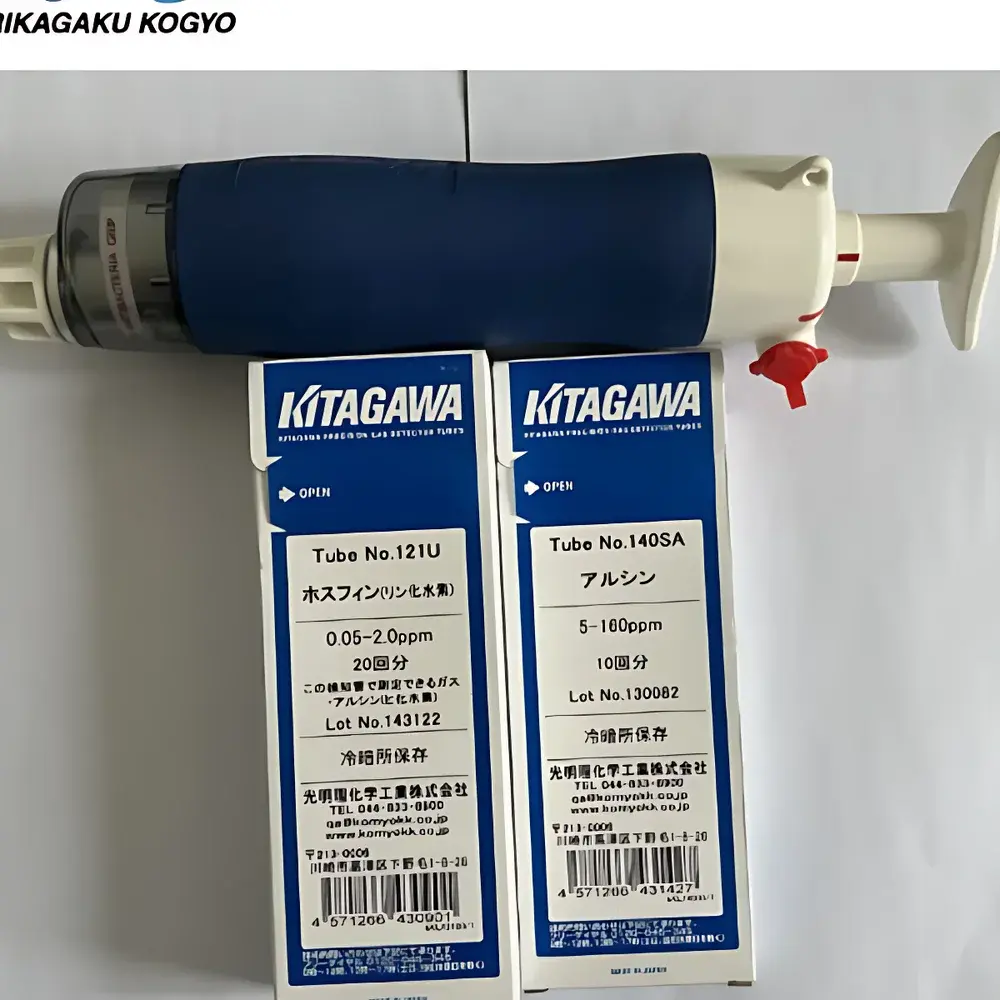
KOMYO RIKAGAKU Kitagawa-style Arsine (AsH₃) Gas Detection Tube Model 121U
| Brand | KOMYO RIKAGAKU |
|---|---|
| Origin | Japan |
| Model | 121U, 140SA |
| Detection Principle | Colorimetric Reaction with Pre-impregnated Reagent |
| Measuring Range | AsH₃ 0.2–10 ppm (typical for 121U |
| Sampling Volume | 100 mL (standard with AP-20 pump) |
| Scale Accuracy | ±25% of full scale (ISO 8573-5 compliant methodology) |
| Shelf Life | 24 months from manufacture (refrigerated storage recommended) |
| Compliance | JIS K 0321, ISO 8573-5, OSHA Z-1.1 referenced |
Overview
The KOMYO RIKAGAKU Kitagawa-style Arsine (AsH₃) Gas Detection Tube Model 121U is a precision-engineered, single-use colorimetric indicator tube designed for rapid, on-site quantification of arsine gas in ambient air or industrial process streams. Developed under the legacy of Dr. Kitagawa’s foundational work in diffusion-controlled gas detection, this tube employs a fixed-volume sampling protocol (100 mL via AP-20 hand pump) to deliver reproducible results within 90 seconds. Arsine diffuses through a calibrated porous glass frit into a reaction zone pre-loaded with lead acetate–impregnated silica gel. The formation of brown-black lead arsenide precipitate generates a sharply defined color front, whose axial progression along the printed concentration scale directly correlates to AsH₃ concentration in parts per million (ppm). This method adheres to the fundamental principles of diffusion-limited stoichiometric reaction kinetics, ensuring field-deployable reliability without electrical power or calibration gases.
Key Features
- Kitagawa-style capillary design with uniform inner diameter (2.5 mm) and thermally stabilized borosilicate glass body for consistent breakthrough timing and minimal parallax error
- Pre-calibrated linear concentration scale (0.2–10 ppm AsH₃) engraved directly onto the tube wall, traceable to NMIJ (National Metrology Institute of Japan) reference standards
- Integrated desiccant barrier prevents moisture interference—critical for arsine stability in high-humidity environments (RH ≤ 90%)
- Batch-specific expiration date and lot number laser-etched for full traceability under ISO/IEC 17025 laboratory quality systems
- Compatible exclusively with KOMYO AP-20 dual-stroke piston pump (certified at ±5% volume delivery per stroke per JIS B 7952)
Sample Compatibility & Compliance
The 121U tube is validated for use in clean, non-condensing air matrices at temperatures between 5–40°C and atmospheric pressure ±10 kPa. It is not suitable for sampling in corrosive atmospheres (e.g., Cl₂, H₂S >5 ppm), particulate-laden streams (>1 mg/m³), or saturated vapor conditions. Performance meets JIS K 0321:2019 “Method for Determination of Toxic Gases Using Indicator Tubes” and aligns with ISO 8573-5:2010 Annex C for qualitative/semi-quantitative compressed air contaminant screening. While not intended for regulatory compliance reporting per OSHA 29 CFR 1910.1200 or EU REACH Annex XVII, it serves as a primary triage tool in emergency response protocols aligned with NFPA 472 and IEC 61511 SIL-1 functional safety requirements.
Software & Data Management
As a passive, analog measurement device, the 121U requires no firmware, drivers, or software integration. All data acquisition is manual: users record observed color front position, ambient temperature/pressure, pump stroke count, and lot number in field logbooks or LIMS-compatible paper forms (e.g., ASTM E2714-compliant templates). For digital workflows, KOMYO provides PDF-based calibration certificates (NIST-traceable where applicable) and batch-specific uncertainty budgets upon request—supporting GLP audit trails when archived with raw field sheets. No electronic data interchange (EDI) or FDA 21 CFR Part 11 electronic signature capability is provided, consistent with ISO/IEC 17025 Clause 7.5.2 for manual methods.
Applications
- Routine leak checks in semiconductor fabrication facilities during GaAs wafer processing
- Emergency response verification following suspected arsine release in metallurgical refining zones (e.g., copper smelting off-gas lines)
- Confined space entry pre-screening in wastewater treatment plants where arsenic-contaminated sludge may generate AsH₃ under anaerobic conditions
- Verification of abatement system efficiency downstream of thermal oxidizers handling arsenic-bearing feedstocks
- Educational demonstrations of stoichiometric gas-solid reaction kinetics in university analytical chemistry laboratories
FAQ
What is the shelf life of Model 121U, and how should it be stored?
Unopened tubes retain accuracy for 24 months from date of manufacture when stored at 2–8°C in original aluminum pouches. Exposure to ambient light or temperatures >30°C accelerates reagent degradation.
Can Model 121U be used for continuous monitoring?
No. It is strictly a discrete, single-sample measurement device. Continuous arsine monitoring requires electrochemical sensors or FTIR-based fixed systems compliant with IEC 60079-29-1.
Does this tube cross-react with phosphine (PH₃)?
Yes—lead acetate reacts similarly with PH₃, producing analogous discoloration. Confirmatory analysis via GC-MS or ICP-MS is required if phosphine co-presence is suspected.
Is training required to achieve acceptable inter-operator precision?
Yes. Per ISO/IEC 17025 Clause 6.2.5, operators must complete KOMYO-certified proficiency testing (≥90% concordance across three replicate measurements) prior to field deployment.







