
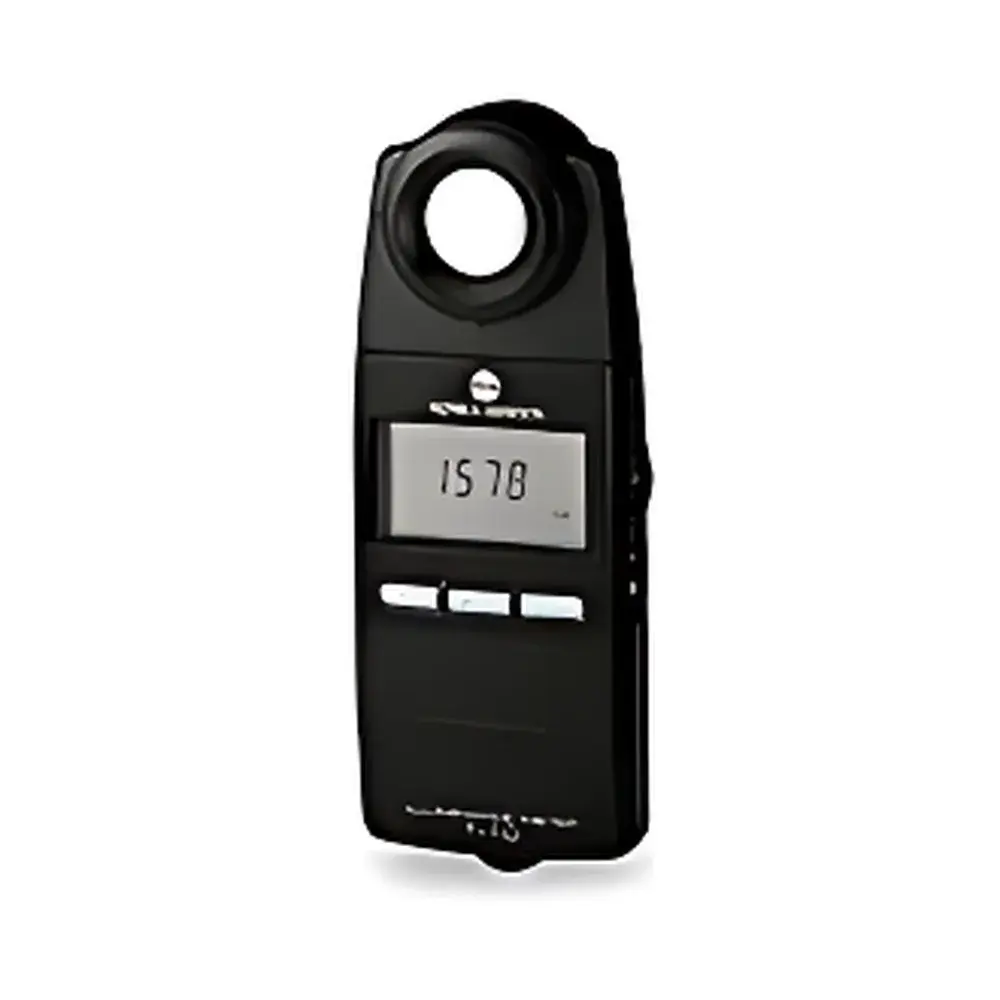
Konica Minolta T-10 / T-10M Illuminance Meter
| Brand | Konica Minolta |
|---|---|
| Origin | Japan |
| Model | T-10 / T-10M |
| Illuminance Range | 0.01–299,900 lx |
| Spectral Match | f₁′ ≤ 8% (vs. CIE V(λ)) |
| Cosine Error | ±1% at 10°, ±7% at 60°, ±25% at 80° |
| Accuracy | ±2% ±1 digit (Konica Minolta standard) |
| Output | RS-232C digital, 1 mV/digit analog |
| Display | Backlit LCD, 3–4 digits |
| Operating Temp | –10 to 40°C, RH ≤ 85% (non-condensing) |
| Power | 2× AA batteries (≥72 h continuous) |
| Dimensions (main unit) | 69 × 161.5 × 30 mm |
| Weight | 200 g (T-10), 205 g (T-10M) |
| Compliance | Designed for ISO/CIE-compliant photometric measurement in industrial, architectural, and environmental applications |
Overview
The Konica Minolta T-10 and T-10M are precision digital illuminance meters engineered for photometric compliance with CIE Publication No. 15 and ISO/CIE 19476:2014 standards. Based on silicon photodiode detection with rigorously optimized spectral response, these instruments replicate the human eye’s photopic luminous efficiency function V(λ) within an f₁′ error of ≤8%—a critical specification for traceable illuminance quantification in lighting validation, workplace safety assessment, and regulatory testing. Unlike generic light meters, the T-10 series implements a dual-path optical architecture: the T-10 uses a standard cosine-corrected sensor head (Φ16.5 mm active area) for broad-area ambient and task lighting evaluation, while the T-10M integrates a telecentric, non-reflective SLR-type optical system with a 1/3° field-of-view—enabling high-resolution spot measurements on discrete emitters such as LED chips, traffic signals, aviation beacons, and display panels. Both models operate on the fundamental principle of photometric integration: incident radiant flux is spectrally weighted by V(λ), spatially averaged via cosine correction, and converted to lux (lx) or foot-candles (fc) using calibrated responsivity coefficients traceable to NMI-level reference standards.
Key Features
- Ultra-wide dynamic range: 0.01–299,900 lx with fully automatic range switching—eliminates manual gain selection during rapid ambient transitions (e.g., daylight-to-indoor or pulsed LED testing).
- Dual-output interface: RS-232C serial port enables direct PC control and real-time data streaming; analog output (1 mV per digit, max 3 V) supports integration with chart recorders, DAQ systems, and PLC-based monitoring networks.
- True flicker-capable photometry: Synchronized sampling circuitry captures temporal variations in modulated sources (e.g., PWM-driven LEDs, fluorescent ballasts), supporting flicker index and percent flicker calculations when paired with Konica Minolta’s optional analysis software.
- Self-calibrating zero-point initialization: Automatic dark-current compensation occurs at power-on—even without the protective cap—ensuring measurement readiness within <1 second.
- Robust environmental tolerance: Rated for operation from –10°C to +40°C and up to 85% RH (non-condensing), validated for use in construction sites, greenhouse environments, tunnel maintenance, and outdoor signage verification.
- Modular expandability: Optional multi-sensor adapters allow daisy-chaining up to 16 T-10/T-10M units for spatial illuminance mapping—critical for ANSI/IES LM-79-compliant projector lumen validation and uniformity analysis across large surfaces.
Sample Compatibility & Compliance
The T-10 series is validated for use with all common artificial and natural light sources—including incandescent, halogen, fluorescent, HID, OLED, and narrowband LED spectra—provided their peak emission falls within 380–780 nm. Its f₁′ ≤ 8% spectral mismatch ensures conformance with CIE S 014-2/E:2020 and ISO/CIE 19476:2014 requirements for general illuminance measurement. Cosine correction performance (±1% at 10°, ±7% at 60°) meets IESNA RP-16-17 tolerances for horizontal plane measurements in office lighting audits and roadway illumination surveys. The instrument supports GLP-compliant workflows: user-applied CCF (Color Correction Factor) values can be stored per application, and all measurement logs include timestamp, sensor ID, and environmental metadata—facilitating FDA 21 CFR Part 11–aligned audit trails when used in pharmaceutical facility lighting qualification (e.g., ISO 14644 cleanroom illumination validation).
Software & Data Management
Konica Minolta’s proprietary T-10 Control Software (Windows-compatible, USB/RS-232) provides full remote operation, real-time graphing, and batch export to CSV or Excel formats. It enables automated measurement sequences—including time-weighted average (TWA) illuminance logging, cumulative exposure (lx·h) tracking, and statistical reporting (min/max/mean/stdev). For regulated environments, the software supports electronic signature capture, user access levels, and immutable audit logs compliant with ISO/IEC 17025:2017 clause 7.7. Raw analog outputs can be fed into third-party SCADA or LabVIEW systems for continuous environmental monitoring in smart building management or agricultural photoperiod control applications.
Applications
- Lighting design verification: Measuring horizontal/vertical illuminance in offices, hospitals, schools, and industrial facilities per EN 12464-1 and IES RP-12-19 guidelines.
- LED product development: Characterizing spatial uniformity, angular distribution, and temporal stability of luminaires and displays—especially with the T-10M’s 1/3° FOV for chip-level brightness profiling.
- Transportation infrastructure: Validating luminance and illuminance on roadways, tunnels, railway platforms, and airport runways per CIE 115 and FAA AC 150/5340-30H.
- Agricultural photobiology: Monitoring photosynthetically active radiation (PAR)-correlated illuminance in greenhouses and vertical farms where spectral quality impacts plant morphology.
- Regulatory compliance: Supporting ISO 9001 lighting process controls, ISO 14001 environmental monitoring, and OSHA 1910.303(d) workplace illumination requirements.
FAQ
Does the T-10 series support calibration traceable to national metrology institutes?
Yes—the factory calibration is traceable to the National Metrological Institute of Japan (NMIJ) via Konica Minolta’s ISO/IEC 17025-accredited calibration laboratory. Certificate includes uncertainty budget per JIS Z 8402-10.
Can the T-10M measure luminance (cd/m²) directly?
No—it measures illuminance only (lx). Luminance requires known distance and geometry; however, the T-10M’s narrow FOV enables accurate inverse-square law estimation when used with fixed-mount fixtures.
Is underwater measurement possible?
The sensor head is IP67-rated when used with optional waterproof housing (sold separately); the main unit remains external and must be operated above water.
How does the auto-zero function handle ambient infrared interference?
The photodiode incorporates an integrated IR-blocking filter aligned to the CIE V(λ) curve; zeroing compensates only for thermal drift and dark current—not broadband IR radiation.
What is the maximum cable length supported for multi-sensor configurations?
Up to 100 m per segment using shielded RS-485 repeaters (not included); standard 1-m cables ship with each unit.




