
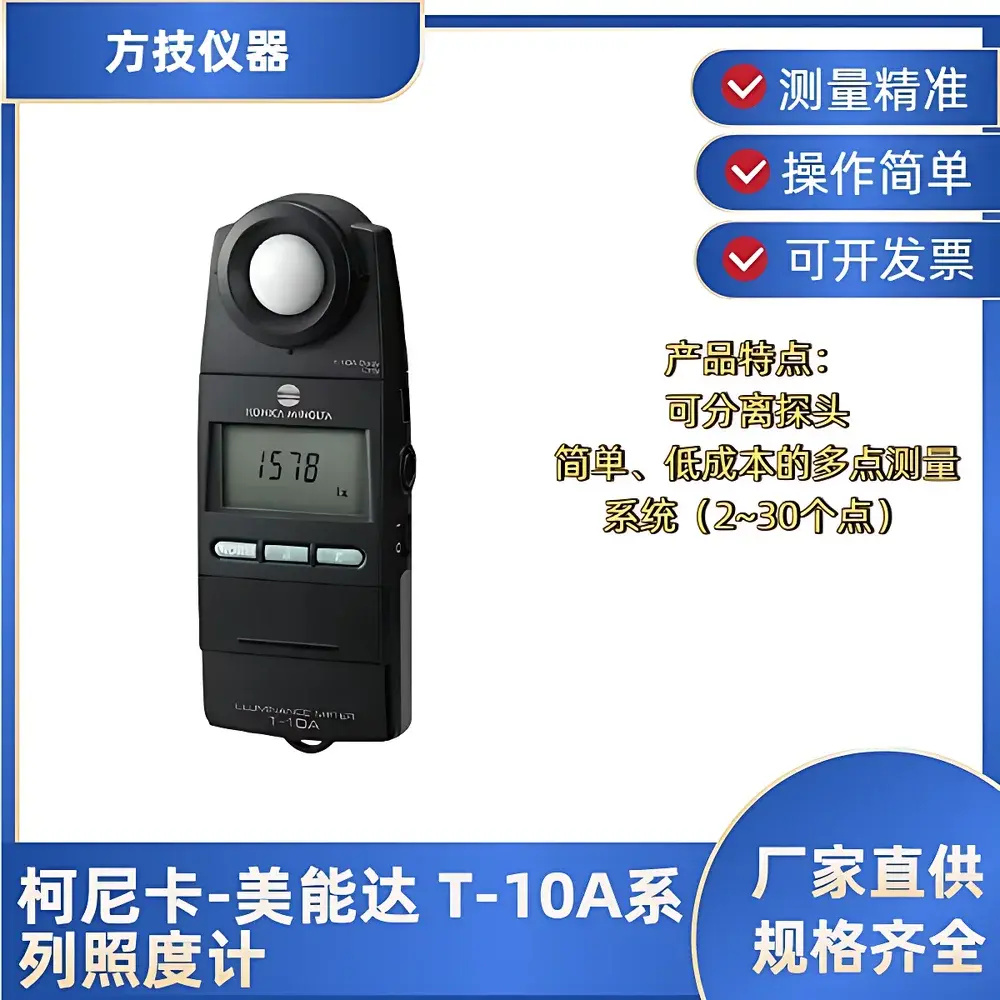
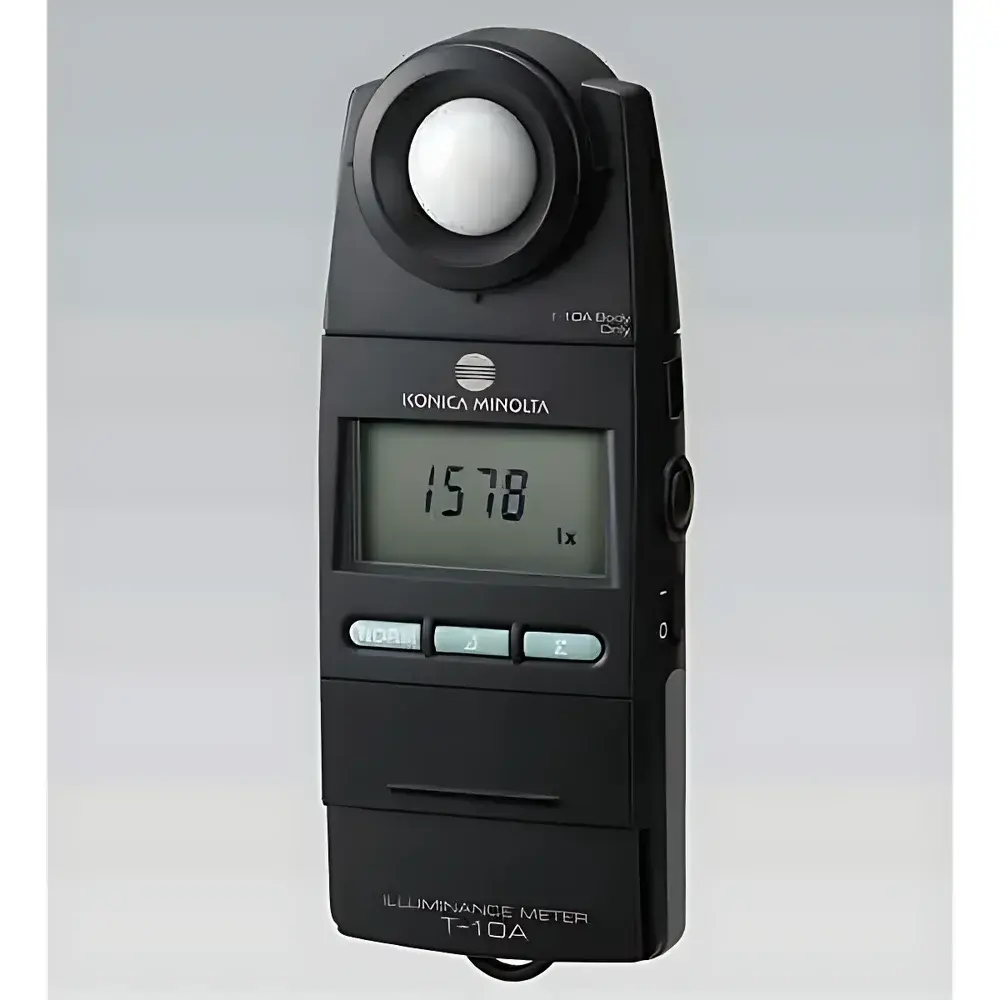
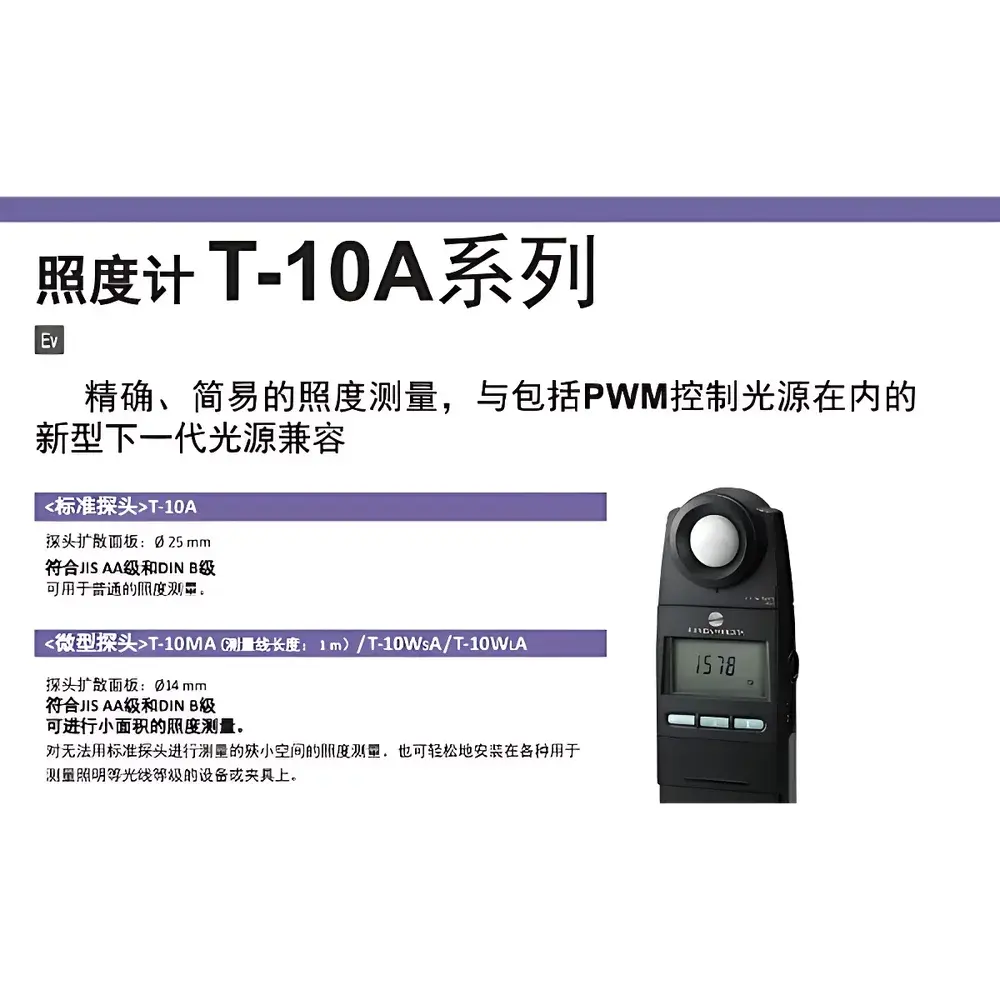
Konica Minolta T-10A Series Handheld High-Precision Illuminance Meter
| Brand | Konica Minolta |
|---|---|
| Origin | Japan |
| Manufacturer Type | Authorized Distributor |
| Product Origin | Imported |
| Model | Konica Minolta T-10A Series Handheld High-Precision Illuminance Meter |
| Price | USD 980 (FOB Yokohama) |
| Compliance | JIS C 1609-1:2006 Class AA |
| Measurement Range | 0.1–299,900 lx (typical, dependent on probe configuration) |
| Spectral Response | f1' ≤ 3.0% (JIS AA-compliant) |
| Cosine Correction Error | ≤ ±2% (up to 75° incidence) |
| Sampling Rate | 10 Hz (standard), configurable up to 100 Hz for PWM analysis |
| Probe Connectivity | Detachable via shielded LAN cable (IEC 61000-4-3 compliant interface) |
| Multi-point Capability | 2–30 independent measurement points (synchronized acquisition) |
Overview
The Konica Minolta T-10A Series is a handheld, high-precision illuminance meter engineered for photometric traceability and metrological integrity in industrial, architectural, and R&D lighting applications. It operates on the fundamental principle of silicon photodiode-based photometric detection, calibrated against NMI-traceable standard lamps and optimized with a multi-layer interference filter and precision cosine diffuser to achieve JIS C 1609-1:2006 Class AA and DIN 5032-7 Class B compliance. Unlike conventional illuminance meters limited by slow response time and poor temporal resolution, the T-10A Series incorporates a high-speed analog front-end and synchronized digital sampling architecture capable of resolving pulse-width modulated (PWM) light sources—such as modern white LEDs, OLED panels, and dimmable smart luminaires—without aliasing or integration error. Its design prioritizes field-deployable accuracy over laboratory-grade convenience, enabling reliable measurements under real-world conditions including variable ambient temperature (5–40 °C), non-uniform angular incidence, and dynamic luminous flux profiles.
Key Features
- Class AA photometric accuracy per JIS C 1609-1:2006 and Class B per DIN 5032-7—validated via third-party calibration reports traceable to NMIJ (National Metrology Institute of Japan)
- Detachable probe architecture with shielded LAN interface (up to 30 m cable length), enabling flexible integration into fixed-mount inspection systems or spatial mapping rigs
- Real-time PWM-compatible measurement mode with user-selectable sampling rates (10–100 Hz) and adjustable integration windows to capture duty cycle, frequency, and flicker metrics (supplementary to illuminance)
- Multi-point synchronized acquisition across 2–30 spatially distributed probes—each probe independently calibrated and timestamped with microsecond-level synchronization
- Robust mechanical design: IP50-rated housing, magnesium alloy probe body, and anti-reflective diffuser surface resistant to UV degradation and mechanical abrasion
- Built-in memory (16 MB) supporting CSV export of time-stamped illuminance logs, plus USB-C host interface for direct data transfer to PC or external storage
Sample Compatibility & Compliance
The T-10A Series is validated for use with all common artificial light sources encountered in quality control and environmental assessment workflows—including tungsten-halogen, fluorescent, HID, and solid-state lighting (SSL) technologies. Its spectral responsivity curve (f1′ ≤ 3.0%) ensures minimal deviation from the CIE photopic luminosity function V(λ), critical for evaluating white LED systems with elevated blue emission. The instrument meets requirements for routine photometric verification under ISO/CIE 19476 (LED lamp testing), IEC 62612 (self-ballasted LED lamps), and EN 12464-1 (lighting of work places). For regulated environments, it supports GLP-compliant operation through audit-trail-enabled firmware (v3.2+), including operator ID logging, calibration certificate reference embedding, and tamper-evident file hashing.
Software & Data Management
Konica Minolta’s proprietary T-10 Manager software (Windows 10/11, 64-bit) provides full instrument control, multi-probe configuration, and post-acquisition spatial visualization. It enables contour mapping of illuminance distributions (e.g., projector uniformity, streetlight pole spacing validation), statistical reporting (min/max/mean/std dev per point), and automated pass/fail evaluation against user-defined thresholds. Raw data exports comply with ASTM E308-22 Annex A3 formatting conventions and include embedded metadata: probe serial numbers, calibration expiration dates, ambient temperature, and GPS coordinates (when connected via optional Bluetooth GNSS module). All exported files are digitally signed using SHA-256 and support FDA 21 CFR Part 11–compliant electronic signatures when deployed with enterprise authentication servers.
Applications
- Architectural lighting validation: measuring horizontal/vertical illuminance across façades, atriums, and circulation zones per EN 12464-1 and LEED v4.1 credit IEQc8.1
- Projection system homogeneity testing: 5–25 point grid measurements to quantify ANSI lumen distribution and uniformity ratio (U2 = Emin/Eavg)
- Streetlight commissioning and maintenance: multi-pole comparative analysis for luminance consistency and dark-sky compliance (IDA/IES RP-8)
- LED manufacturing QA: batch verification of luminous flux stability under PWM dimming protocols (0.1–10 kHz range)
- Photobiological safety screening: supplemental illuminance input for IEC/TR 62778-based blue-light hazard assessments
- Educational photometry labs: student-accessible interface with guided measurement workflows and NIST-traceable uncertainty budgets
FAQ
Does the T-10A Series support calibration traceability to international standards?
Yes—each unit ships with a factory calibration certificate traceable to NMIJ Standard Lamp SL-2000, with uncertainty budgets reported per ISO/IEC 17025:2017 Annex A.3.
Can the detachable probe be used in high-temperature environments?
The probe is rated for continuous operation at 5–40 °C; extended exposure above 40 °C requires active thermal shielding and recalibration verification.
Is multi-point synchronization hardware-based or software-dependent?
Synchronization is implemented via hardware-triggered LAN packet timing (IEEE 1588 PTP profile), ensuring sub-millisecond inter-probe skew regardless of host PC latency.
How frequently must the instrument be recalibrated?
Annual recalibration is recommended for ISO/IEC 17025 compliance; Konica Minolta offers accredited recalibration services with turnaround ≤ 5 business days.
Does the T-10A Series measure flicker metrics (e.g., SVM, percent flicker)?
While illuminance is its primary photometric quantity, time-resolved waveform capture enables post-processing calculation of IEEE 1789-2015 flicker parameters when used with T-10 Manager v4.1+.





