
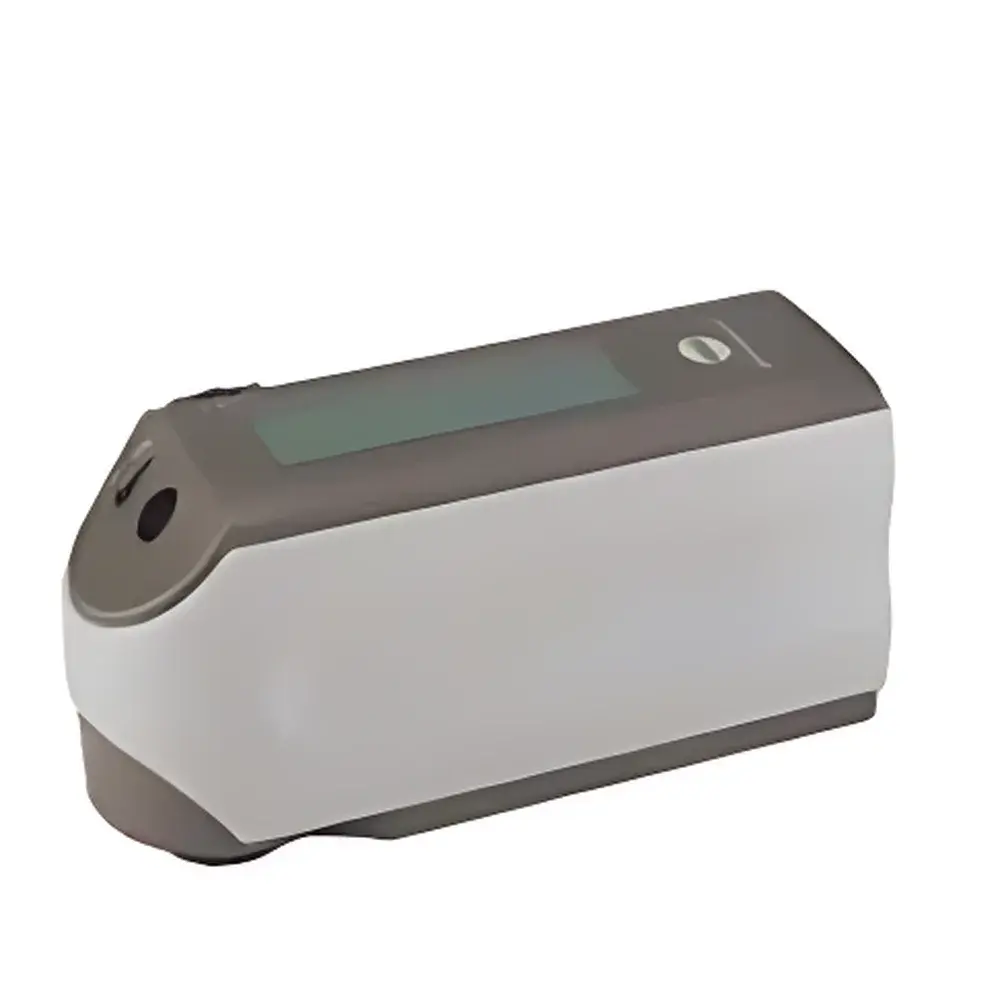
Konica Minolta CM-2300d Portable Spectrophotometer
| Brand | Konica Minolta |
|---|---|
| Origin | Japan |
| Model | CM-2300d |
| Instrument Type | Portable |
| Optical Geometry | 0/45° integrating sphere |
| Light Source | Dual pulsed xenon lamps |
| Spectral Range | 360 nm to 740 nm |
| Wavelength Interval | 10 nm |
| Spectral Bandwidth | ~10 nm |
| Reflectance Range | 0–175% |
| Display Resolution | 0.01% |
| Measurement Time | ~1.5 s (SCI & SCE simultaneously) |
| Repeatability | ΔE*ab ≤ 0.08 (after white calibration, 30 measurements at 10 s intervals) |
| Inter-instrument Agreement | ΔE*ab ≤ 0.4 (SCI, based on BCRA Series II standards) |
| Measuring/Aperture Area | Ø8 mm / Ø11 mm |
| Weight | 670 g (without batteries) |
| Data Storage Capacity | 1,700 sets (each set includes paired SCI/SCE data) |
| Compliance | CIE No. 15, ISO 7724-1, ASTM E1164, DIN 5033 Teil 7, JIS Z8722 Condition C |
Overview
The Konica Minolta CM-2300d is a portable, high-precision spectrophotometer engineered for industrial color measurement and quality control in production and laboratory environments. It operates on the principle of diffraction-grating-based spectral separation, capturing full reflectance spectra across the visible range (360–740 nm) at 10 nm intervals. Its dual-pulsed xenon lamp illumination ensures stable, flash-based excitation—eliminating thermal drift and enabling consistent measurement under variable ambient lighting. The instrument employs a 0/45° optical geometry with an integrated 52 mm diameter integrating sphere, supporting simultaneous measurement of both Specular Component Included (SCI) and Specular Component Excluded (SCE) modes without mechanical reconfiguration. This architecture aligns with CIE, ISO, and ASTM standards for colorimetric accuracy and facilitates traceable, repeatable evaluation of surface color independent of gloss or texture variations.
Key Features
- Simultaneous SCI/SCE acquisition in under 1.5 seconds—no mode switching required, preserving spatial registration and measurement stability.
- Dual-pulsed xenon light source delivers uniform spectral power distribution and eliminates lamp aging effects common in tungsten-halogen systems.
- High-resolution silicon photodiode array (40-element dual row) coupled with precision diffraction grating enables robust spectral fidelity and low signal-to-noise ratio.
- Integrated illuminated viewfinder with crosshair targeting allows precise positioning on irregular, curved, or textured surfaces—even in low-light conditions.
- Compact ergonomic design (69 × 96 × 193 mm; 670 g without batteries) optimized for handheld operation across factory floors, R&D labs, and field inspections.
- Onboard storage for up to 1,700 measurement sets (each containing matched SCI/SCE spectral and tristimulus data), with timestamping and user-defined sample IDs.
- Real-time relative gloss index display derived from 60° specular reflectance estimation—supporting concurrent assessment of color and surface appearance.
Sample Compatibility & Compliance
The CM-2300d is validated for non-destructive color evaluation of diverse substrates including molded plastics, automotive coatings, textiles, leather, printed media, pharmaceutical tablets, cosmetics, food packaging, and architectural materials. Its Ø8 mm measuring aperture accommodates fine-detail features, while the Ø11 mm illuminating area ensures representative sampling of heterogeneous surfaces. All optical and metrological performance complies with international standards: CIE Publication No. 15 (2004), ISO 7724-1:1984 (colorimetry), ASTM E1164-22 (standard practice for reflectance factor measurement), DIN 5033 Teil 7 (1984), and JIS Z8722 Condition C (2012). Instrument inter-unit agreement (ΔE*ab ≤ 0.4) meets GLP-aligned requirements for multi-site color consistency audits. Calibration traceability is maintained via NIST-traceable white reference tile (CM-A145) and optional zero-calibration box (CM-A32).
Software & Data Management
Data export and advanced analysis are supported by SpectraMagic NX software (CM-S100w), a Windows-based application compliant with FDA 21 CFR Part 11 for electronic records and signatures. The software provides audit trail logging, user access control, version-controlled method templates, and automated report generation—including pass/fail evaluation against user-defined tolerances (CIEDE2000, CMC, or custom ΔL*a*b* limits). Raw spectral data (360–740 nm at 10 nm steps) can be exported in CSV or XML formats for integration into LIMS, MES, or statistical process control (SPC) platforms. RS-232C serial interface (D-sub 9-pin) enables direct connection to legacy QC workstations or programmable logic controllers (PLCs) for inline feedback loops.
Applications
This spectrophotometer serves critical roles across regulated and high-precision industries. In automotive manufacturing, it verifies paint batch consistency against master standards under both matte and glossy finish conditions. In plastics compounding, it supports pigment formulation validation and incoming raw material screening per ISO 105-A02. For pharmaceutical solid dosage forms, it quantifies tablet coating uniformity and batch-to-batch hue shift in compliance with USP and ICH Q5C guidelines. In textile dyeing, it enables shade matching across fiber types (cotton, polyester, nylon) using CIE 10° observer data and D65 illumination. Food packaging applications include verification of label ink consistency and substrate whiteness (WI ASTM E313) across production runs.
FAQ
Does the CM-2300d support GLP-compliant calibration documentation?
Yes—white calibration data, date/time stamps, operator ID, and environmental conditions (temperature/humidity) are embedded in each measurement record and retained in SpectraMagic NX audit logs.
Can the instrument measure transparent or translucent samples?
No—it is designed for opaque or semi-opaque reflective surfaces only; transmission mode is not supported.
Is spectral data export compatible with third-party color formulation software?
Yes—CSV exports contain full wavelength-by-wavelength reflectance values (31 points), compatible with industry-standard formulation engines such as X-Rite Color iMatch and Datacolor Match Textile.
What is the recommended recalibration interval for routine QC use?
Daily white calibration is advised; full system verification using BCRA Series II tiles is recommended every 30 days or after impact events.
Does the device meet IP rating requirements for industrial environments?
It carries no formal IP rating, but its sealed optical path and shock-absorbing housing provide operational reliability in typical manufacturing settings (5–40°C, ≤80% RH, non-condensing).




