
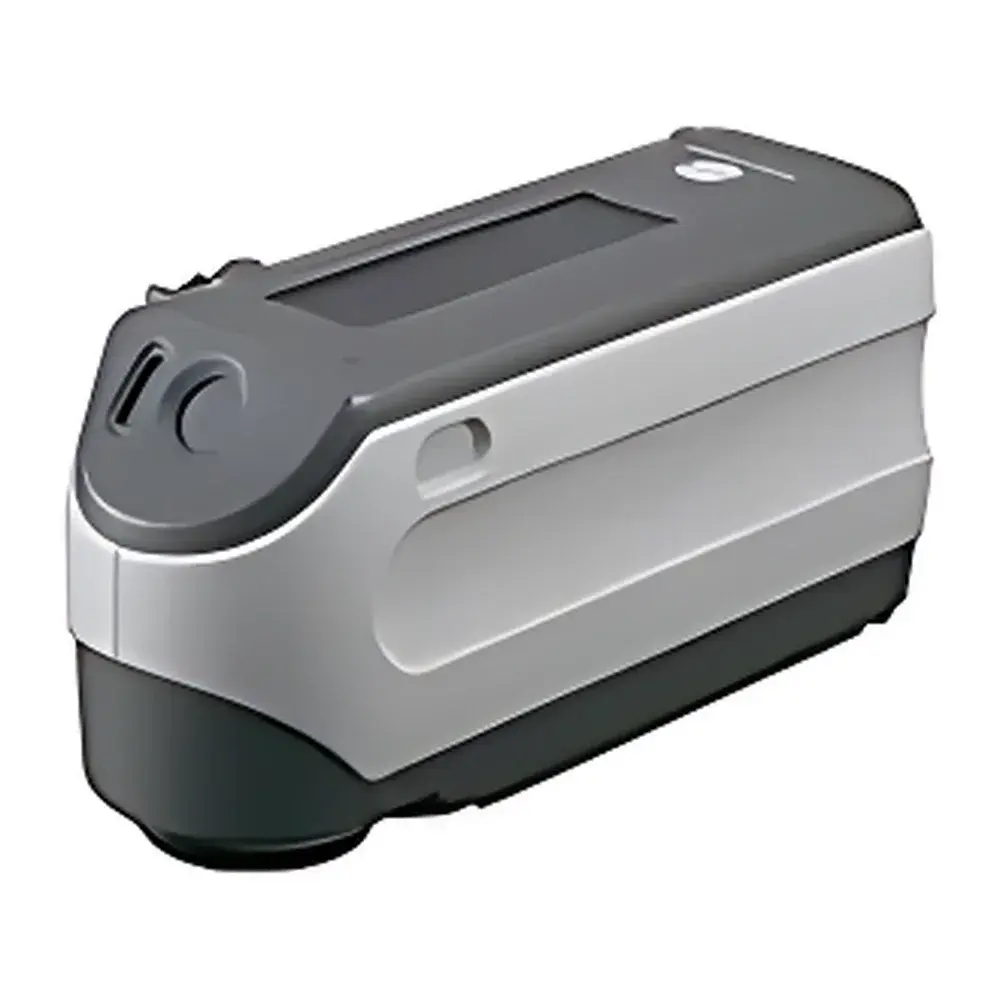
Konica Minolta CM-2500c Portable Spectrophotometer
| Brand | Konica Minolta |
|---|---|
| Origin | Japan |
| Model | CM-2500c |
| Illumination/Reception Geometry | 45°/0° (45° annular illumination, vertical reception) |
| Detector | Dual 40-element silicon photodiode arrays |
| Spectral Separation | Planar diffraction grating |
| Wavelength Range | 360–740 nm |
| Wavelength Interval | 10 nm |
| FWHM | Approx. 10 nm |
| Reflectance Range | 0–175% (resolution: 0.01%) |
| Light Source | Dual pulsed xenon lamps |
| Measurement Time | ~1.5 s |
| Minimum Measurement Interval | 4 s |
| Battery Life | ~1,000 measurements (alkaline AA, 23°C) |
| Aperture Size | 7 mm measuring / 11 mm illumination |
| Repeatability | ΔE*ab ≤ 0.05 (white calibration tile, 30 measurements at 10 s intervals) |
| Instrument Error | ΔE*ab ≤ 0.25 (BCRA Series II tiles, avg., vs. master unit, 23°C) |
| Measurement Modes | Single / auto-averaged (3/5/8 shots) |
| Interface | RS-232C |
| Observer Angles | 2° and 10° (CIE 1931 & CIE 1964) |
| Illuminants | A, C, D50, D65, F2, F6, F7, F8, F10, F11, F12 (dual-illuminant simultaneous evaluation) |
| Color Spaces | L*a*b*, L*C*h, CMC(1:1), CMC(2:1), CIE94, CIEDE2000, Yxy, XYZ, Hunter Lab, MI, WI(ASTM E313), WI(CIE), YI(ASTM E313/D1925), ISO Brightness (ISO 2470), Tint (CIE), A/T concentration |
| Data Storage | 700 measurements |
| Pass/Fail Criteria | Box or ellipse tolerance definition |
| Power Supply | 4 × AA batteries or AC adapter |
| Dimensions (W×H×D) | 69 × 96 × 193 mm |
| Weight | ~670 g (battery-free) |
| Operating Environment | 5–40°C, ≤80% RH (non-condensing at ≤35°C) |
| Storage Conditions | 0–45°C, ≤80% RH (non-condensing at ≤35°C) |
Overview
The Konica Minolta CM-2500c is a portable spectrophotometer engineered for high-precision color measurement in industrial quality control environments where geometric consistency with human visual perception is critical. It implements the CIE-recommended 45°/0° illumination/reception geometry—where light is delivered via a uniform annular ring at 45° incidence and reflected energy is collected perpendicularly—minimizing directional bias from surface texture, gloss, or microstructure. This optical configuration closely emulates how observers view flat, non-metallic samples under standard lighting conditions, making it particularly suitable for evaluating automotive interior trim, coated metal coils, printed packaging, textile substrates, and high-visibility safety apparel. Unlike diffuse/8° or d/0 instruments, the 45/0 design delivers superior inter-instrument agreement for textured or structured surfaces and avoids specular component exclusion artifacts common in sphere-based systems. The CM-2500c integrates a planar diffraction grating and dual 40-element silicon photodiode arrays to resolve spectral reflectance data across 360–740 nm at 10 nm intervals, enabling full spectral reconstruction and advanced color difference computation per ISO 11664 and CIE Publication 179.
Key Features
- 45°/0° optical geometry compliant with ASTM E308, ISO 7724-1, and JIS Z 8722 for geometrically consistent color evaluation
- Compact, ergonomic housing weighing only 670 g (battery-free), optimized for extended handheld use in lab and field settings
- Intuitive navigation interface centered on a tactile rotary encoder (“Navigation Wheel”), enabling menu traversal and parameter selection with one hand—eliminating reliance on complex button arrays
- Dual-pulsed xenon lamp system ensures stable spectral output over time, minimizing drift and supporting long-term measurement reproducibility
- 7 mm measuring aperture (11 mm illumination area) accommodates curved, recessed, or irregularly shaped samples without requiring custom fixtures
- Real-time pass/fail assessment with configurable tolerance zones—supporting both rectangular (ΔL*, Δa*, Δb*) and elliptical (CMC, CIE94, CIEDE2000) acceptability criteria
- Onboard storage for up to 700 spectral measurements with full metadata (illuminant, observer, color space, date/time)
Sample Compatibility & Compliance
The CM-2500c is validated for use across diverse material classes including injection-molded plastics, woven and nonwoven textiles, coil-coated metals, flexographic and offset-printed substrates, and pigmented polymer films. Its 45/0 geometry inherently suppresses sensitivity to surface gloss variations, enabling robust comparison of matte, semi-gloss, and satin finishes without mechanical gloss masking. The instrument conforms to key international standards governing color measurement practice: ISO 13655 (spectral measurement geometry), ISO 11664-4 (CIE colorimetric observers), ASTM D2244 (color difference calculation), and ISO 12647-2 (process control in graphic arts). While not FDA 21 CFR Part 11–certified out-of-the-box, audit-ready data export via RS-232C supports integration into GLP/GMP-compliant workflows when paired with validated third-party software platforms.
Software & Data Management
Raw spectral data and computed colorimetric values are exported via RS-232C to Konica Minolta’s proprietary SpectraMagic NX software (Windows-compatible), which provides comprehensive reporting, statistical process control (SPC) charting, batch comparison, and multi-instrument fleet calibration tracking. SpectraMagic NX supports IQ/OQ documentation templates aligned with ISO/IEC 17025 requirements and enables traceable calibration history logging—including white tile verification timestamps and deviation thresholds. Export formats include CSV, TXT, and XML for downstream integration with LIMS or MES systems. No cloud connectivity or proprietary firmware updates are required; all calibration and configuration parameters reside locally on-device, ensuring data sovereignty and operational continuity in regulated environments.
Applications
- Automotive: In-line verification of seat fabrics, dashboard polymers, door panels, and headliner materials against OEM color standards (e.g., Ford WSS-M99P1111-A, GMW14872)
- Coatings & Plastics: Monitoring batch-to-batch consistency of coil-coated steel, extruded profiles, and injection-molded housings under D65 or D50 illumination
- Packaging: Ensuring brand-color fidelity across laminated cartons, shrink sleeves, and label stocks—especially critical for Pantone Matching System (PMS) compliance
- Textiles & Apparel: Quantifying metamerism risk between dye lots under multiple illuminants (e.g., D65 vs. F11), supporting ISO 105-B02 and AATCC TM15
- Quality Auditing: Performing supplier qualification checks per ISO 9001 clause 8.6, with documented measurement uncertainty derived from repeatability studies per ISO/IEC 17025 Annex A.4
FAQ
What distinguishes 45/0 geometry from 8°/d or d/8° configurations?
The 45/0 optical arrangement eliminates the influence of specular reflection by excluding the specular component at normal incidence—making it ideal for textured or moderately glossy surfaces where visual appearance correlates strongly with this geometry. It is specified in ISO 7724-1 and widely adopted in automotive and packaging industries.
Can the CM-2500c measure transparent or translucent films?
No—it is designed exclusively for opaque, reflective samples. Transmittance measurement requires a dedicated transmission-mode spectrophotometer (e.g., CM-3600A) with integrating sphere optics.
Is the instrument compatible with modern Windows OS versions and USB-to-RS232 adapters?
Yes—SpectraMagic NX v2.90+ supports Windows 10/11; certified USB-RS232 adapters (e.g., FTDI-based) are recommended to ensure stable communication and avoid handshake failures.
How often must the white calibration tile be replaced?
Konica Minolta recommends annual verification using a traceable NIST-traceable standard; replacement is advised if measured ΔE*ab drift exceeds 0.10 relative to baseline after cleaning per instruction manual.
Does the device support user-defined color spaces or custom illuminants?
No—only pre-programmed CIE illuminants and standard color spaces are available onboard. Custom calculations require post-processing in SpectraMagic NX or third-party tools like MATLAB or Python (via exported CSV).




