
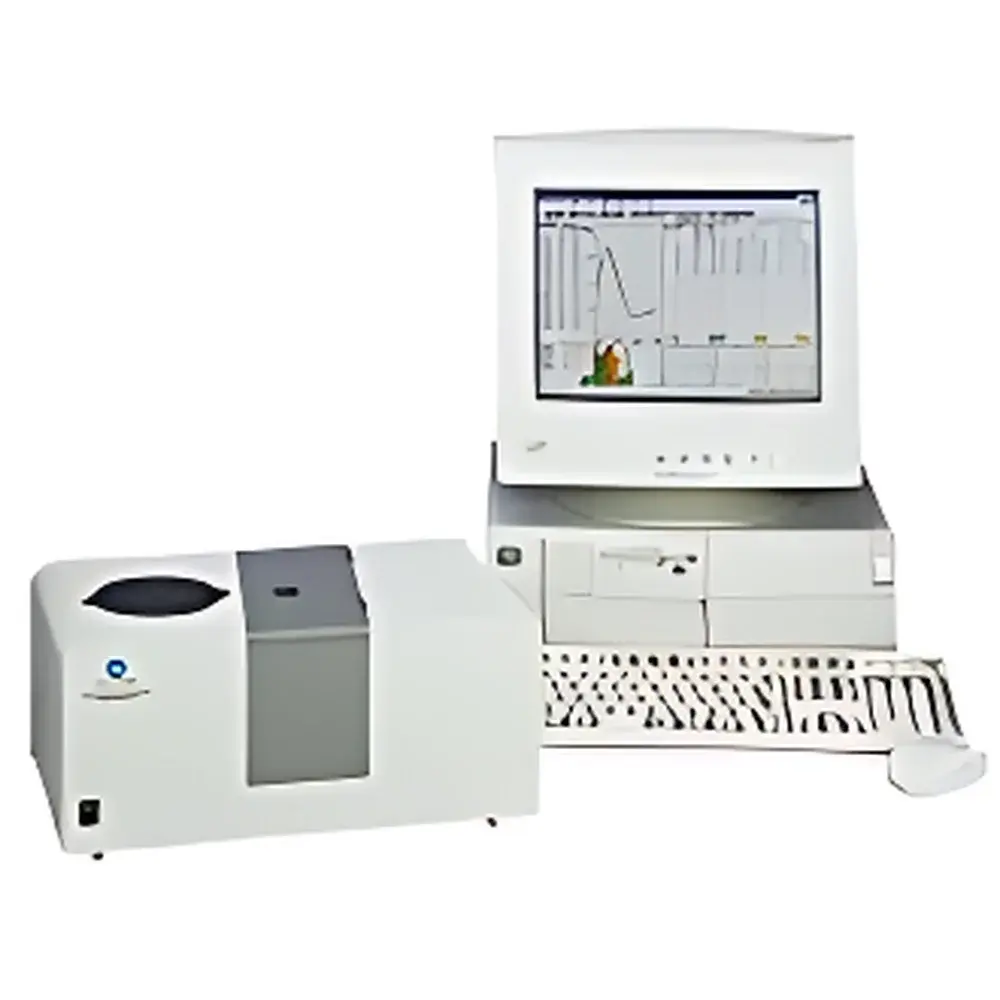
Konica Minolta CM-3500d Spectrophotometer
| Brand | Konica Minolta |
|---|---|
| Origin | Japan |
| Model | CM-3500d |
| Illumination/Reception Geometry (Reflectance) | d/8° (diffuse illumination, 8° viewing), switchable between SCI (Specular Component Included) and SCE (Specular Component Excluded) |
| Illumination/Reception Geometry (Transmittance) | d/0° (diffuse illumination, 0° viewing) |
| Detector | Dual 18-element silicon photodiode array with wedge-type continuous interference filter |
| Wavelength Range | 400–700 nm |
| Wavelength Interval | 20 nm |
| FWHM | ~20 nm (average) |
| Photometric Range | 0–175% (resolution: 0.01%) |
| Light Source | Pulsed xenon arc lamp |
| Measurement Time | Approx. 2.5 s (to data output) |
| Minimum Measurement Interval | 3 s |
| Aperture Options (Reflectance) | LAV (Φ30 mm measurement / Φ36 mm illumination), MAV (Φ8 mm measurement / Φ11 mm illumination) |
| Aperture (Transmittance) | ~Φ22 mm |
| Repeatability (after white calibration, 30 measurements at 10 s intervals on white calibration tile) | Spectral reflectance SD ≤ 0.20%, ΔE*ad ≤ 0.05 |
| Instrumental Error | ΔE*ad ≤ 0.15 (typical, BCRA Series II 12-tile average) |
| Temperature Drift | Spectral reflectance ±0.30%/°C, ΔE*ab ≤ 0.05/°C |
| Interface | RS-232C |
| Power Supply | AC 100/120/230 V, 50/60 Hz (with included AC adapter) |
| Operating Environment | 0–40°C, ≤85% RH (non-condensing at ≤35°C) |
| Storage Environment | −20–45°C, ≤85% RH (non-condensing at ≤35°C) |
| Dimensions (W × H × D) | 413 × 190 × 240 mm |
| Weight | 10 kg |
Overview
The Konica Minolta CM-3500d is a high-precision, top-viewing spectrophotometer engineered for rigorous color measurement across industrial, laboratory, and quality assurance environments. It employs a d/8° optical geometry compliant with ISO 7724-1, DIN 5033-7, CIE No. 15, and ASTM E308—ensuring traceable, internationally recognized spectral data acquisition. Its dual-mode reflectance capability (SCI/SCE) enables both material-intrinsic color evaluation (e.g., for pigment formulation or spectral database development) and appearance-relevant assessment aligned with human visual perception (e.g., for final product inspection under controlled lighting). For transparent or translucent materials—including liquids, films, and molded plastics—the instrument supports d/0° transmittance measurement using an integrated transmission chamber. The pulsed xenon arc lamp delivers stable, flash-based illumination without thermal drift, eliminating warm-up time and enabling rapid, repeatable acquisitions. With a 400–700 nm spectral range sampled at 20 nm intervals and a photometric resolution of 0.01%, the CM-3500d provides full spectral reflectance/transmittance curves suitable for advanced color difference analysis (ΔE*ab, ΔE*00), metamerism evaluation, and spectral derivative calculations.
Key Features
- d/8° Reflectance with SCI/SCE Switching: Enables separation of surface gloss effects from body color—critical for R&D validation of colorants and production-line pass/fail decisions aligned with visual standards.
- Top-Viewing Optical Design: Facilitates direct placement of solids, powders, pastes, gels, and opaque liquids onto the measurement port—eliminating sample repositioning errors common in horizontal-port instruments.
- Modular Aperture System: Standard LAV (Φ30 mm) and MAV (Φ8 mm) ports support macro- and micro-area measurements; optional Φ3 mm port accommodates small or heterogeneous samples such as textile yarns or printed dots.
- Dual-Channel Photodiode Array: Utilizes two 18-element silicon arrays with wedge-type interference filters to ensure high signal-to-noise ratio and long-term wavelength stability without mechanical grating movement.
- Transmission Chamber Integration: Dedicated d/0° path with standardized ~Φ22 mm aperture enables quantitative transmittance measurement per ISO 11664-4 and ASTM D1003, supporting QC of optical filters, packaging films, and ophthalmic lenses.
- Thermal & Temporal Stability: Engineered for ambient operation up to 40°C with documented drift compensation: ΔE*ab ≤ 0.05/°C and spectral reflectance drift ≤ ±0.30%/°C—essential for uncontrolled factory-floor deployment.
Sample Compatibility & Compliance
The CM-3500d accommodates diverse physical forms without requiring destructive preparation. Solid samples—including painted panels, injection-molded parts, and ceramic tiles—are measured directly via the top port. Powders and viscous materials (e.g., inks, adhesives, cosmetic creams) are analyzed using optional shell-type holders (CM-A125, CM-A126) that standardize packing density and surface geometry. Transparent liquids (e.g., beverages, solvents) and rigid transmissives (e.g., acrylic sheets, glass substrates) are evaluated in the transmission chamber using quartz or plastic cuvettes (CM-A97–CM-A132). All optical configurations comply with ISO/IEC 17025 requirements for measurement uncertainty estimation, and the instrument’s documented repeatability (ΔE*ad ≤ 0.05) and accuracy (ΔE*ad ≤ 0.15 vs. BCRA Series II) meet GLP and ICH Q5E color consistency thresholds for regulated industries including pharmaceuticals and medical devices.
Software & Data Management
Controlled exclusively via SpectraMagic NX software (Windows OS), the CM-3500d supports full audit-trail functionality compliant with FDA 21 CFR Part 11. Each measurement record includes timestamp, operator ID, instrument serial number, calibration status, aperture selection, geometry mode (SCI/SCE), and raw spectral data—exportable as CSV, XML, or CxF/X3 format for integration into LIMS or ERP systems. SpectraMagic NX provides statistical process control (SPC) charts, tolerance zone mapping (ellipsoidal or rectangular ΔE limits), batch comparison reports, and spectral difference overlays. Raw spectral curves may be processed using built-in CIE illuminant conversions (A, C, D50, D65, F2, etc.), observer angles (2°/10°), and color spaces (CIELAB, CIELCH, CMC, DIN99, ∆E00). Data integrity is enforced through password-protected method templates and electronic signature workflows.
Applications
- Automotive: Paint batch release verification against master standards; inter-coat color matching for multi-layer finishes.
- Plastics & Polymers: Pigment dispersion uniformity assessment; UV-stabilizer efficacy tracking via spectral shift analysis.
- Food & Beverage: Liquid transparency grading (e.g., apple juice clarity); solid food surface browning index (ΔE*ab vs. reference tiles).
- Pharmaceuticals: Coating color consistency of tablets per USP ; gelatin capsule hue verification under D65 illumination.
- Textiles & Apparel: Dye lot conformance across fiber types (cotton, polyester, nylon); metamerism screening under multiple illuminants.
- Printing & Packaging: Spot color verification (Pantone®, FOGRA), substrate-dependent ink gamut mapping, and varnish gloss/color interaction modeling.
FAQ
Does the CM-3500d support compliance with ISO 13655 for M1/M2/M3 measurement modes?
No—the CM-3500d implements fixed d/8° geometry with SCI/SCE switching only. It does not provide selectable UV component control (M0–M3) required by ISO 13655; users requiring M1 (D50 UV-enhanced) must employ a separate UV-calibrated instrument.
Can the CM-3500d measure metallic or pearlescent coatings?
It provides reliable colorimetric values (L*a*b*) but lacks gonio-spectrophotometric capability; for sparkle, graininess, or flip-flop effects, a multi-angle device (e.g., Konica Minolta CM-2600d) is recommended.
Is SpectraMagic NX validated for GxP environments?
Yes—version 2.9.0 and later include IQ/OQ documentation templates, electronic signature modules, and configurable audit logs meeting ALCOA+ principles for regulated laboratories.
What is the calibration frequency recommendation?
White calibration is required before each measurement session; zero calibration (using CM-A124) is advised daily or when ambient temperature shifts >5°C.
Are there firmware updates available for improved spectral interpolation?
Firmware v2.10 introduces optimized Savitzky-Golay smoothing for low-SNR transmittance data, reducing noise in 400–420 nm region without compromising resolution.






