
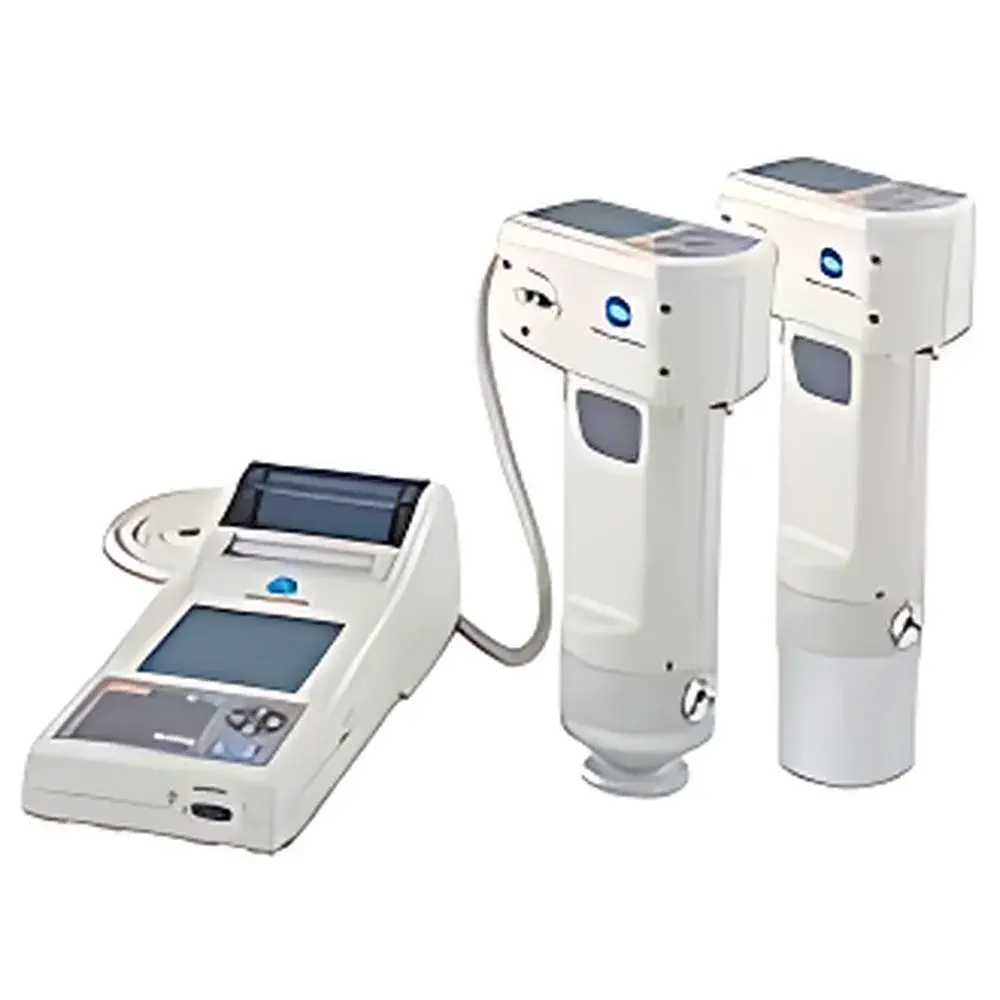
Konica Minolta CR-400/CR-410 Color Difference Meter
| Brand | Konica Minolta |
|---|---|
| Origin | Japan |
| Model | CR-400 / CR-410 |
| Illumination/Reception Geometry | d/0 (diffuse illumination, 0° viewing |
| Detector | Silicon photodiodes (6 channels) |
| Light Source | Pulsed xenon lamp |
| Measurement Time | 1 s |
| Minimum Interval Between Measurements | 3 s |
| Repeatability | ΔE*ab ≤ 0.07 (after white calibration, 30 measurements at 10 s intervals) |
| Instrument Error | ΔE*ab ≤ 0.6 (CR-400), ≤ 0.8 (CR-410) against BCRA Series II 12-color standard set |
| Aperture Size | CR-400: Ø8 mm measurement / Ø11 mm illumination |
| CR-410 | Ø50 mm measurement / Ø53 mm illumination |
| Reflectance Range | Y = 0.01–160.00% |
| Observer Angle | CIE 2° standard observer |
| Illuminants | C, D65 |
| Color Spaces | XYZ, Yxy, L*a*b*, L*C*h, CIELAB, CIELUV, CMC(l:c), CIE 1994, CIE 2000, Hunter Lab, CIE Whiteness (WI) & Yellowness (YI) per ASTM E313/D1925 (C or D65 dependent) |
| Display | Backlit dot-matrix LCD (15 × 9 characters + icon line) |
| Memory Capacity | 1000 measurements (head-only mode) |
| Interface | RS-232C (default baud rate: 9600 bps) |
| Power | 4 × AAA alkaline or Ni-MH batteries |
| Dimensions (W × H × D) | 102 × 244 × 63 mm |
| Weight | ~550 g (CR-400), ~570 g (CR-410), incl. batteries |
| Operating Environment | 0–40 °C, ≤85% RH (non-condensing) |
| Storage Environment | −20–40 °C, ≤85% RH (non-condensing) |
Overview
The Konica Minolta CR-400 and CR-410 are precision color difference meters engineered for reliable, repeatable reflectance-based color measurement in industrial quality control, R&D, and regulatory-compliant environments. Based on the d/0 optical geometry—compliant with JIS Z 8722 and aligned with ISO/CIE conventions—the instruments employ pulsed xenon illumination to eliminate thermal drift and ensure spectral stability across repeated measurements. Unlike spectrophotometers, these tristimulus colorimeters utilize six silicon photodiodes paired with interference filters to approximate CIE 1931 2° standard observer functions under C or D65 illuminants. This design prioritizes speed, robustness, and long-term calibration stability over full spectral acquisition, making them ideal for high-throughput production lines, raw material verification, pharmaceutical tablet coating assessment, food surface evaluation, and dermatological pigment analysis where absolute spectral fidelity is secondary to inter-instrument agreement and process consistency.
Key Features
- High repeatability: ΔE*ab ≤ 0.07 (CR-400) and ≤ 0.07 (CR-410) under controlled white calibration conditions—validated per ISO 13655 and ASTM E308 protocols.
- Dual-aperture configuration: CR-400 (Ø8 mm) optimized for flat, homogeneous surfaces (e.g., painted panels, plastic sheets, coated tablets); CR-410 (Ø50 mm) engineered for heterogeneous, textured, or granular samples (e.g., textiles, wood veneers, ground spices, powdered APIs) without requiring spatial averaging.
- Multi-language interface support: On-device display and key labeling configurable in English, German, French, Italian, Spanish, or Japanese—facilitating global deployment and multilingual operator training.
- Integrated data handling: Standalone operation with 1000-measurement internal memory and 100 reference color storage; expandable to 2000 measurements when paired with optional data processor units.
- Comprehensive pass/fail evaluation: Programmable tolerance limits using box-shaped or elliptical ΔE*ab boundaries, compatible with ISO 11664-4 and CIE TC 1-52 guidelines for acceptability thresholds.
- Flexible calibration architecture: 20-channel calibration system (ch00 reserved for white calibration; ch01–ch19 user-definable), supporting field recalibration against master standards without software dependency.
- Backlit high-contrast LCD with graphical capability: Real-time numeric and vector-based color difference visualization—including L*a*b* chromaticity plots and deviation arrows—enhancing on-site interpretation without PC linkage.
Sample Compatibility & Compliance
The CR-400/410 series accommodates a broad spectrum of physical sample types—from smooth metallic finishes and polymer films to coarse powders, woven fabrics, biological tissues, and irregularly shaped solids. The CR-410’s large-area aperture eliminates edge effects and spatial variance inherent in small-spot measurements, satisfying ASTM D2244 requirements for representative sampling of non-uniform substrates. Both models comply with ISO 9001 traceability frameworks and support GLP/GMP documentation workflows via SpectraMagic NX software, which provides full 21 CFR Part 11 audit trails—including user authentication, electronic signatures, and immutable measurement history logs. All factory calibrations are traceable to NIST-traceable ceramic standards, and instrument error specifications meet or exceed those required for ISO/IEC 17025-accredited color testing laboratories.
Software & Data Management
Konica Minolta’s SpectraMagic NX (CM-S100w) serves as the primary enterprise-grade software platform for advanced data analysis, report generation, and multi-instrument fleet management. It enables full compliance with FDA 21 CFR Part 11 through role-based access control, secure electronic records, and time-stamped audit trails. Users can define custom indices using XYZ, Yxy, or L*a*b* inputs—up to six unique formulas per application (e.g., textile whiteness index, pharmaceutical hue shift metric, food browning ratio). Raw measurement files export in CSV, TXT, and proprietary .smx formats, and integrate seamlessly with LIMS and MES systems via RS-232C serial protocol (4800–19200 bps). Optional CR-S4w utility software supports basic QC charting and statistical process control (SPC) for lean manufacturing environments.
Applications
- Pharmaceuticals: Tablet coating uniformity assessment per USP <1061>; excipient batch-to-batch color matching; stability-indicating color change monitoring.
- Food & Beverage: Surface color grading of fruits, meats, baked goods; shelf-life tracking of oxidation-induced hue shifts; regulatory compliance with EU Directive 2002/72/EC.
- Paints & Coatings: Batch release verification against AATCC TM173, ISO 18314-1, and SAE J1545 standards.
- Plastics & Polymers: Molding color consistency across injection cycles; pigment dispersion homogeneity validation.
- Cosmetics & Dermatology: Skin tone mapping, melanin/erythema quantification, and clinical trial endpoint measurement per ISO 8559 anthropometric guidelines.
- Building Materials: Stone, tile, and concrete finish evaluation under standardized lighting conditions per ASTM C1549.
FAQ
What is the difference between d/0 and 0/d geometry?
The CR-400/410 uses d/0 geometry—diffuse illumination with 0° viewing—which includes both diffuse and specular reflectance components. This aligns with JIS Z 8722 and is appropriate for measuring materials where gloss effects are part of the perceived color (e.g., glossy plastics, lacquered wood).
Can I use the CR-400/410 for transmission measurements?
No. These instruments are designed exclusively for reflectance-mode measurement of opaque or translucent solid surfaces. Transmission applications require dedicated transmission densitometers or spectrophotometers with integrating spheres.
Is calibration traceable to national standards?
Yes. Each unit ships with NIST-traceable ceramic calibration tiles (CR-A43/CR-A44), and Konica Minolta maintains ISO/IEC 17025 accreditation for its calibration laboratory in Yokohama, Japan.
Does the device support color difference calculation against multiple references simultaneously?
Yes—up to 100 reference colors can be stored internally, and the instrument displays ΔE*ab, ΔL*, Δa*, and Δb* values relative to any selected target in real time.
What battery life can be expected during continuous operation?
Approximately 800 measurements per full charge (Ni-MH) or set of alkaline AAA cells under typical ambient conditions (23°C, LCD backlight enabled for 30 s per measurement).



