
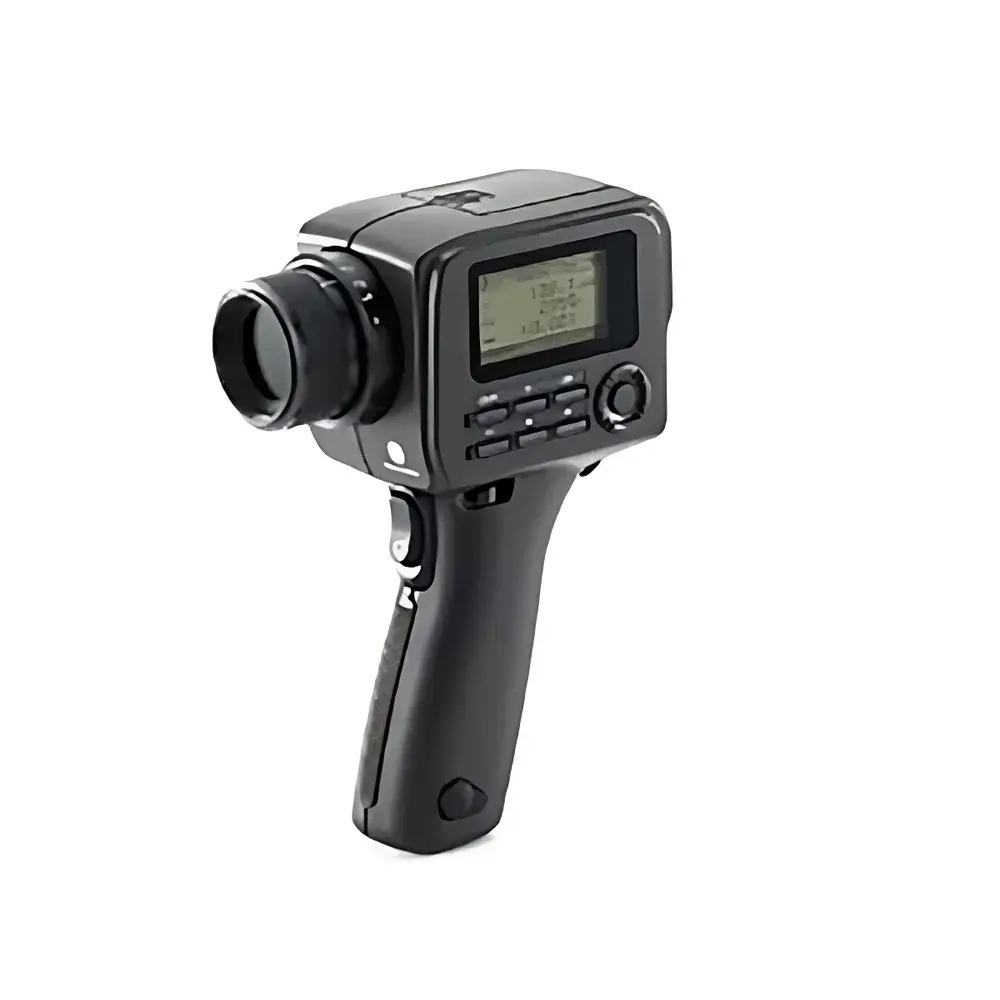
Konica Minolta CS-150/CS-160 Chroma Meter & Luminance Meter
| Brand | Konica Minolta |
|---|---|
| Origin | Japan |
| Model | CS-150 / CS-160 |
| Measurement Angle | 1° (CS-150) / 1/3° (CS-160) |
| Luminance Range | 0.01–999,900 cd/m² (CS-150) / 0.1–9,999,000 cd/m² (CS-160) |
| Colorimetric Compliance | CIE 1931 x(λ), y(λ), z(λ) tristimulus matching |
| Spectral Response Match | Optimized to CIE V(λ) photopic luminosity function |
| Minimum Measured Area | 14.4 mm Ø (CS-150, 1014 mm distance) / 4.5 mm Ø (CS-160, 213 mm) |
| Repeatability | ±0.2% +1 digit (luminance), ±0.001 (chromaticity at ≥10 cd/m²) |
| Accuracy | ±2% ±1 digit (luminance), ±0.004 (chromaticity at ≥5 cd/m²) |
| Data Storage | 1,000 measurements |
| Interface | USB 2.0 (data transfer & bus power) |
| Software | CS-S20w (included) |
| Calibration Channels | 10 user-definable reference sources |
| Operating Temp. | 0–40°C, ≤85% RH (non-condensing) |
Overview
The Konica Minolta CS-150 and CS-160 Chroma Meter & Luminance Meters are precision handheld optical instruments engineered for simultaneous, non-contact measurement of luminance (Lv) and tristimulus color values (X, Y, Z; x, y; u′, v′; λd, Pe) in a single point. Based on the fundamental principles of photometry and colorimetry, these instruments employ a single-lens reflex (SLR) optical architecture with silicon photodiodes spectrally filtered to approximate the CIE 1931 standard observer functions—specifically the x(λ), y(λ), and z(λ) color-matching functions—and the CIE V(λ) photopic luminous efficiency function. This spectral design ensures high fidelity to human visual response under photopic conditions, minimizing metamerism-related errors in both absolute luminance quantification and chromaticity evaluation. As direct successors to the CS-100A, the CS-150/CS-160 series incorporates improved sensor linearity, extended dynamic range, enhanced stray-light rejection, and refined optical alignment—enabling reliable operation across applications ranging from low-luminance OLED characterization to ultra-bright LED signage and aviation lighting compliance verification.
Key Features
- SLR optical system with parallax-free targeting: Ensures exact correspondence between viewfinder framing and actual measurement area—critical for repeatable small-spot assessment.
- High-dynamic-range photometric capability: CS-150 measures from 0.01 to 999,900 cd/m²; CS-160 extends to 9,999,000 cd/m²—supporting both dim display panels and high-intensity signal lamps without manual range switching.
- Adjustable integration time (0.7–7.1 s) and auto-exposure mode: Optimizes signal-to-noise ratio across variable illumination conditions while maintaining traceable exposure control.
- Two angular configurations: CS-150 uses a 1° field-of-view (FOV) for general-purpose spot measurement; CS-160 employs a 1/3° FOV for high-resolution targeting of micro-scale emitters (e.g., individual LED die, pixel sub-elements).
- Close-up lens compatibility (optional): Enables minimum measurable spot diameters of 1.3 mm (CS-150) and 0.4 mm (CS-160), validated per ISO/CIE metrological practice for near-field imaging.
- Onboard color difference calculation (Δx, Δy, Δu′, Δv′, ΔE*uv): Supports rapid pass/fail evaluation against user-defined reference standards—integral to QC workflows in lighting manufacturing and screen calibration.
- 10-channel user calibration: Allows instrument-to-instrument matching using customer-specific reference sources—essential for multi-station production line consistency and GLP-aligned inter-laboratory reproducibility.
Sample Compatibility & Compliance
The CS-150/CS-160 is designed for non-contact, surface-normal measurement of self-luminous and reflective targets where physical contact is impractical or prohibited—including freshly painted surfaces, sterile medical equipment, curved transportation signage, and high-temperature industrial fixtures. Its spectral response conforms to CIE Publication No. 15:2018 and ISO/CIE 11664-1:2019 for colorimetry, and its photometric calibration traceability aligns with NIST-traceable standards via Konica Minolta’s certified reference luminance sources. The instruments meet requirements for routine verification under IEC 62471 (photobiological safety), FAA AC 150/5340-30H (airport lighting), EN 12899-1 (road traffic signs), and JIS Z 8722 (color measurement methods). No internal warm-up or zeroing cycle is required, enabling immediate deployment in field audits or factory floor inspections.
Software & Data Management
The included CS-S20w software provides full instrument control, real-time data streaming, batch export (CSV, TXT), statistical analysis (mean, SD, min/max), and customizable reporting templates compliant with ISO/IEC 17025 documentation requirements. All measurement records include timestamp, instrument ID, operator ID (user-configurable), exposure parameters, and ambient temperature/humidity metadata—supporting audit-ready data integrity. USB 2.0 interface enables both data acquisition and bus-powered operation, eliminating dependency on external batteries during benchtop use. Firmware updates and configuration backups are managed directly through CS-S20w, with version history logging for regulatory traceability. The software supports 21 CFR Part 11-compliant user access controls when deployed in pharmaceutical or medical device QA environments.
Applications
- LED chip and package validation: Luminance uniformity, chromaticity binning, and spatial color shift analysis.
- Traffic, rail, and aviation signal compliance: Verification of luminance thresholds and chromaticity coordinates per ICAO Annex 14, EASA CS-ADR-DSN, and AASHTO M252.
- Display manufacturing: OLED, LCD, and microLED panel grading; black level accuracy; viewing angle consistency testing.
- Automotive interior/exterior lighting: Headlamp beam pattern homogeneity, DRL color stability, and dashboard backlight uniformity.
- Architectural lighting QA: Tunable white fixture CCT verification and lumen maintenance tracking over time.
- Academic and metrology labs: Reference source characterization, inter-instrument comparison studies, and CIE color space education modules.
FAQ
What is the difference between CS-150 and CS-160?
The CS-160 features a narrower 1/3° measurement angle versus the CS-150’s 1°, enabling higher spatial resolution and extended luminance range up to 9.999×10⁶ cd/m². Both share identical photometric accuracy, spectral matching, and software functionality.
Can the CS-150/CS-160 measure reflectance?
No—these are dedicated luminance and colorimeters for self-luminous or illuminated surfaces. Reflectance requires a separate illuminant and calibrated reference tile; use Konica Minolta CM-700d or CM-3700A for reflectance applications.
Is USB bus power sufficient for continuous operation?
Yes—USB 2.0 supplies adequate power for all operational modes, including continuous measurement and real-time data streaming, eliminating battery drain during extended lab sessions.
How is instrument-to-instrument variability minimized?
Through 10-channel user calibration against common reference sources and adherence to Konica Minolta’s inter-unit consistency protocol—validated per ISO 5-4:2022 for colorimetric instruments.
Does the CS-S20w software support automated report generation for ISO 17025 accreditation?
Yes—customizable report templates include configurable headers, measurement uncertainty statements (per GUM), operator signatures, and electronic audit trails compatible with accredited laboratory quality management systems.





