
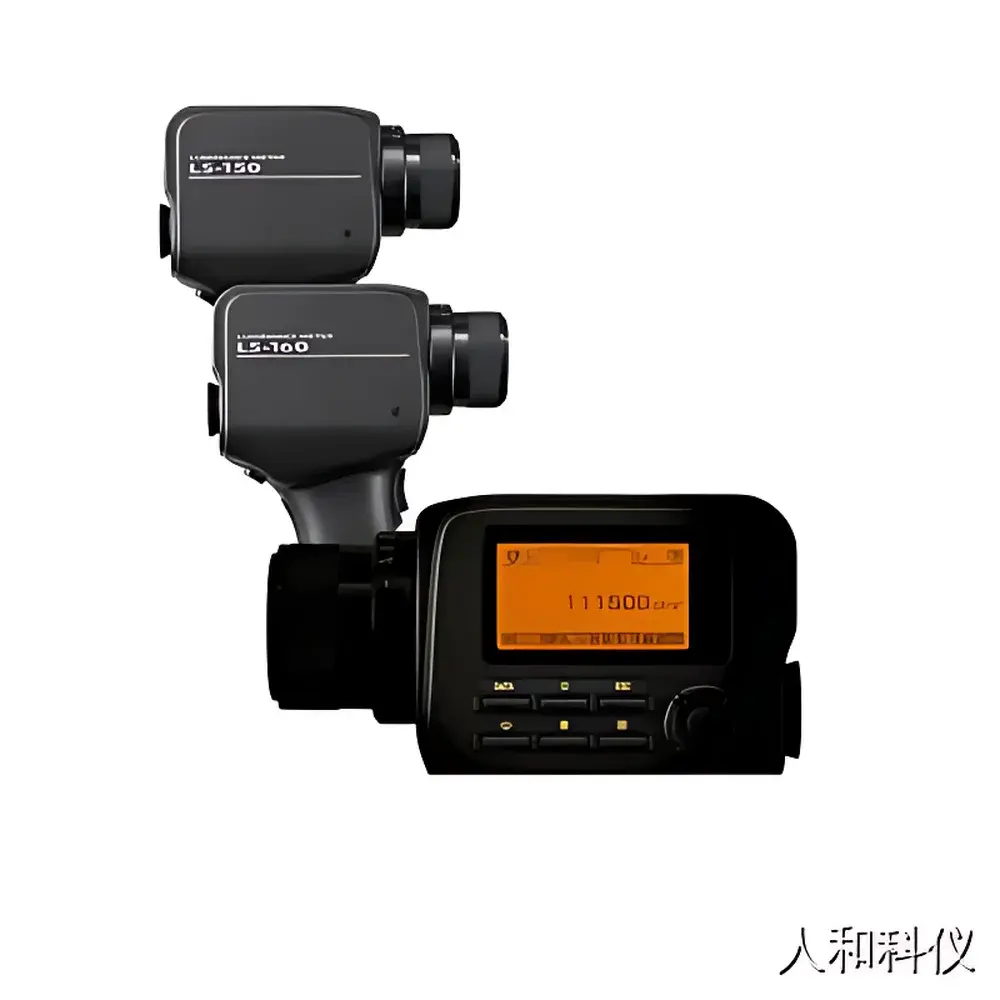
Konica Minolta LS-150 / LS-160 Luminance Meter
| Brand | Konica Minolta |
|---|---|
| Origin | Japan |
| Model | LS-150 / LS-160 |
| Luminance Range | 0.001–999,900 cd/m² (LS-150), 0.01–9,999,000 cd/m² (LS-160) |
| Measurement Angle | 1° (LS-150), 1/3° (LS-160) |
| Optical System | Single-Lens Reflex (SLR), f=85 mm, F2.8 |
| Spectral Response | Matched to CIE V(λ) Photopic Luminosity Function |
| Accuracy | ±2% ±2 digits (≤1 cd/m²), ±2% ±1 digit (>1 cd/m²) |
| Repeatability | 0.2% + 1 digit |
| Minimum Measured Area | Ø14.4 mm (1°), Ø4.5 mm (1/3°) |
| with optional macro lens | Ø1.3 mm (LS-150), Ø0.4 mm (LS-160) |
| Shortest Measurement Distance | 1012 mm (1°), 213 mm (1/3°) |
| Stray Light Suppression | ≤1% |
| Polarization Error | ≤1% |
| Temperature Drift | ≤0.2%/K |
| Compliance | DIN 5032-7 Class B (LS-150) |
| Interface | USB 2.0 |
| Power | USB bus power or AC adapter (optional) |
| Dimensions | 71 × 214 × 154 mm |
| Weight | 850 g (body only) |
Overview
The Konica Minolta LS-150 and LS-160 are high-precision, portable luminance meters engineered for traceable photometric measurement of light-emitting surfaces and self-luminous sources. Based on the CIE 1931 photopic luminosity function V(λ), these instruments deliver spectrally accurate luminance values in candela per square meter (cd/m²) or foot-lamberts (fl), calibrated against internationally recognized photometric standards. Their single-lens reflex (SLR) optical architecture ensures precise spatial targeting—enabling users to visually confirm the exact measurement area through an integrated viewfinder, even at close working distances. Unlike integrating sphere-based or cosine-corrected sensors, the LS-150/160 employ a telephoto imaging path with fixed focal length (f = 85 mm, F2.8), delivering high angular resolution and minimal parallax error. This design is especially critical for evaluating non-uniform emitters such as OLED microdisplays, automotive LED clusters, and aviation signal lights—where measurement spot size, edge definition, and spectral fidelity directly impact compliance verification.
Key Features
- High-fidelity V(λ) spectral matching: Optimized silicon photodetector with multi-layer interference filters achieves <1.5% deviation from CIE V(λ) across 380–780 nm—validated per DIN 5032-7 Class B (LS-150) and supporting ISO/CIE traceability requirements.
- Two precision measurement angles: LS-150 offers 1° field-of-view (FOV) for general-purpose surface luminance; LS-160 provides 1/3° FOV for high-resolution assessment of small-area emitters (e.g., individual pixels, indicator LEDs).
- Extended dynamic range: Measures from 0.001 cd/m² up to 999,900 cd/m² (LS-150) and 0.01–9,999,000 cd/m² (LS-160), accommodating both low-brightness ambient signage and ultra-bright HDR displays and traffic signals.
- Advanced stray-light suppression: Internal baffling, blackened optical path, and optimized lens coating reduce extraneous irradiance contribution to ≤1%, ensuring reliable readings in complex lighting environments (e.g., tunnels, control rooms, outdoor test sites).
- Macro measurement capability: With optional close-up lenses, minimum measurable spot diameters shrink to Ø1.3 mm (LS-150) and Ø0.4 mm (LS-160)—enabling pixel-level evaluation of micro-LED arrays and miniature instrumentation displays.
- Real-time dual-display feedback: Simultaneous luminance readout on both backlit LCD (external) and LED-backlit 4-digit viewfinder display, with adjustable brightness and auto/manual exposure timing (0.7–7.1 s).
Sample Compatibility & Compliance
The LS-150 and LS-160 are validated for use across diverse emissive and reflective surfaces—including CRT monitors, OLED/LED/LCD panels, electroluminescent (EL) films, roadway retroreflective signs, airport runway edge lights, railway semaphore signals, and architectural façade lighting systems. Both models meet fundamental photometric metrology requirements defined in DIN 5032-7 (Class B), while their V(λ) conformity supports alignment with CIE S 014-2/E:2021, ISO/CIE 11664-3:2019, and JIS Z 8722. The LS-150 is explicitly certified to DIN 5032-7 Class B for laboratory-grade luminance verification. Neither instrument requires external calibration references during routine operation; however, user calibration against a Konica Minolta standard source (e.g., LS-100 calibration lamp) is supported via menu-driven offset and gain adjustment. All measurements comply with GLP documentation practices when paired with CS-S20 software, which logs timestamp, operator ID, instrument serial number, and environmental conditions (temperature/humidity).
Software & Data Management
The included CS-S20 Luminance Measurement Software enables full instrument control, real-time data streaming, batch export (CSV, TXT), and report generation compliant with internal QA protocols. Data files retain metadata including measurement mode (luminance, ΔL, peak/valley hold), exposure time, V(λ) correction factor, and user-applied color compensation coefficients (0.001–9.999). Audit trails record all parameter changes, calibration events, and firmware updates—supporting FDA 21 CFR Part 11 readiness when configured with electronic signatures and role-based access control. USB 2.0 interface ensures stable communication up to 400 Hz sampling rate for flicker analysis (e.g., PWM-driven LED drivers), and synchronization pulses allow integration into automated test benches via TTL trigger input.
Applications
- Display manufacturing QC: Pixel uniformity mapping, HDR white point validation, and burn-in assessment for smartphones, automotive HUDs, and medical monitors.
- Transportation safety certification: Luminance verification of road tunnel wall reflectivity, airport approach lighting systems (ALS), and railway signal aspect brightness per ICAO Annex 14 and EN 12899-1.
- Architectural lighting design: In-situ validation of facade illumination levels, emergency exit sign visibility, and glare index calculations (UGR) per CIE 117.
- R&D photometry labs: V(λ) response characterization, spectral mismatch error quantification, and development of custom luminance transfer standards.
- Regulatory testing: Compliance checks against ENERGY STAR Luminaires V2.2, UL 1598, and IEC 62471 photobiological safety thresholds where luminance-derived radiance estimates are required.
FAQ
What is the difference between LS-150 and LS-160 in terms of optical configuration?
The LS-150 uses a 1° measurement angle with a minimum spot size of Ø14.4 mm at 1012 mm distance; the LS-160 employs a 1/3° angle, achieving Ø4.5 mm at 213 mm—and down to Ø0.4 mm with the optional macro lens.
Can the LS-150/160 measure pulsed or modulated light sources?
Yes—both models support synchronous measurement at frequencies from 20 Hz to 400 Hz via external trigger input, enabling accurate time-resolved luminance capture for PWM-driven LEDs and strobed displays.
Is user calibration possible without sending the unit to a service center?
Yes—CS-S20 software allows user calibration using a Konica Minolta reference source; the instrument stores up to 10 user-defined calibration points with date/time stamping and operator ID logging.
Does the LS-150 meet any formal photometric classification standards?
Yes—the LS-150 complies with DIN 5032-7 Class B, specifying maximum permissible errors for luminance meters used in industrial and laboratory applications requiring moderate accuracy.
How is stray light controlled in high-ambient environments like outdoor daylight testing?
The SLR optical path incorporates multi-stage internal baffles, non-reflective matte-black interior surfaces, and a removable ND eyepiece filter—reducing off-axis irradiance contribution to ≤1% of full-scale reading.





