
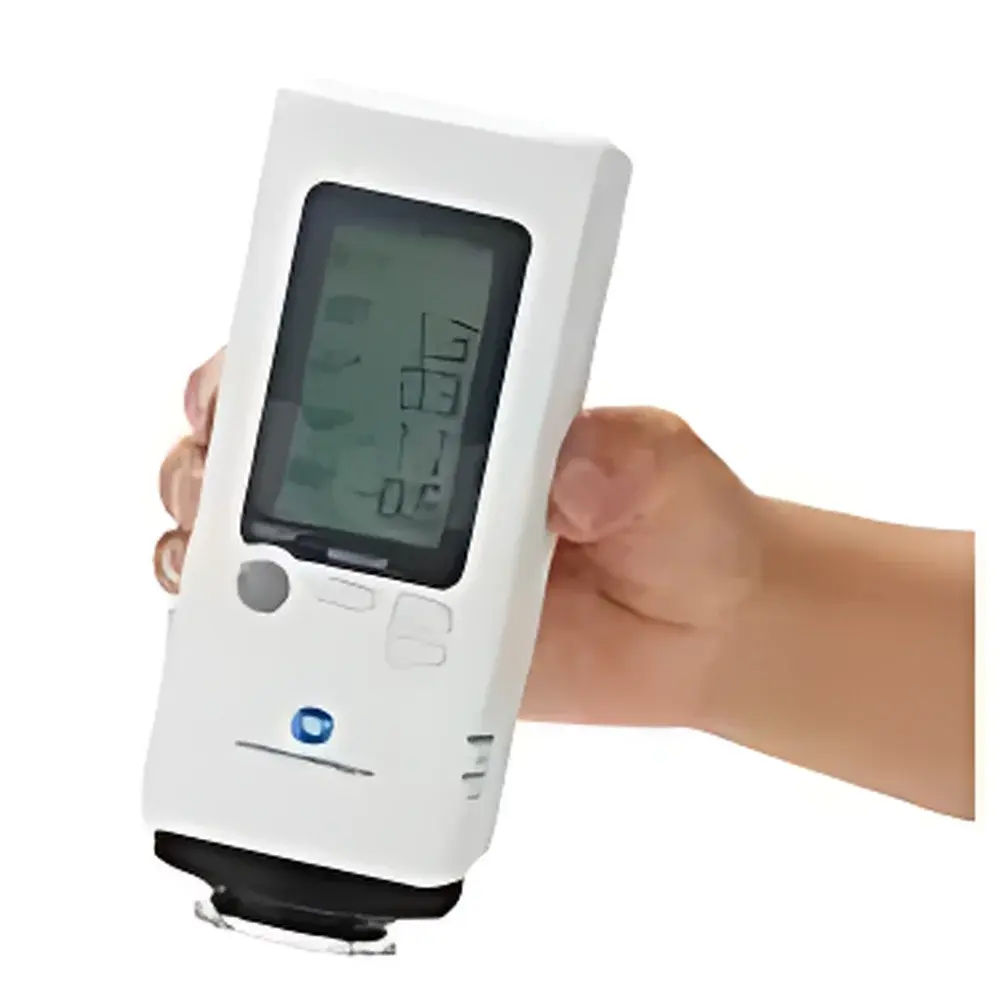
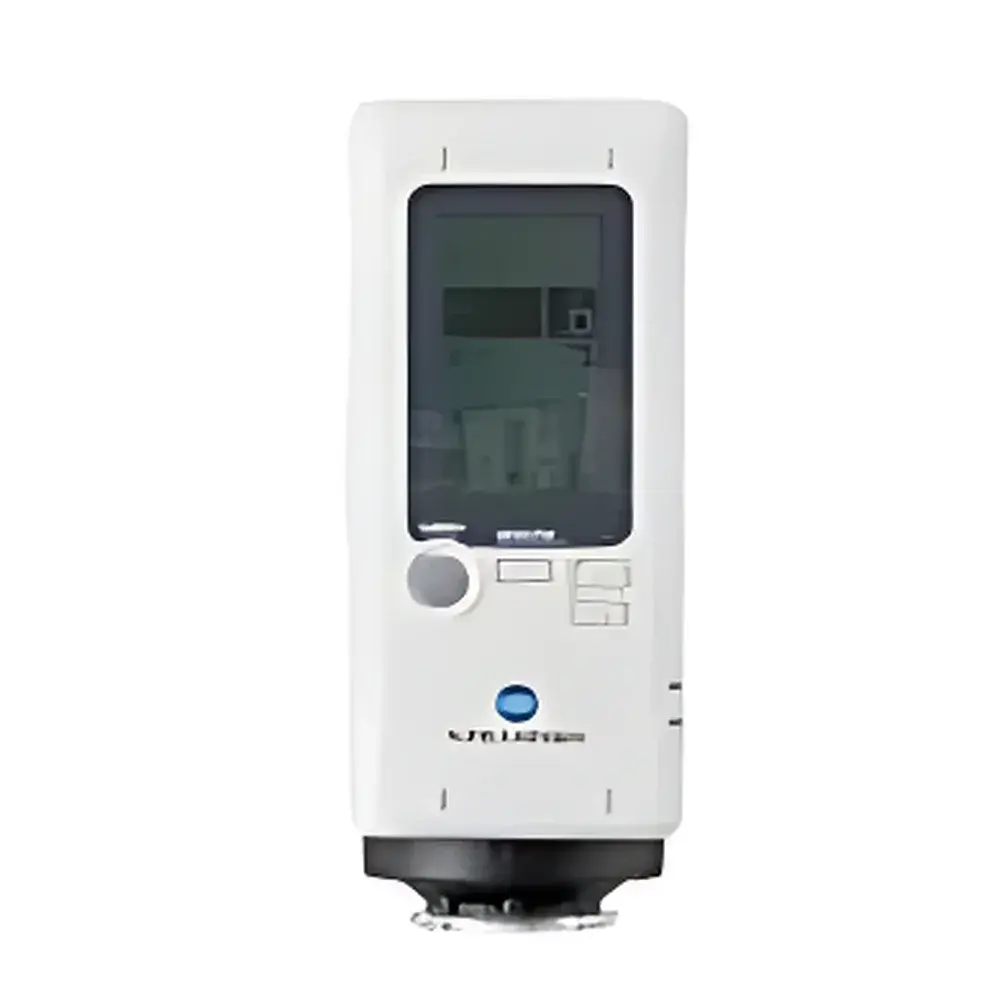
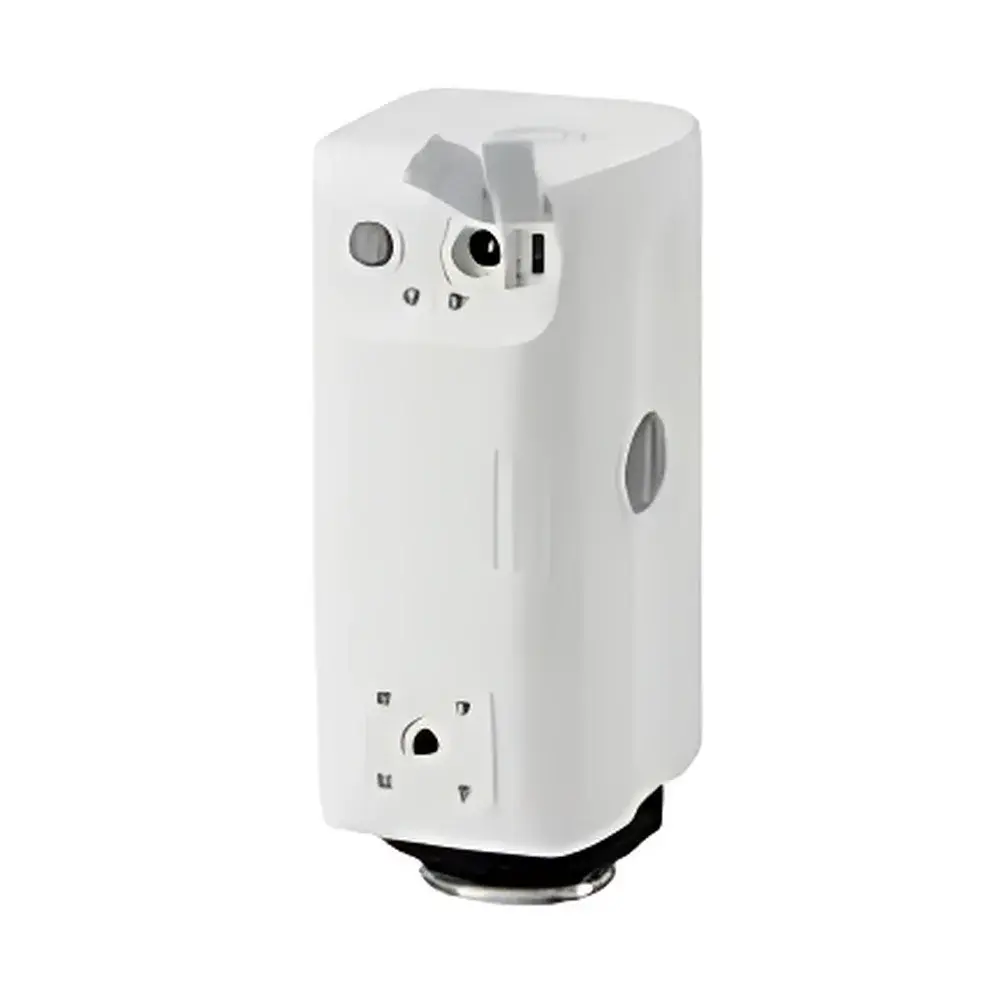
Konika-Minolta CR-10plus Portable Color Difference Meter
| Brand | Konica Minolta |
|---|---|
| Origin | Japan |
| Model | CR-10plus |
| Instrument Type | Portable |
| Optical Geometry | 8°/diffuse (8/d) |
| Light Source | Pulsed Xenon Lamp |
| Spectral Range | 400–700 nm |
| Repeatability | σ(ΔE*ab) ≤ 0.1 |
| Display Languages | English, Chinese, Japanese |
| Measurement Aperture | Ø8 mm (standard), Ø5 mm (optional) |
| Observer Angle | 10° |
| Illuminant | D65 |
| Color Spaces | CIE L*a*b*, L*C*H*, CIE 1976 ΔE*ab |
| Data Storage | Up to 1,000 measurements (including reference standards) |
| Interface | USB 2.0 |
| Power Supply | 4 × AA alkaline/Ni-MH batteries, USB bus power, or AC adapter (optional) |
| Dimensions | 66 × 158 × 85 mm |
| Weight | 420 g (without batteries) |
| Operating Environment | 0–40°C, ≤85% RH (non-condensing at 35°C) |
| Compliance | DIN 5033-7, JIS Z 8722 (Condition d), ISO 7724-1, CIE No. 15, ASTM E1164 |
Overview
The Konica Minolta CR-10plus is a compact, handheld color difference meter engineered for rapid, repeatable color assessment in production, quality control, and supplier verification environments. It operates on the CIE 1976 L*a*b* color space and employs an 8°/diffuse (8/d) optical geometry—compliant with DIN 5033-7, JIS Z 8722 Condition d, ISO 7724-1, CIE No. 15, and ASTM E1164—to capture both specular-included (SCI) reflectance data under standardized D65 illumination and 10° observer conditions. The instrument uses a pulsed xenon lamp as its broadband light source, delivering stable spectral output across the visible range (400–700 nm), enabling accurate tristimulus value calculation via six silicon photodiodes. With a repeatability of σ(ΔE*ab) ≤ 0.1 under controlled white calibration plate measurement (n = 30, 10 s interval), the CR-10plus meets the precision requirements for routine pass/fail evaluation in industrial QC labs and field-based inspection workflows.
Key Features
- Three-step operation: Power on → Measure reference → Measure sample — no calibration required between successive measurements when using stored standard data.
- Large backlit LCD display supporting English, Chinese, and Japanese interfaces for global operator accessibility.
- Ergonomic housing with contoured grip zones and tactile button placement optimized for single-hand operation and extended use.
- Integrated pass/fail judgment system: User-defined ΔE*ab, ΔL*a*b*, or ΔL*C*H* thresholds trigger visual (LED color coding) and audible (distinctive beep patterns) feedback without PC connection.
- Dual aperture options: Standard Ø8 mm probe for general-purpose measurement; optional Ø5 mm attachment for small-area or high-spatial-resolution applications.
- Multi-mode power architecture: Operates on four AA alkaline or Ni-MH rechargeable cells, USB bus power (e.g., from laptop or power bank), or external AC adapter (sold separately).
Sample Compatibility & Compliance
The CR-10plus accommodates flat, opaque, or semi-opaque solid samples with surface gloss levels typical of plastics, paints, textiles, ceramics, and coated metals. Its 8/d geometry ensures consistent readings across varying surface finishes by including specular reflectance—critical for evaluating textured or brushed materials where SCI mode better correlates with visual perception. The instrument conforms to international colorimetric standards essential for audit-ready documentation in regulated sectors: DIN 5033-7 (German standard for colorimetry), JIS Z 8722 (Japanese industrial standard for color measurement), ISO 7724-1 (general principles of color measurement), CIE Publication No. 15 (colorimetry fundamentals), and ASTM E1164 (standard practice for instrumental color measurement). While not validated for GLP/GMP environments requiring 21 CFR Part 11-compliant electronic records, its deterministic firmware behavior and traceable measurement logic support alignment with internal QA protocols and supplier qualification programs.
Software & Data Management
The CR-10plus includes embedded firmware that supports standalone data logging—up to 1,000 measurement records (including reference standards)—without external hardware. All stored entries retain full metadata: date/time stamp, reference ID, sample ID, color difference values (ΔL*, Δa*, Δb*, ΔC*, ΔH*, ΔE*ab), and pass/fail status per user-defined tolerance. When connected via USB 2.0 to a Windows PC, the bundled Konica Minolta Color Management Software enables advanced reporting: statistical summaries (mean, SD, min/max), trend charts over time, batch export to CSV or Excel, and comparative analysis against master standards. Audit trails are maintained within the software environment, though native electronic signature or role-based access control is not implemented—making it suitable for non-regulated manufacturing QA but requiring supplemental procedural controls for FDA-regulated product release decisions.
Applications
- Production line color consistency checks for molded plastic components, automotive trim, and consumer electronics housings.
- Supplier incoming inspection of raw materials such as pigments, masterbatches, and pre-colored resins.
- Batch-to-batch comparison in paint, ink, and coating formulation laboratories.
- Field verification of color-critical signage, packaging, and printed marketing collateral.
- Teaching and training in color science curricula where portability and intuitive interface lower entry barriers for students.
FAQ
What color difference formula does the CR-10plus use by default?
The device calculates ΔE*ab (CIE 1976) as the primary metric, but also supports ΔL*a*b* and ΔL*C*H* for dimensional breakdowns of lightness, chroma, and hue deviation.
Can the CR-10plus measure transparent or translucent samples?
No—it is designed for opaque or semi-opaque surfaces only; transmission or fluorescence-capable instruments (e.g., CM-700d series) are required for clear films or liquids.
Is the Ø5 mm aperture included with the base unit?
No—the Ø5 mm measuring port is an optional accessory; the standard configuration ships with the Ø8 mm aperture.
Does the CR-10plus support Bluetooth or Wi-Fi connectivity?
No—data transfer is exclusively via USB 2.0 cable; wireless functionality is not implemented in this model.
How often must the instrument be calibrated?
White calibration using the supplied ceramic tile is recommended before each measurement session or after significant ambient temperature shifts; no factory recalibration is needed under normal use conditions.





