
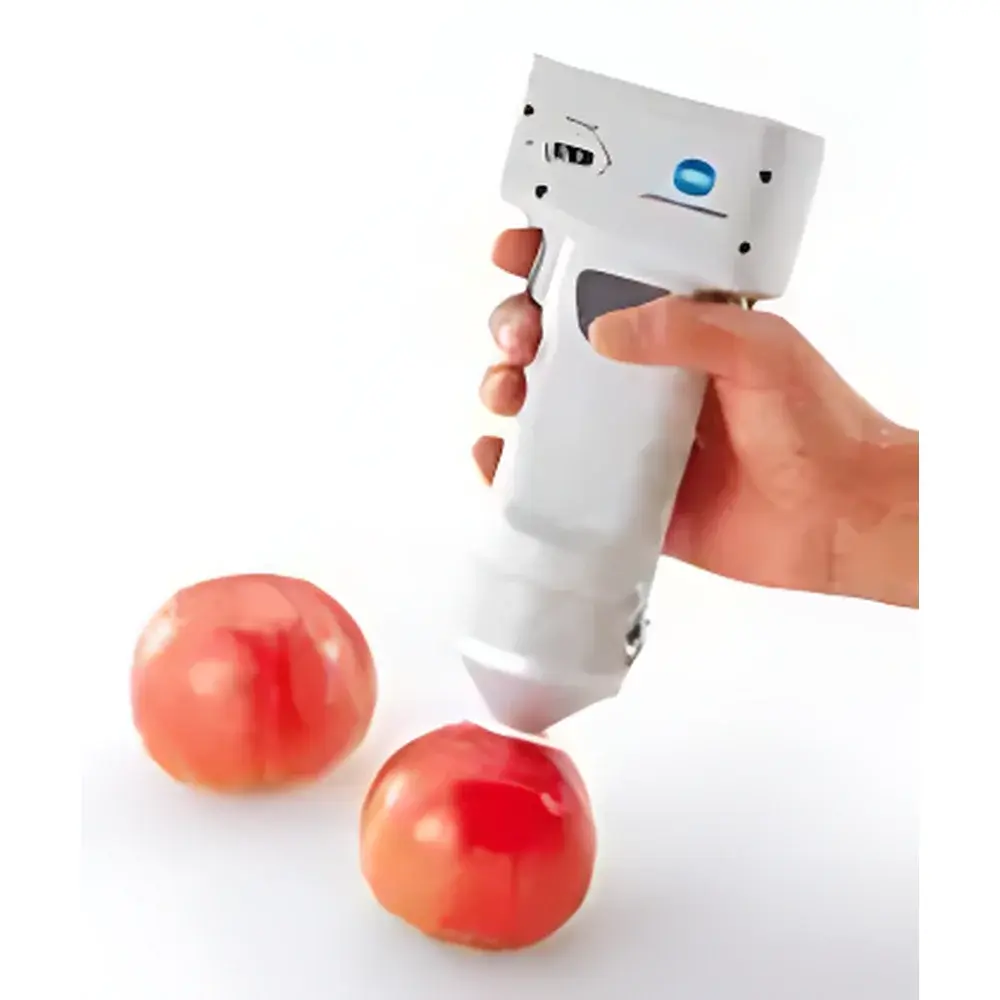
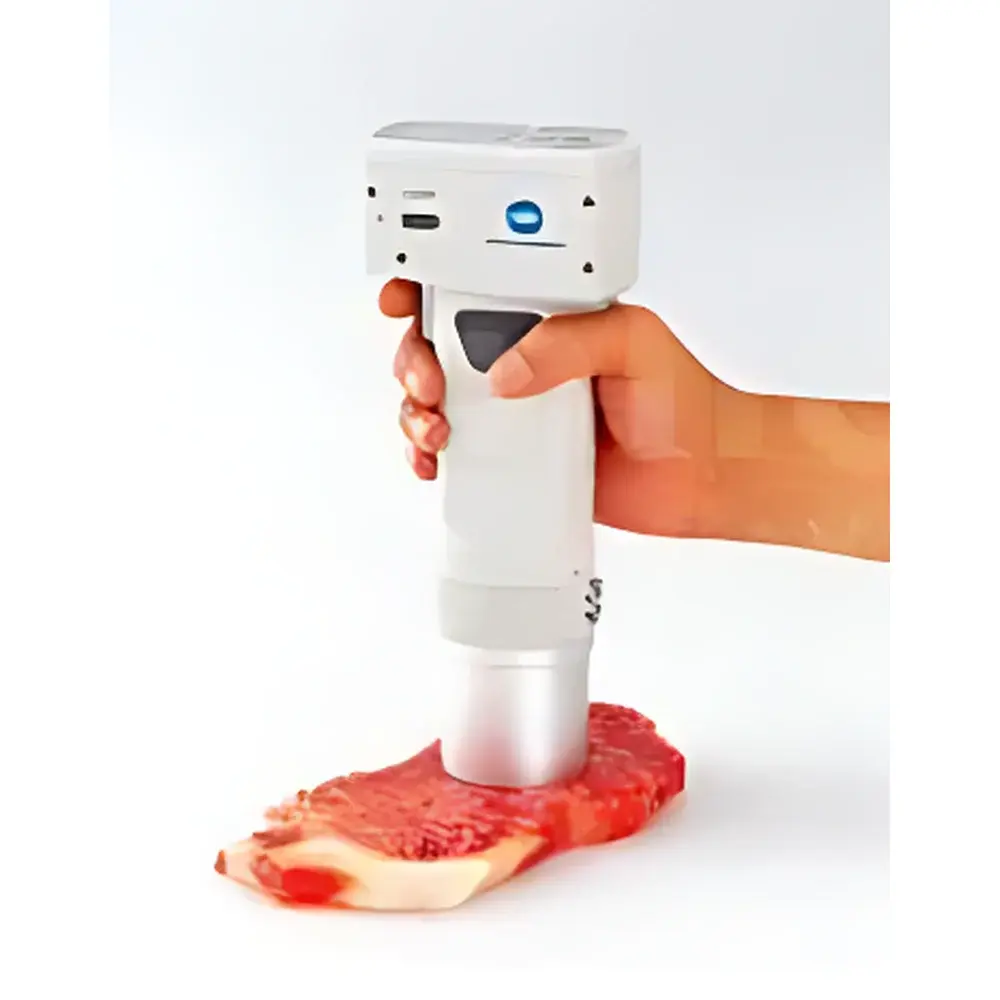
Konika-Minolta CR-410 Portable Color Difference Meter
| Brand | Konica Minolta |
|---|---|
| Origin | Japan |
| Instrument Type | Portable |
| Optical Geometry | d/8° integrating sphere |
| Light Source | Pulsed Xenon Lamp |
| Spectral Range | Y Reflectance 0.01–160.00% |
| Repeatability | ΔE*ab ≤ 0.07 (std. dev., white calibration, 30 measurements at 10 s intervals) |
| Measurement Aperture | Ø50 mm / Illumination Area: Ø53 mm |
| Measurement Time | 1 s |
| Minimum Interval | 3 s |
| Battery Life | ~800 measurements (AAA alkaline/Ni-MH, Konica Minolta specified conditions) |
| Display | Backlit dot-matrix LCD (15×9 characters + icon line), 6 language options (EN/DE/FR/IT/ES/JP) |
| Data Storage | 1,000 measurements (instrument-only) |
| Standard Calibration | CR-A44 white calibration tile |
| Compliance | CIE 1931 2° standard observer, CIE No. 15:2004, ISO 7724-1, ASTM E308, JIS Z 8722 |
Overview
The Konica Minolta CR-410 is a high-precision portable color difference meter engineered for rapid, repeatable reflectance-based color measurement in industrial quality control environments. It operates on the CIE-compliant d/8° integrating sphere optical geometry—ensuring uniform illumination and diffuse viewing of samples while capturing total reflectance including specular component (SCI mode). The pulsed xenon lamp provides stable, daylight-simulated illumination across the visible spectrum (approx. 400–700 nm), eliminating thermal drift and enabling consistent spectral response without warm-up delay. Designed for field and production-floor deployment, the CR-410 delivers metrological-grade performance with repeatability of ΔE*ab ≤ 0.07 under controlled calibration conditions—meeting stringent requirements for inter-laboratory comparability and long-term stability tracking. Its compact form factor (102 × 244 × 63 mm), lightweight construction (~550 g with batteries), and dual power options (4×AAA cells or AC adapter AC-A17) support extended unattended operation in diverse manufacturing settings—from automotive paint lines to textile dye houses and food packaging facilities.
Key Features
- High-repeatability d/8° optical system with integrated pulsed xenon illumination and six silicon photodiodes for robust spectral sampling
- ΔE*ab repeatability ≤ 0.07 (standard deviation, post-white calibration, 30 consecutive measurements at 10 s intervals)
- Instrument error ≤ ΔE*ab 0.8 (BCRA Series II 12-color tile average, CIE 1964 10° observer reference)
- Multi-standard color space support: CIE XYZ, Yxy, L*a*b*, L*C*h, Hunter Lab, CMC(l:c), CIE 1994, CIEDE2000, CIE Whiteness (WI/Tw), ASTM E313/YI, and user-defined indices
- Configurable pass/fail evaluation using box-type or elliptical tolerance limits—programmable via optional DP-400 data processor or SpectraMagic NX software
- On-device storage for 1,000 measurement records and 100 reference standards; expandable to 2,000 records and 100 pages with DP-400
- Backlit multilingual LCD interface (English, German, French, Italian, Spanish, Japanese) with intuitive soft-key navigation and SMS-style alphanumeric input
- RS-232C serial interface (4800–19200 bps, factory default 9600 bps) compliant with legacy QC systems and PC-based data logging
Sample Compatibility & Compliance
The CR-410 accommodates flat, curved, textured, and moderately irregular surfaces within its Ø50 mm measurement aperture. Its large-area illumination (Ø53 mm) minimizes edge effects and enhances spatial averaging for heterogeneous materials such as molded plastics, coated metals, printed substrates, and dyed fabrics. The instrument conforms to ISO 7724-1:2019 (Colorimetry — Part 1: CIE standard illuminants and observers), ASTM E308-22 (Standard Practice for Computing the Colors of Objects by Using the CIE System), and JIS Z 8722:2012 (Methods of color measurement). While not inherently 21 CFR Part 11 compliant as a standalone device, audit-ready data export and traceable calibration workflows are enabled when paired with SpectraMagic NX CM-S100w—supporting GLP/GMP documentation requirements in regulated industries including pharmaceutical packaging and medical device labeling.
Software & Data Management
Data acquisition, analysis, and reporting are extended through two complementary platforms: the DP-400 portable data processor and SpectraMagic NX desktop software. The DP-400 enables real-time statistical evaluation (mean, min/max, standard deviation), automatic thermal-printed reports (384-dot thermal printer), and time-stamped batch logging (YYYY-MM-DD HH:MM). SpectraMagic NX provides advanced capabilities including multi-instrument fleet calibration management, SPC charting (X-bar/R, Cp/Cpk), spectral comparison overlays, and automated compliance reporting against ISO/ASTM tolerances. Both tools support full audit trails, user access levels, and electronic signature functionality—facilitating alignment with FDA 21 CFR Part 11 Annex 11 and ISO/IEC 17025 documentation standards.
Applications
The CR-410 serves as a primary color verification tool across sectors where visual consistency directly impacts brand integrity and regulatory acceptance. In automotive and industrial coatings, it validates batch-to-batch hue match against master standards under D65 or C illuminants. Within polymer and rubber manufacturing, it monitors pigment dispersion stability during extrusion and molding cycles. Print and packaging users rely on its CIEDE2000 delta-E calculations to enforce GRACoL/SWOP specifications. Food processors apply it to assess surface color uniformity of baked goods, confectionery coatings, and dried produce—correlating instrumental values with sensory panel outcomes. Additional validated use cases include ceramic glaze consistency, pharmaceutical tablet film coating, and architectural finish qualification per AAMA 2603/2604 protocols.
FAQ
What calibration standards are required for daily operation?
A certified white calibration tile (CR-A44) is mandatory for baseline correction. Optional black trap and green/grey reference tiles may be used for enhanced linearity verification in high-accuracy applications.
Can the CR-410 measure transparent or translucent materials?
No—it is optimized for opaque or diffusely reflecting surfaces. For transmission or semi-transparent samples, Konica Minolta recommends the CM-700d spectrophotometer with transmission accessory.
Is firmware upgrade supported in-field?
Yes—firmware updates are distributed via SpectraMagic NX and applied through RS-232C connection; no hardware modification is required.
How does the CR-410 handle ambient light interference?
The pulsed xenon source and synchronized detection electronics reject continuous ambient illumination, enabling reliable operation under typical factory lighting (up to 10,000 lux) without shielding.
Does the instrument support custom color difference formulas?
User-defined indices can be registered via SpectraMagic NX and deployed as searchable parameters on the CR-410 display—up to six formula sets per instrument memory.




