
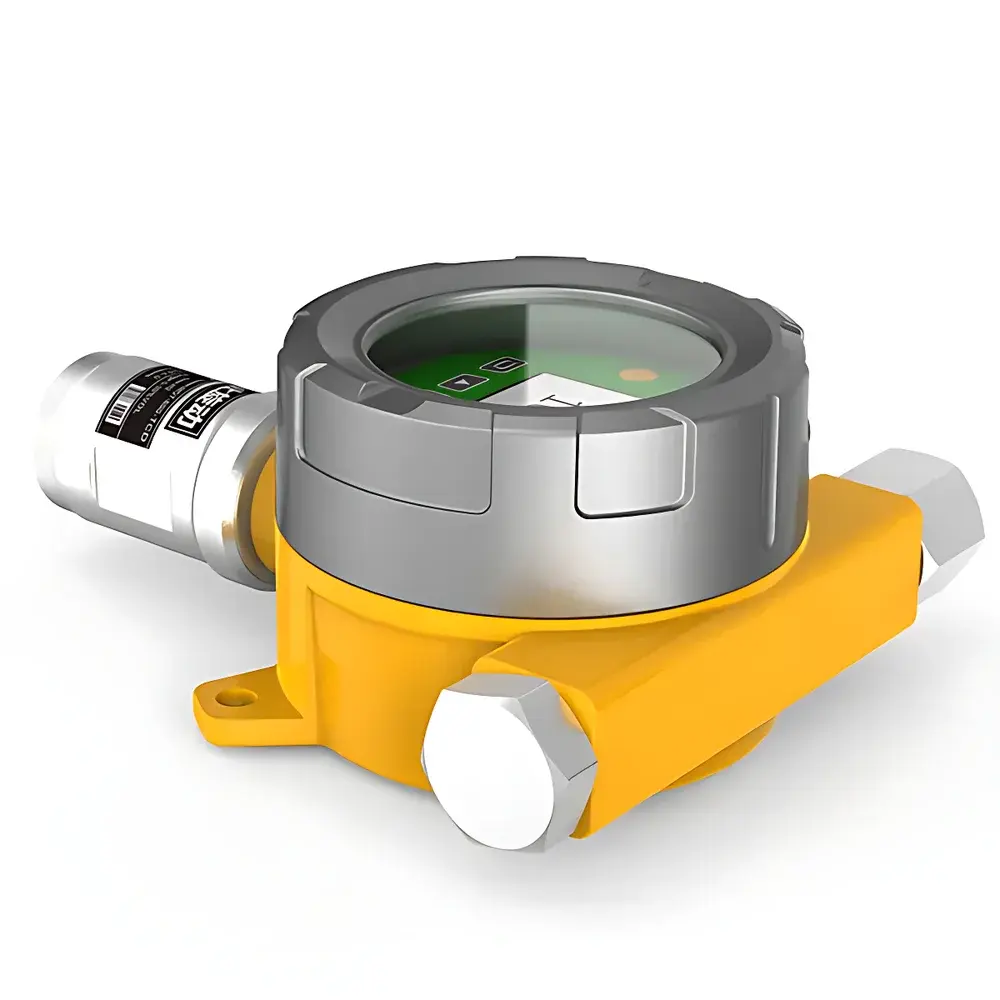
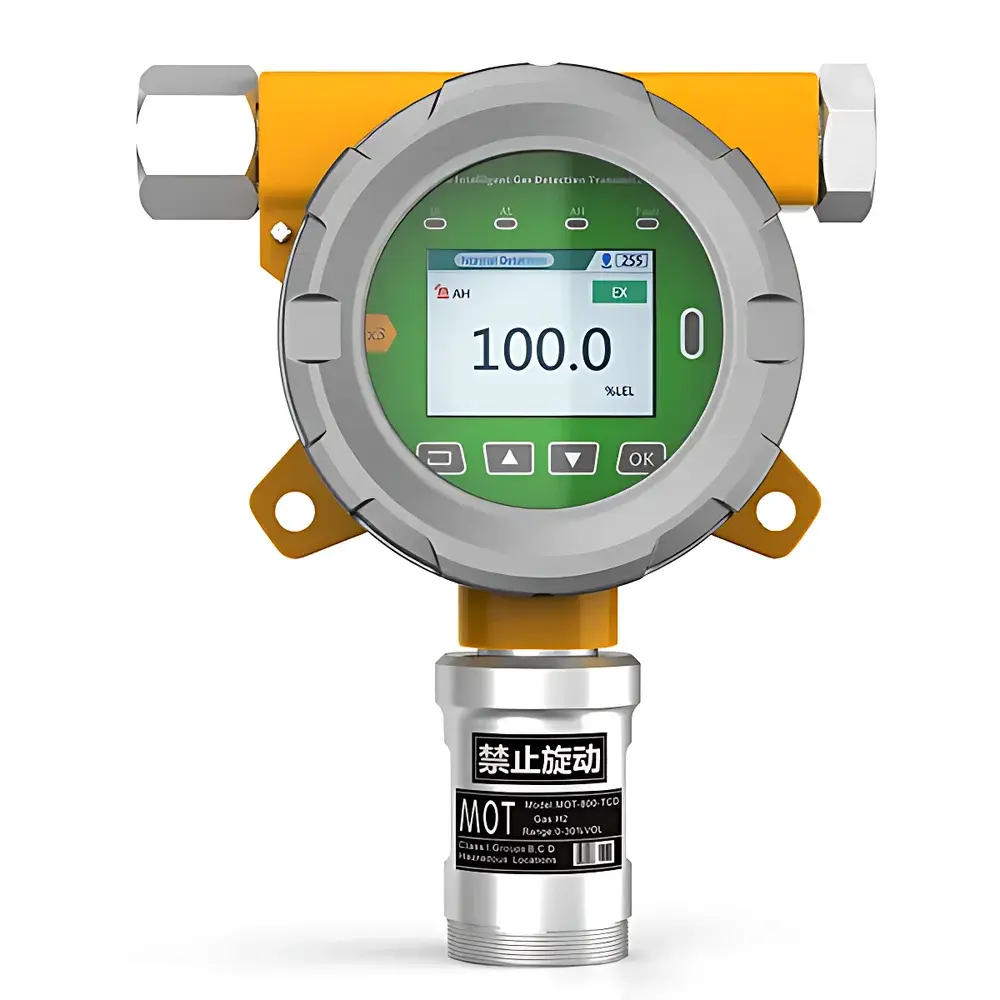
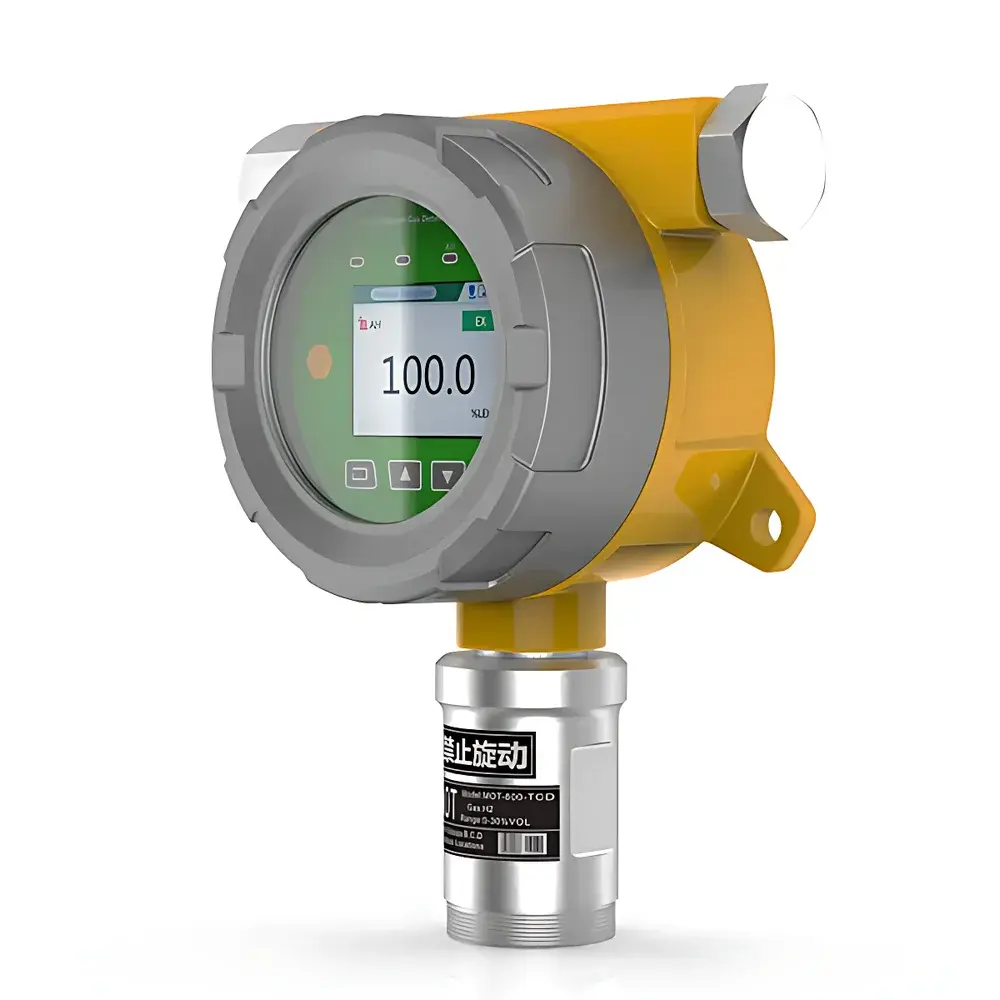
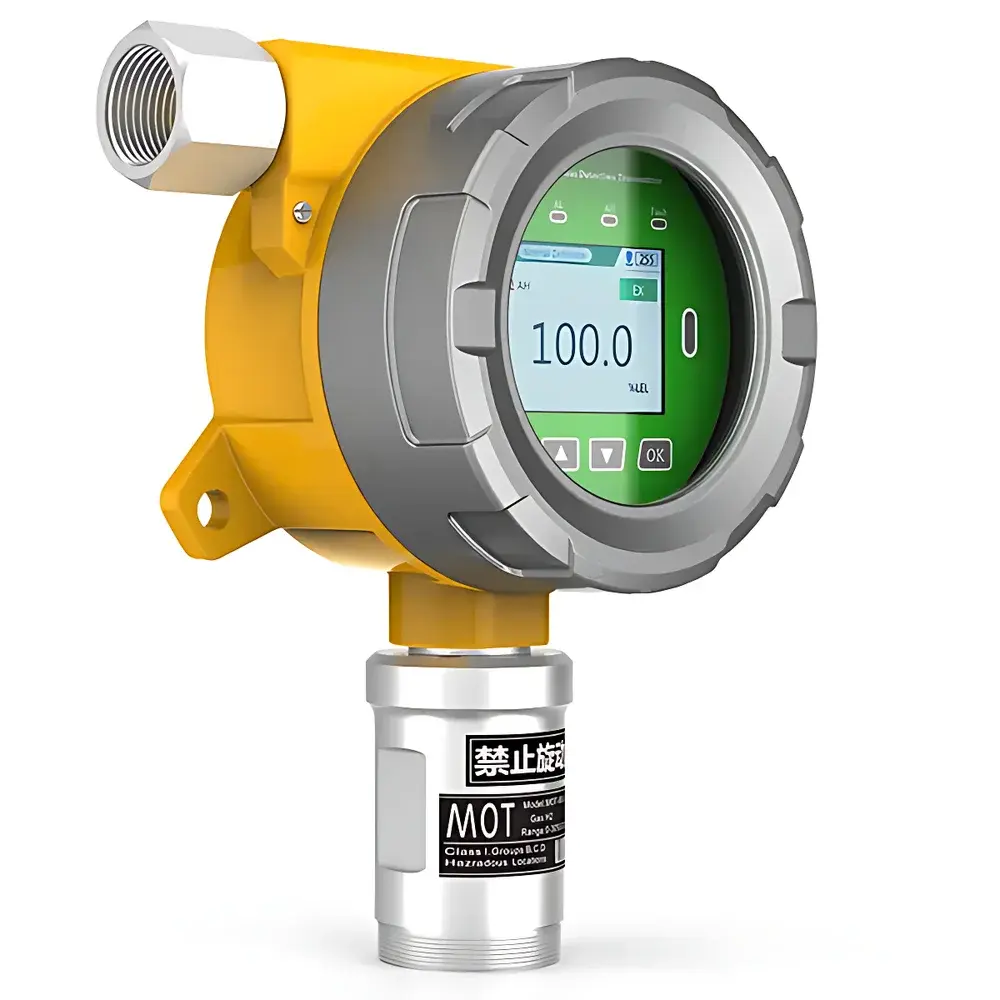
Korno MOT500-THT Tetrahydrothiophene (THT) Fixed Gas Detector
| Brand | Korno |
|---|---|
| Origin | Guangdong, China |
| Manufacturer Type | Manufacturer |
| Country of Origin | China |
| Model | MOT500-THT |
| Detection Principle | Electrochemical Sensor |
| Installation Type | Fixed |
| Measurement Range | 0–20 ppm / 0–50 ppm / 0–100 ppm (selectable) |
| Resolution | 0.01 ppm (for 0–100 ppm range) |
| Accuracy | ≤±3% FS (dependent on sensor batch and calibration) |
| Linearity Error | ≤±1% FS |
| Zero Drift | ≤±2% FS |
| Repeatability | ≤±1% FS |
| Response Time (T90) | ≤20 s |
| Recovery Time | ≤20 s |
| Enclosure Rating | IP66 |
| Explosion Protection Certification | CCRI24.8021X (compliant with GB/T 3836.1–2021, GB/T 3836.2–2021, GB/T 3836.31–2021) |
| Operating Temperature | −20 to +50 °C |
| Operating Humidity | ≤95% RH (non-condensing) |
| Power Supply | 24 VDC (12–30 VDC) |
| Output Signals | 4–20 mA (16-bit precision, up to 1 km), RS485 (MODBUS RTU, up to 2 km), 0–5 V / 0–10 V analog, 2× SPDT relays (expandable to 3) |
| Communication Options | Cable (3/4-core), TCP/IP (fiber/Ethernet, optional), GPRS (optional), 433 MHz wireless (2–10 km, optional) |
| Mounting | Wall-mount, pipe-mount (M40×1.5 mm thread), flow-through configuration |
| Gas Sampling | Diffusion, flow-through, or pump-aspirated (configurable) |
| Sensor Expansion | Up to 6 electrochemical sensors (multi-gas capability) |
| Housing Material | Die-cast aluminum with sandblasted oxidation + fluorocarbon coating |
| Dimensions & Weight | 198 × 162 × 85 mm (L×W×H), 1.5 kg (net) |
Overview
The Korno MOT500-THT is a fixed-mount, continuous-duty tetrahydrothiophene (THT) gas detector engineered for reliable, long-term monitoring in natural gas odorization systems, pipeline integrity verification, and industrial safety applications. It employs high-stability, imported electrochemical sensing technology—specifically optimized for THT’s unique redox behavior at ambient temperatures—to deliver repeatable, low-drift concentration measurements in real time. Unlike catalytic bead or PID-based alternatives, the electrochemical cell provides selective detection of THT without cross-sensitivity to common background gases such as methane, CO₂, or H₂S (within typical natural gas matrix concentrations). The instrument’s microcontroller-based signal processing architecture ensures stable baseline output, adaptive temperature compensation, and digital filtering to suppress electrical noise from industrial environments. Designed for deployment in classified hazardous areas, the MOT500-THT meets the structural and ignition protection requirements of Class I, Division 1 (or Zone 1 equivalent) per Chinese national explosion-proof standards (GB/T 3836 series), enabling safe operation in gas compressor stations, metering skids, city gate stations, and LNG terminals.
Key Features
- Electrochemical sensing platform with factory-calibrated THT-specific electrodes, delivering consistent sensitivity across the full 0–100 ppm measurement range
- Selectable span ranges (0–20 ppm, 0–50 ppm, or 0–100 ppm) to match application-specific regulatory thresholds or process control setpoints
- High-resolution analog output (0.01 ppm) and 16-bit 4–20 mA transmission for integration into legacy DCS/PLC architectures with minimal signal degradation over distances up to 1 km
- Multi-protocol digital interface: standard MODBUS RTU over RS485 (2 km max), plus optional TCP/IP Ethernet, GPRS cellular, or 433 MHz RF telemetry for centralized SCADA or cloud-based monitoring
- Modular sensor architecture supporting up to six independent electrochemical channels—enabling simultaneous THT + auxiliary gas monitoring (e.g., O₂ deficiency, H₂S, Cl₂, SO₂) without additional enclosures
- Robust die-cast aluminum housing with fluorocarbon finish and IP66 ingress protection, rated for outdoor exposure and corrosive atmospheres including coastal or chemically treated utility sites
- Configurable dual-stage relay outputs with dry-contact ratings (125 VAC/0.3 A, 30 VDC/1 A) for direct interlocking with ventilation fans, shutoff valves, or audible/visual alarm beacons
Sample Compatibility & Compliance
The MOT500-THT is validated for continuous sampling of THT in natural gas streams, air-diluted odorant test benches, and ambient air near odorization injectors. Its diffusion-, flow-through-, or pump-aspirated sampling configurations accommodate varying site constraints—including low-flow pipelines, pressurized enclosures, or unobstructed ambient zones. All variants comply with GB/T 3836.1–2021 (general explosion-proof requirements), GB/T 3836.2–2021 (flameproof “d” enclosure), and GB/T 3836.31–2021 (dust-ignition-proof “t” construction), certified by CCRI (China Certified Reference Institute) under certificate no. CCRI24.8021X. While not CE-marked or ATEX-certified out-of-box, the unit’s intrinsic design principles align with IEC 60079-29-1 (gas detection performance) and ISO 10156 (gas mixture compatibility). For GLP/GMP-regulated facilities, optional audit-trail-enabled firmware supports configurable calibration logging, user access control, and timestamped event records compatible with 21 CFR Part 11–aligned data management systems.
Software & Data Management
The detector operates autonomously without external software but integrates seamlessly with third-party industrial platforms via standardized protocols. Its embedded firmware supports remote configuration via Modbus register mapping—including zero/span calibration initiation, alarm threshold adjustment, relay hysteresis setting, and sensor lifetime diagnostics. When paired with Korno’s optional K-Cloud gateway (TCP/IP or GPRS), raw and processed THT values, sensor health metrics (e.g., baseline voltage, electrolyte saturation status), and fault codes are transmitted in JSON or CSV format to secure MQTT brokers or RESTful APIs. Local data logging (up to 30 days at 1-minute intervals) is available via microSD card (optional). All communication layers support TLS 1.2 encryption and role-based authentication to meet cybersecurity requirements for critical infrastructure monitoring.
Applications
- Natural gas distribution networks: Continuous verification of THT dosage compliance at city gate stations and regional pressure reduction facilities
- Odorant injection system validation: Real-time feedback for proportional dosing pumps to maintain 10–20 mg/m³ THT concentration per EN 13726 and GB 17820
- Leak detection in odorization cabinets, valve rooms, and above-ground regulator stations
- Occupational health monitoring in maintenance workshops handling THT containers or injection equipment
- Regulatory reporting: Automated generation of daily THT concentration summaries aligned with municipal gas safety ordinances
- Research & development: Quantitative evaluation of odorant persistence, adsorption losses in polyethylene piping, or catalytic degradation in filter media
FAQ
What is the recommended calibration frequency for the MOT500-THT in continuous operation?
For applications requiring traceability to national standards, quarterly bump testing with certified 10 ppm THT span gas is advised; full two-point (zero/span) calibration every six months is recommended under stable environmental conditions. More frequent calibration may be necessary in high-humidity or particulate-laden installations.
Can the MOT500-THT be used in pressurized natural gas lines directly?
No—it is not rated for direct in-line installation at pipeline pressure. Use only with appropriate pressure-reducing sample conditioning systems (e.g., needle valve + back-pressure regulator + particulate filter) to deliver gas at atmospheric or slightly positive pressure to the sensor chamber.
Does the device support HART protocol?
No—HART is not implemented. Analog 4–20 mA output is compliant with standard current-loop interfaces, but digital communication is limited to MODBUS RTU over RS485 or optional TCP/IP/GPRS modules.
Is sensor replacement field-serviceable?
Yes—electrochemical cartridges are user-replaceable without soldering or firmware reconfiguration. Each sensor includes laser-etched serial number and embedded calibration coefficients readable by the host controller upon insertion.
What is the expected service life of the THT electrochemical sensor?
Typical operational lifespan is 24 months under continuous monitoring at ambient temperature and ≤70% RH. Exposure to >90% RH, solvent vapors, or H₂S >1 ppm accelerates electrolyte depletion and reduces usable life.
Related Products







