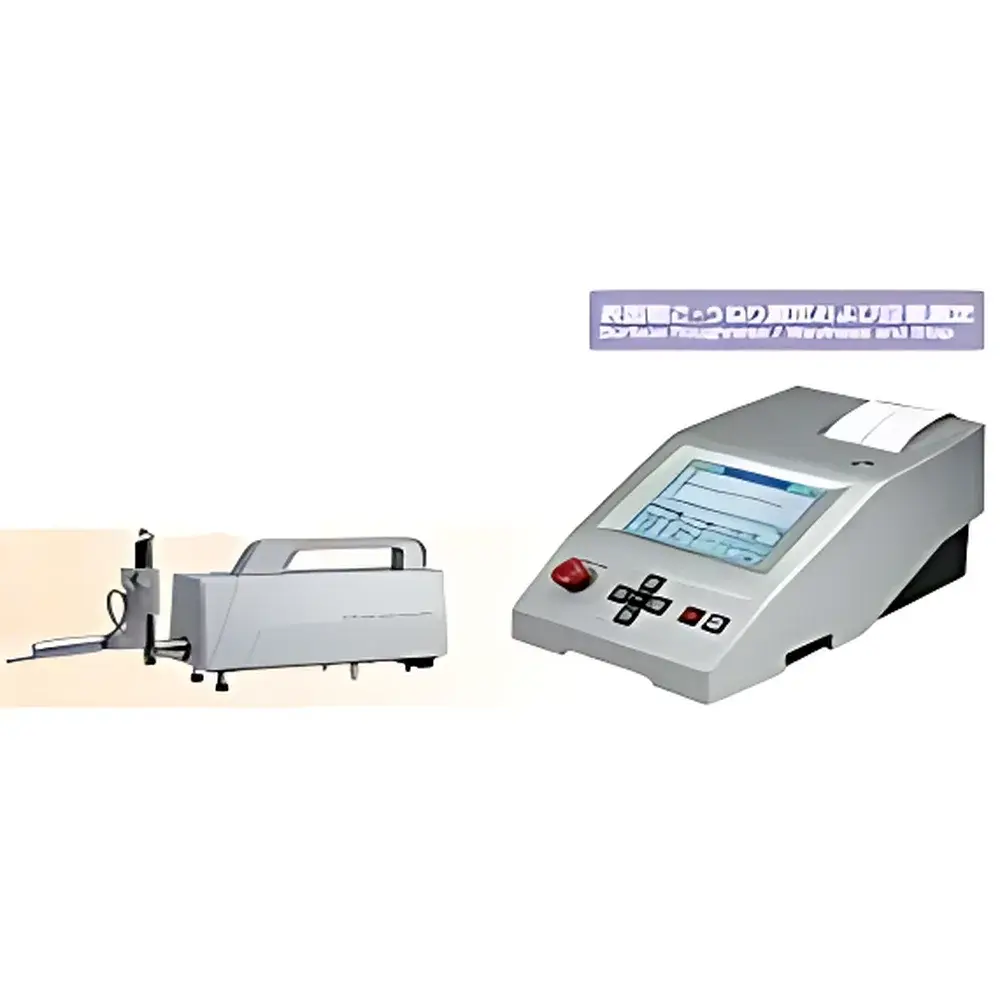
Kosaka SE-500-59 Portable Stylus Profilometer
| Origin | Germany |
|---|---|
| Manufacturer Type | Authorized Distributor |
| Origin Category | Imported |
| Model | Kosaka SE-500-59 |
| Price Range | USD 42,000 – 56,000 |
| Measurement Principle | Contact Stylus Profilometry (ISO 3274, ISO 4287, ISO 11562 compliant) |
| Vertical Measurement Range | ±400 µm (800 µm total) |
| Vertical Resolution | 0.08 nm |
| Horizontal Measurement Length | 55 mm (extendable to 81 mm via multi-trace stitching) |
| Straightness Accuracy | ≤0.3 µm over 55 mm |
| Stylus Tip Radius | 2 µm diamond |
| Stylus Force | 0.75 mN |
| Scan Speeds | 0.05–2.0 mm/s (6 discrete speeds + high-speed positioning) |
| Filter Types | Gaussian, 2RC, Special Gaussian |
| Cutoff Wavelengths (Roughness) | λc = 0.08, 0.25, 0.8, 2.5, 8.0 mm |
| Cutoff Wavelengths (Waviness) | λf = 0.8, 2.5, 8.0, 25.0 mm |
| Evaluation Parameters | 120+ standardized parameters per ISO, JIS, ANSI/ASME B46.1, and DIN 4768 |
| Display | 640×480 RGB TFT color LCD with capacitive touchscreen |
| Data Storage | USB flash drive (up to 8 GB) |
| Interface | RS-232 serial output |
| Power Supply | AC 90–240 V, 50/60 Hz, 200 VA |
Overview
The Kosaka SE-500-59 Portable Stylus Profilometer is a precision-engineered, dual-mode (benchtop or portable) surface metrology instrument designed for high-fidelity characterization of surface topography in industrial quality control, R&D laboratories, and field service environments. It operates on the principle of contact stylus profilometry—where a precisely calibrated diamond-tipped probe traverses the sample surface at controlled velocity, converting vertical displacement into analog voltage signals that are digitized and processed in real time. The system adheres strictly to international standards including ISO 3274 (instrument specifications), ISO 4287 (roughness parameters), ISO 11562 (filtering and sampling), and ANSI/ASME B46.1, ensuring traceable, repeatable, and auditable measurement outcomes. Its modular architecture enables rapid deployment across shop-floor, cleanroom, and mobile calibration scenarios without compromising metrological integrity.
Key Features
- True dual-role design: fully functional as both a compact benchtop unit and a transport-ready portable profiler—no recalibration required when transitioning between configurations.
- High-resolution 640×480 RGB TFT display with intuitive touch interface; eliminates reliance on external PCs for routine operation and real-time visualization.
- Ultra-fine vertical resolution of 0.08 nm and straightness accuracy ≤0.3 µm over 55 mm—enabling reliable quantification of nanoscale features such as thin-film step heights, MEMS structures, and precision-machined optical surfaces.
- Multi-standard parameter engine supporting 120+ evaluation metrics—including Ra, Rz, Rq, Rsk, Rku, Rmr(c), Rk family (Rk, Rvk, Rpk), as well as waviness (Wa, Wz) and hybrid parameters (Pc, tp, Htp)—all computed in accordance with ISO 25178-2 definitions where applicable.
- Configurable filtering architecture: selectable Gaussian, 2RC, and special Gaussian filters with programmable cutoff wavelengths (λc from 0.08 mm to 8.0 mm; λf up to 25.0 mm), ensuring compliance with application-specific specification documents (e.g., automotive piston ring roughness per ISO 13565-2).
- Motorized Z-axis lift with programmable approach/retract logic minimizes stylus crash risk during automated batch measurements.
Sample Compatibility & Compliance
The SE-500-59 accommodates samples up to 150 mm × 100 mm × 50 mm (L×W×H) using its standard SP-94 base platform, with optional extended-stage kits available for larger substrates. The PU-A4 detector module integrates a replaceable AA2-60 stylus holder accepting interchangeable nose pieces (e.g., ANA series), enabling adaptation to steep slopes (>70°), deep trenches, or fragile coatings. All hardware and firmware comply with CE marking requirements under the EU Machinery Directive 2006/42/EC and EMC Directive 2014/30/EU. Measurement data integrity meets GLP/GMP documentation expectations through timestamped audit logs, user-access controls, and full traceability of filter settings, cutoff values, and calibration history—all exportable in CSV or proprietary .KOS format.
Software & Data Management
The AS-500 signal processing unit provides embedded real-time analysis without dependency on host computers. Raw profile data and computed parameters are stored directly onto USB flash media (tested up to 8 GB), preserving native resolution and metadata. RS-232 serial output supports integration with factory MES systems or custom SPC dashboards. While no proprietary PC software is bundled, Kosaka provides documented API protocols for third-party developers to implement automated reporting, statistical process monitoring (SPC), or 21 CFR Part 11-compliant electronic signatures via validated middleware. Calibration verification is performed using the included SS-N reference standard (certified step height ±5 nm uncertainty), traceable to PTB (Physikalisch-Technische Bundesanstalt).
Applications
- Quantitative assessment of thin-film thickness uniformity and etch depth in semiconductor fabrication lines.
- Verification of surface finish on medical implants (e.g., Ti-6Al-4V orthopedic components per ASTM F2129).
- Characterization of tribological surfaces—including cylinder bores, bearing races, and gear teeth—against OEM-defined Rz/Rq envelopes.
- Validation of additive manufacturing post-processing (e.g., support removal marks, layer line amplitude) per ISO/ASTM 52900 guidelines.
- In-field verification of optical component flatness and edge chamfer consistency prior to coating deposition.
- Root cause analysis of coating delamination via cross-sectional step profiling at interface boundaries.
FAQ
Is the SE-500-59 suitable for measuring soft or compliant materials?
Yes—the 0.75 mN nominal stylus force is adjustable within ±20% via firmware, and low-speed scanning modes (0.05 mm/s) minimize plastic deformation on polymers, elastomers, and photoresists.
Can measurement data be exported in formats compatible with statistical process control (SPC) software?
Yes—CSV exports include raw Z-data, parameter tables, and metadata headers; all fields conform to MSA v4.0 column naming conventions for direct import into JMP, Minitab, or custom Python-based analytics pipelines.
Does the system support automated multi-point measurement routines?
Yes—via programmable XY stage interface (optional), users can define grid-based acquisition sequences with auto-focus, stylus lift, and pass/fail thresholding per location.
What calibration documentation is provided with shipment?
Each unit ships with a factory calibration certificate referencing PTB-traceable artifacts, including uncertainty budgets for vertical scale (k=2, U = ±0.12 nm) and horizontal scale (k=2, U = ±0.15 µm over 55 mm).
Is remote diagnostics or firmware update capability supported?
Firmware updates are performed locally via USB; remote diagnostic access requires optional Ethernet-to-RS232 bridge hardware and pre-approved network segmentation per IEC 62443-3-3 guidelines.