
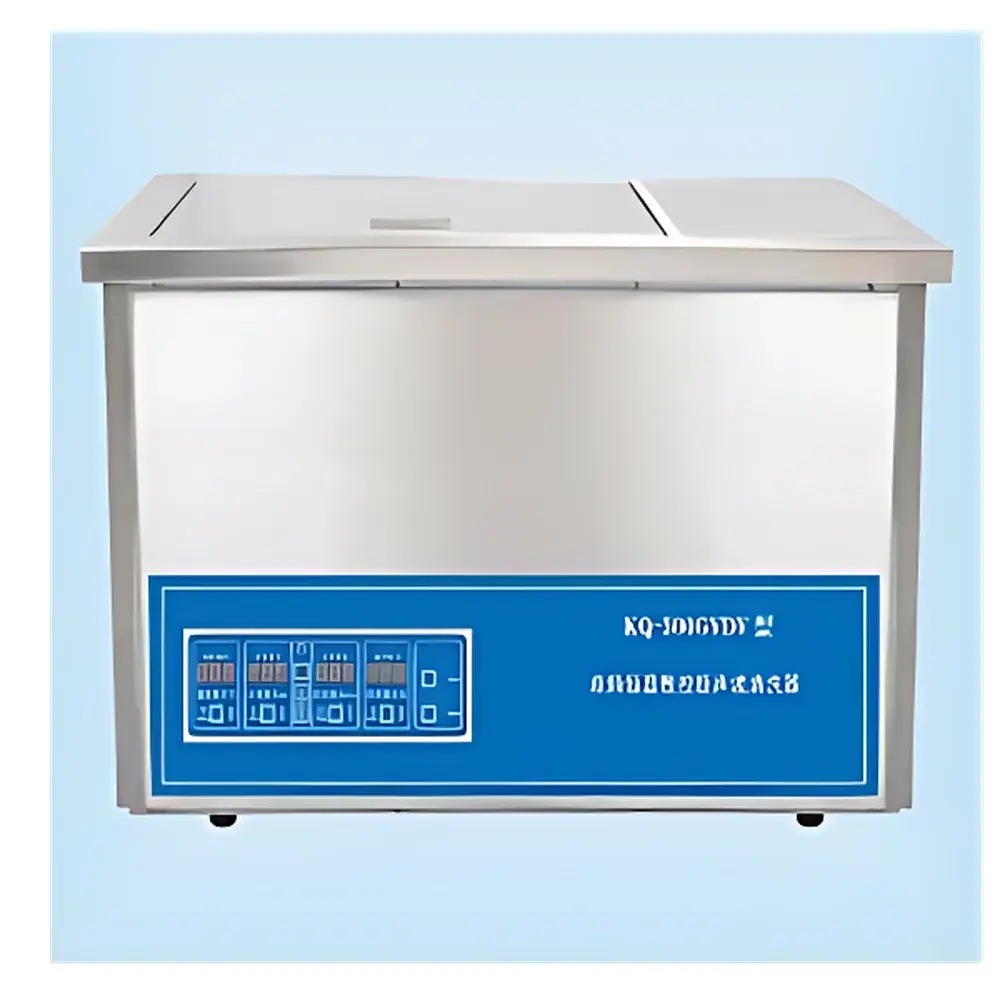
KQ-500GVDV Dual-Frequency Temperature-Controlled Ultrasonic Cleaner
| Brand | — |
|---|---|
| Origin | Jiangsu, China |
| Manufacturer Type | Authorized Distributor |
| Product Category | Domestic |
| Model | KQ-500GVDV |
| Instrument Type | General-Purpose |
| Capacity | 27 L |
| Dimensions (W×D×H) | 910 × 490 × 540 mm |
| Inner Tank Dimensions | 500 × 300 × 180 mm |
| Ultrasonic Frequencies | 45 kHz / 80 kHz |
| Adjustable Ultrasonic Time | 1–999 s |
| Ultrasonic Power Output | 500 W (40–100% adjustable) |
| Heating Power | 800 W |
| Cooling Power | 350 W |
| Temperature Control Range | 0–80 °C |
| Temperature Stability | ±2 °C |
| Water Level Monitoring | Yes |
| Power Supply | 220 V / 50 Hz |
| Accessories | Stainless Steel Basket, Acoustic Lid, Electric Inlet/Drain Control |
Overview
The KQ-500GVDV Dual-Frequency Temperature-Controlled Ultrasonic Cleaner is engineered for laboratories requiring precise thermal management during ultrasonic processing. Unlike conventional ultrasonic cleaners, this system integrates a sealed, fluorine-free compressor-based cooling module with high-efficiency resistive heating—enabling automatic alternation between heating and cooling modes to maintain solution temperature within ±2 °C across extended operation cycles. Its dual-frequency transducer array operates at 45 kHz and 80 kHz, delivering complementary cavitation profiles: lower frequency enhances macro-scale particle dislodgement and bulk energy transfer, while higher frequency improves micro-cleaning resolution and surface interaction uniformity. This architecture supports applications where thermal stability directly influences reaction kinetics, solubility equilibrium, or structural integrity—such as botanical extraction, nanomaterial dispersion, precision component degreasing, and analytical sample preparation prior to HPLC or ICP-MS analysis.
Key Features
- Dual-frequency ultrasonic generation (45 kHz / 80 kHz) with programmable auto-switching intervals for optimized cleaning efficiency across diverse sample matrices
- Microprocessor-controlled temperature regulation with real-time feedback loop; maintains setpoint within ±2 °C over 0–80 °C range
- Integrated refrigeration circuit using hermetically sealed, non-CFC compressor—eliminates ozone-depleting refrigerants and ensures long-term thermal cycle reliability
- Digitally monitored operational parameters: ultrasonic duration (1–999 s), power level (40–100%), actual and set temperature, water level, and voltage/current status
- Stainless steel tank (500 × 300 × 180 mm internal) with acoustic lid and thermal insulation—reduces noise emission (<55 dB(A)) and minimizes heat loss
- Automatic frequency sweeping circuitry to prevent transducer resonance drift and ensure consistent cavitation intensity
- Electrically actuated inlet and drain valves for repeatable fluid handling—compatible with lab water purification systems and waste neutralization protocols
Sample Compatibility & Compliance
The KQ-500GVDV accommodates a broad spectrum of laboratory substrates—including glassware, stainless steel tools, silicon wafers, ceramic filters, polymer membranes, and delicate biological specimens—provided compatible cleaning solutions are selected per material compatibility guidelines (e.g., ASTM D4290 for solvent safety). Its sealed thermal management system complies with IEC 61000-6-3 (EMC emissions) and IEC 61010-1 (safety requirements for electrical equipment). While not certified for sterile processing under ISO 13485 or FDA 21 CFR Part 820, the unit supports GLP-compliant workflows when integrated into validated cleaning SOPs—particularly where temperature consistency is critical for method reproducibility (e.g., USP on ultrasonic cleaning validation).
Software & Data Management
Operation is managed via an embedded single-chip controller with non-volatile memory for parameter retention across power cycles. All settings—including frequency selection, time/power profiles, temperature ramp rates, and duty cycles—are stored digitally and recalled without recalibration. The interface provides simultaneous display of setpoints and real-time values for temperature, water level, and ultrasonic output. Though no external PC connectivity (e.g., USB/Ethernet) is included, event logs—including over-temperature alerts, low-water shutdowns, and power fault triggers—are timestamped and retained for internal audit. Optional RS-232 interface kits enable integration with centralized lab monitoring platforms supporting Modbus RTU protocol.
Applications
- Temperature-sensitive extractions: herbal active compound isolation, lipid recovery from algae biomass, and polysaccharide release from fungal cell walls
- Precision cleaning of optical components, MEMS devices, and semiconductor fixtures where thermal shock must be avoided
- Ultrasonic-assisted dissolution of poorly soluble APIs in formulation development (per USP )
- Dispersion stabilization of carbon nanotubes, graphene oxide, and metal-organic frameworks (MOFs) in aqueous/organic media
- Deagglomeration of catalyst powders prior to BET surface area analysis or XRD characterization
- Removal of organic residues from GC vials, HPLC columns, and electrophoresis tanks without thermal degradation
FAQ
What is the purpose of dual-frequency operation?
Dual-frequency mode enables sequential or alternating excitation at 45 kHz and 80 kHz to broaden the cavitation spectrum—improving removal of both large particulates and submicron contaminants across heterogeneous surfaces.
Can the unit operate continuously at elevated temperatures?
Yes—continuous operation is supported up to 80 °C; the compressor-heater coordination prevents thermal runaway and ensures stable bath conditions for durations exceeding 480 minutes.
Is the stainless steel tank passivated for corrosion resistance?
The inner tank is fabricated from AISI 304 stainless steel with electropolished finish, providing enhanced resistance to chlorinated and acidic cleaning agents commonly used in analytical labs.
How is water level monitored and protected?
Capacitive-level sensing detects minimum fill volume; if below threshold, ultrasonic output is disabled and an audible/visual alert activates to prevent transducer damage.
Does the system support regulatory traceability for QC/QA environments?
While lacking built-in electronic signatures or 21 CFR Part 11 compliance, its digital parameter logging and hardware interlocks support manual audit trails required under ISO/IEC 17025 and GMP Annex 15 verification protocols.



