
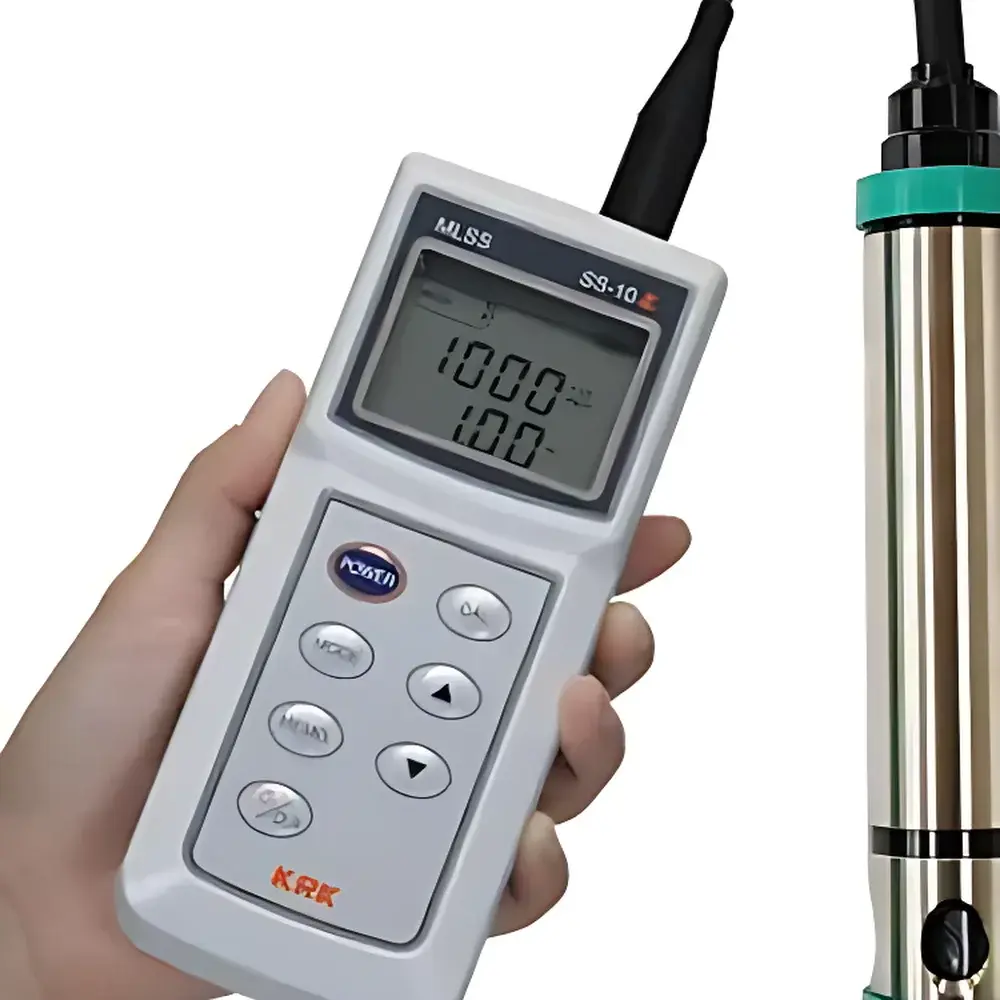
KRK SS-10Z MLSS and Sludge Interface Depth Gauge
| Brand | KRK |
|---|---|
| Origin | Japan |
| Model | SS-10Z |
| Measurement Principle | Near-Infrared Transmission Photometry + Semiconductor Pressure Sensing |
| MLSS Range | 0–20,000 mg/L (display up to 30,000 mg/L) |
| Interface Depth Range | 0–5.00 m (extendable to 10.00 m with optional cable) |
| Resolution | MLSS: 10 mg/L (0–10,000 mg/L), 100 mg/L (10,000–30,000 mg/L) |
| Depth | 0.01 m |
| Accuracy | MLSS: ±2% of reading (≤5,000 mg/L) or ±150 mg/L |
| Depth | ±0.03 m |
| Repeatability | Verified under controlled lab conditions per JIS Z 8015 |
| Calibration Options | 1-point (zero), 2-point (zero/span), or 3–4-point multi-concentration calibration |
| IP Rating | IP67 |
| Power | 3× AA alkaline batteries (LR03), auto-off after 30 min |
| Detector Type | SSD-10Z integrated optical-pressure probe |
| Cable | Standard 6 m (max. 11 m) |
| Weight | Instrument body: ~300 g |
| Detector assembly | 550 g (incl. cable) |
| Compliance | Designed for use in wastewater treatment plants operating under ISO 5667-16, ASTM D3693, and JIS K 0102 environmental testing frameworks |
Overview
The KRK SS-10Z is a field-deployable, dual-parameter sludge monitoring instrument engineered for simultaneous real-time measurement of mixed liquor suspended solids (MLSS) concentration and sludge blanket interface depth in activated sludge tanks, clarifiers, and thickening basins. Its operational principle integrates near-infrared (NIR) transmission photometry—using a stabilized 850 nm LED source—and semiconductor-based hydrostatic pressure sensing within a single compact probe (SSD-10Z). The NIR optical path employs a reference photodiode to continuously monitor source intensity, enabling active compensation for LED aging and thermal drift—a critical design feature that maintains long-term photometric stability without requiring frequent recalibration. The pressure sensor measures hydrostatic head relative to the probe’s immersion depth, allowing precise calculation of sludge interface elevation when combined with MLSS gradient analysis. Unlike turbidity-only sensors, the SS-10Z applies application-specific linearization algorithms derived from over three decades of empirical sludge characterization data across municipal and industrial wastewater streams.
Key Features
- Integrated dual-sensing architecture: Simultaneous NIR transmission (MLSS) and pressure-based depth measurement in one probe.
- Reference-light compensation system: Real-time correction for LED output decay and ambient temperature fluctuations, ensuring <±2% repeatability at ≤5,000 mg/L.
- Application-tailored measurement modes: Preloaded linearization curves for dairy, food processing, septic tank, municipal wastewater, anaerobic digesters, and gravity thickeners—each optimized for characteristic particle size distribution and organic loading profiles.
- Dynamic interface alerting: Visual alarm (“ALM” + “mg/L” flashing) triggers when MLSS exceeds user-defined thresholds (configurable ≥15,000 mg/L), with concurrent display of corresponding interface depth.
- Ruggedized field design: IP67-rated housing, shock-absorbing rubber buffer mounts on detector body, ergonomic handheld unit with non-slip grip, and battery-powered operation (3× LR03, 30-min auto-off).
- Multi-point calibration support: Flexible zero, two-point (zero/span), or 3–4 point calibration using certified reference sludge suspensions—fully traceable to NIST-traceable standards.
Sample Compatibility & Compliance
The SS-10Z is validated for use in aerobic and anoxic zones of conventional activated sludge systems, oxidation ditches, membrane bioreactors (MBRs), and primary/secondary clarifiers. It accommodates variable sludge rheology—including high-fat dairy effluents, fibrous food waste slurries, and mineral-rich municipal biosolids—via its adaptive linearization engine. While optimized for MLSS concentrations between 500–12,000 mg/L, it maintains functional output up to 30,000 mg/L (display-limited to 20,000 mg/L). Optical performance may diminish in highly colored or strongly absorbing matrices (e.g., dye-house or pharmaceutical wastewaters); users are advised to conduct site-specific validation per ISO 5667-16 Annex B. The device meets IEC 60529 (IP67), complies with electromagnetic compatibility requirements per EN 61326-1, and supports GLP-aligned audit trails when paired with KRK’s optional data logging software.
Software & Data Management
Though the SS-10Z operates as a standalone field meter, its analog/digital hybrid output architecture enables seamless integration with plant SCADA systems via optional RS-485 or 4–20 mA interfaces (available as add-on modules). KRK’s free PC utility (SS-Config v2.1) permits firmware updates, alarm threshold configuration, mode selection, and calibration coefficient management. All calibration events—including date, operator ID, standard values used, and deviation logs—are stored locally in non-volatile memory with time stamps, satisfying basic 21 CFR Part 11 data integrity expectations for non-critical process monitoring. Raw readings export to CSV for post-processing in LIMS or statistical process control platforms.
Applications
- Optimizing return activated sludge (RAS) pumping schedules by tracking dynamic interface migration during diurnal load cycles.
- Validating secondary clarifier performance against ISO 11508 and EPA Method 160.1 criteria for settleability assessment.
- Monitoring digester feed consistency in anaerobic digestion trains to prevent hydraulic overloading.
- Supporting compliance reporting for NPDES permits requiring sludge blanket depth monitoring in tertiary treatment facilities.
- Field verification of online MLSS analyzers during commissioning or periodic QA/QC audits.
FAQ
Can the SS-10Z measure in highly colored or chemically aggressive wastewater?
It is calibrated for typical biological sludges; strong chromophores (e.g., textile dyes) or oxidants may attenuate NIR signal integrity. Site-specific verification is recommended.
What is the maximum cable length supported for submersion?
Standard cable is 6 m; extended versions up to 11 m are available with reinforced shielding and pressure-compensated connectors.
Does the device require annual factory recalibration?
No—its reference-light stabilization eliminates routine factory recalibration. Field 2-point verification every 6 months is sufficient for most applications.
Is the pressure sensor affected by temperature-induced density changes in warm sludge?
Yes—density variation impacts hydrostatic head interpretation. The SS-10Z includes optional temperature compensation input (via external Pt100) for high-accuracy depth calculation above 30°C.
How is zero calibration performed in situ?
Using deionized water or clarified effluent in a clean calibration vessel; the instrument supports dry-air zeroing only for pressure sensor offset verification—not for optical zero.







