
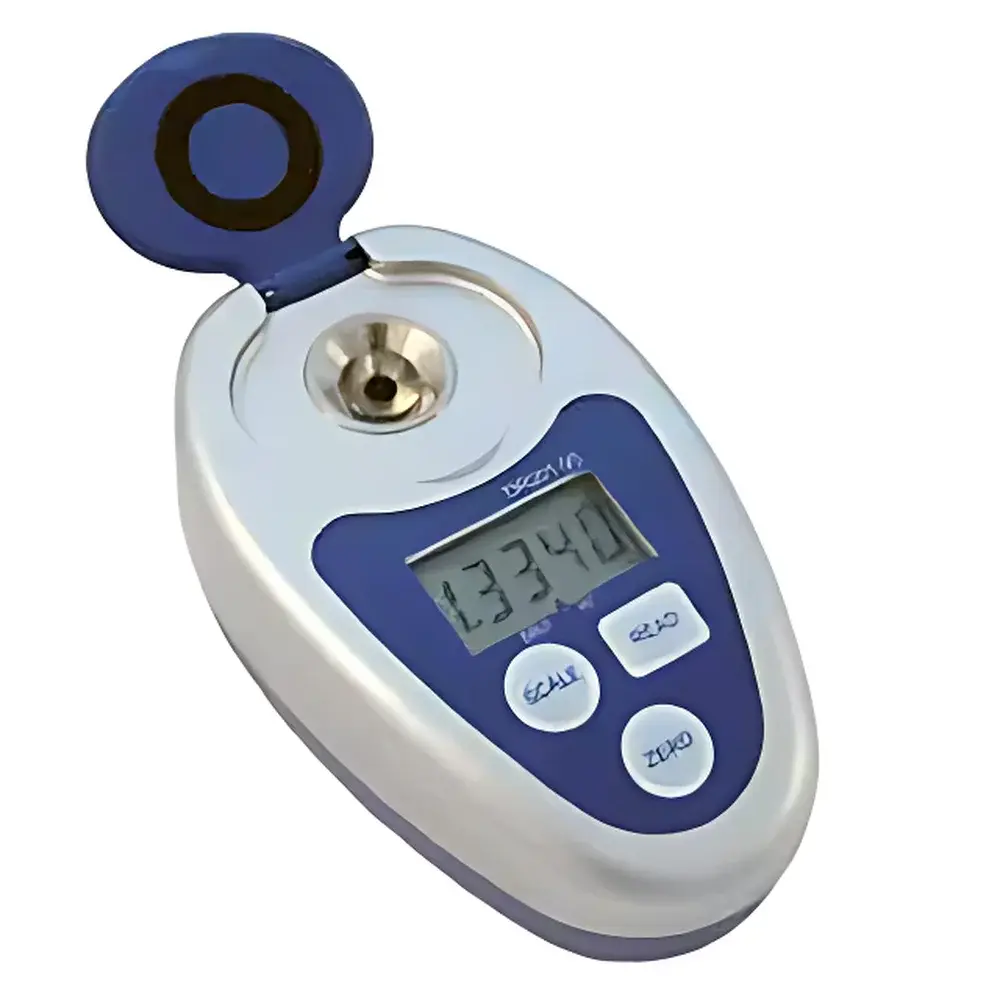
KRUESS DR301-95 / DR201-95 / DR101-60 Digital Portable Refractometers
| Brand | KRUESS |
|---|---|
| Origin | Germany |
| Model Range | DR301-95, DR201-95, DR201-95-OE, DR101-60 |
| Measurement Range | 1.3330–1.5318 nD (DR301-95/DR201-95), 1.3330–1.4419 nD (DR101-60) |
| Brix Range | 0–95 % (DR301-95/DR201-95), 0–60 % (DR101-60), 0–250 °Oechsle (DR201-95-OE) |
| Refractive Index Accuracy | ±0.00015 nD (DR301-95), ±0.0003 nD (DR201-95), ±0.0005 nD (DR101-60) |
| Brix Accuracy | ±0.1 % (DR301-95), ±0.2 % (DR201-95), ±0.25 % (DR101-60) |
| Resolution | 0.0001 nD / 0.1 %Brix (all models) |
| Temperature Measurement Range | –40 to +40 °C (DR301-95), 0 to +40 °C (others) |
| Temp. Accuracy | ±0.5 °C |
| Temp. Compensation Range | 5–40 °C (DR301-95), 10–40 °C (others) |
| Prism Material | Optical glass |
| Housing | Impact-resistant polymer (DR301-95), IP65-rated waterproof casing (DR101-60) |
| Power | 9 V alkaline battery (DR301-95), two 1.5 V AAA batteries (DR201-95 & DR101-60) |
| Dimensions (L×W×H) | 180×100×60 mm (DR301-95), 130×80×40 mm (DR201-95), 110×62×32 mm (DR101-60) |
| Weight | 500 g (DR301-95), 200 g (DR201-95), 160 g (DR101-60) |
Overview
The KRUESS DR301-95, DR201-95, and DR101-60 series are precision digital portable refractometers engineered for rapid, field-deployable measurement of refractive index (nD) and derived concentration units—including %Brix, %NaCl, °Oechsle, and user-defined scales—based on the fundamental optical principle of total internal reflection at the prism-sample interface. Each instrument employs a high-stability Abbe-type optical glass prism coupled with a temperature-compensated photodiode array detector and microprocessor-controlled signal processing. Unlike analog handheld units reliant on subjective visual interpolation, these devices deliver objective, repeatable digital readouts traceable to NIST-traceable calibration standards. Designed for compliance-critical environments, all models meet ISO 21747:2020 (Refractometers — Performance requirements and test methods) and support GLP/GMP-aligned operation through built-in calibration logging, timestamped measurements, and non-volatile memory storage.
Key Features
- Triple-scale measurement capability: simultaneous display of refractive index (nD), %Brix, and %NaCl—with optional °Oechsle scaling (DR201-95-OE) or two fully customizable user-defined calibration curves (DR301-95 only)
- Integrated Peltier-free automatic temperature compensation (ATC) across operational ranges: 5–40 °C (DR301-95), 10–40 °C (DR201-95 & DR101-60), ensuring measurement stability without external thermostats
- High-resolution optical detection: 0.0001 nD resolution and ±0.00015 nD accuracy (DR301-95) enable detection of subtle compositional shifts in process streams or quality control samples
- Ruggedized industrial design: DR101-60 features an IP65-rated waterproof housing suitable for washdown environments; DR301-95 includes a stainless-steel sample stage for rapid cleaning and resistance to corrosive agents
- Battery-operated portability: 9 V alkaline power (DR301-95, >10,000 readings per charge) or dual AAA cells (DR201-95/DR101-60, >1,000 readings), eliminating dependency on mains power during field audits or production line checks
- Onboard data management: DR301-95 supports USB connectivity for direct export of measurement logs (CSV format) to LIMS or QA databases; configurable pass/fail alarm thresholds with audible feedback
Sample Compatibility & Compliance
All three models accept aqueous and low-viscosity organic solutions (e.g., sucrose syrups, brines, ethanol-water mixtures, glycol-based coolants, pharmaceutical excipient solutions) with minimal sample volume (0.3–0.5 mL). The optical glass prism is chemically inert to common food-grade acids, alkalis, and alcohols—validated per ASTM D1218 for refractometer prism compatibility. Calibration is performed using certified reference materials: Type I deionized water (nD = 1.3330 at 20 °C) for zero-point verification, and sucrose standard solutions traceable to NIST SRM 84d. Instruments comply with EU Directive 2014/30/EU (EMC), RoHS 2011/65/EU, and carry CE marking. DR301-95 firmware supports audit trail generation required under FDA 21 CFR Part 11 for electronic records in regulated pharmaceutical and biotech manufacturing.
Software & Data Management
The DR301-95 integrates with KRUESS RefraSoft™ PC software (Windows 10/11 compatible) for advanced data handling: real-time graphing of temporal nD trends, statistical process control (SPC) charting (X̄/R charts), batch report generation with operator ID, instrument serial number, and environmental metadata. All measurement events—including calibration date, ambient temperature, and user-defined parameters—are stored in encrypted internal memory (≥500 entries) with tamper-evident timestamps. Exported CSV files include ISO 8601-formatted timestamps and uncertainty annotations per GUM (JCGM 100:2008) guidelines. No proprietary drivers required—USB connection emulates standard CDC ACM class for plug-and-play interoperability with laboratory information systems (LIS) and MES platforms.
Applications
These refractometers serve as primary QC tools across regulated and industrial sectors. In beverage and sugar refining, they verify syrup concentration pre-evaporation and final product Brix consistency per AOAC 932.12. In pharmaceutical manufacturing, they monitor excipient solution density for oral liquid formulations compliant with USP . In metalworking fluid management, real-time nD tracking detects coolant degradation or contamination per ISO 6743-2. Wastewater treatment plants use them for rapid estimation of dissolved solids (TDS) in influent streams (correlation coefficient r² ≥ 0.98 vs. gravimetric TDS). Additional validated applications include: paper pulp consistency (ISO 535), textile dye bath concentration (AATCC Test Method 108), and antifreeze glycol concentration in automotive and HVAC systems (ASTM D1120).
FAQ
What calibration standards are required for daily verification?
Deionized water (nD = 1.3330 at 20 °C) is mandatory for zero-point calibration; optional secondary verification uses certified sucrose standards (e.g., 10 %Brix ±0.02 %Brix).
Can the DR101-60 be used in wet or outdoor environments?
Yes—the IP65-rated enclosure protects against dust ingress and low-pressure water jets, enabling safe operation in food processing washdown zones or field sampling locations.
Is temperature compensation linear across the full range?
Compensation follows a third-order polynomial algorithm derived from empirical nD/T data for aqueous sucrose solutions (0–95 %Brix), minimizing residual error to <±0.00005 nD between 10–40 °C.
How is measurement traceability maintained for regulatory audits?
DR301-95 stores calibration history with digital signatures; exported reports include instrument ID, firmware version, calibration certificate numbers, and operator credentials—fully aligned with ALCOA+ data integrity principles.
Do these instruments require annual factory recalibration?
No—KRUESS certifies 24-month calibration stability under normal operating conditions; users perform interval verification per internal SOPs using traceable standards, with optional accredited recalibration services available via KRUESS Service Centers in Hamburg and Singapore.





