
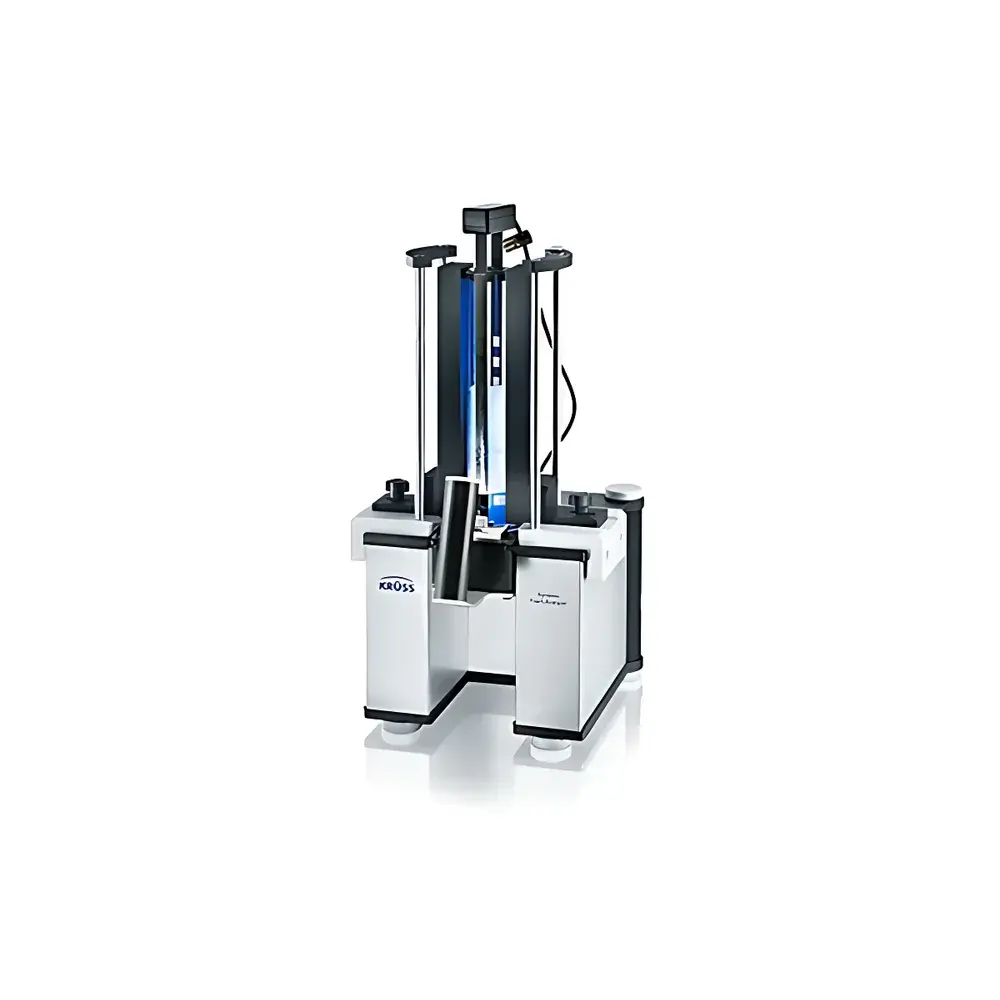
Krüss DFA100 Dynamic Foam Analyzer
| Brand | Krüss |
|---|---|
| Origin | Germany |
| Model | DFA100 |
| Optical Sensor Resolution | 1728 × 1 px |
| Light Source | LED (Main Wavelength: 469 nm |
| IR Auxiliary | 850 nm) |
| Height Resolution | 200 dpi (0.125 mm) |
| Time Resolution | 20 fps |
| Scan Height | 216 mm |
| Gas Flow Rate (Internal) | 0.2–1.0 L/min |
| Gas Flow Rate (External) | 0.05–1.0 L/min |
| Operating Pressure | 5 ± 0.5 bar |
| Stirring Speed | up to 8000 rpm |
| Temperature Range | 4–90 °C |
| Compatible Gases | Air, N₂, CO₂ |
Overview
The Krüss DFA100 Dynamic Foam Analyzer is a precision-engineered instrument designed for quantitative, time-resolved characterization of foam generation and decay kinetics in liquid systems. Based on high-speed optical imaging and controlled gas dispersion or mechanical agitation, the DFA100 applies standardized physical measurement principles—namely, real-time height profiling via linear CCD sensor arrays and calibrated gas flow dynamics—to quantify key interfacial phenomena including foaming capacity, foam stability, drainage behavior, and liquid fraction evolution. Unlike static foam tests (e.g., Ross-Miles), the DFA100 captures the full temporal profile of foam formation and collapse under programmable, reproducible conditions—enabling correlation between formulation variables (surfactant type, concentration, electrolyte content, temperature) and macroscopic foam response. Its architecture supports both fundamental research into surfactant adsorption kinetics and applied development in industrial formulations where foam control is critical—such as detergents, fire-fighting foams, food emulsions, and mineral flotation slurries.
Key Features
- High-resolution optical detection system with 1728 × 1 px linear CCD sensor and dual-wavelength illumination (469 nm visible + 850 nm infrared) for robust contrast across diverse foam structures and opaque liquids.
- Time-resolved imaging at 20 frames per second, enabling accurate capture of rapid foam initiation (<1 s) and transient collapse events—including short-lived metastable foam states.
- Dual foam generation modes: precise electronic mass-flow-controlled sparging (internal/external gas lines) and high-speed mechanical stirring (up to 8000 rpm), each independently programmable for process-relevant simulation.
- Integrated temperature control module supporting measurements from 4 °C to 90 °C, facilitating studies of thermal effects on foam lifetime and drainage kinetics.
- Modular design allowing optional add-ons for liquid fraction analysis (conductivity or optical transmission modules) and bubble size distribution assessment via image segmentation algorithms.
- Gas compatibility with air, nitrogen, and carbon dioxide—enabling evaluation of pH-sensitive or oxidation-prone systems without artifact introduction.
Sample Compatibility & Compliance
The DFA100 accommodates aqueous and non-aqueous solutions, suspensions, and low-viscosity dispersions (typically < 100 mPa·s). Sample volumes range from 20 mL to 250 mL depending on vessel configuration. The system complies with measurement traceability requirements outlined in ISO 697 and ASTM D1173 for foaming tendency and stability testing. When operated with validated SOPs and audit-trail-enabled software (see Software & Data Management), data generated meets GLP and GMP documentation standards. All wetted parts are chemically resistant (borosilicate glass, PTFE, stainless steel 316), ensuring compatibility with aggressive surfactants, acids, bases, and organic solvents commonly used in formulation labs.
Software & Data Management
Krüss FoamScan™ software provides intuitive method setup, real-time visualization, and automated parameter extraction—including maximum foam height (Hmax), foam volume index, liquid hold-up, half-life (t1/2), drainage onset time, and decay rate constants. Export formats include CSV, Excel, and PDF reports compliant with 21 CFR Part 11 requirements when configured with user authentication, electronic signatures, and immutable audit trails. Batch processing enables statistical comparison across multiple formulations or aging conditions. Raw image sequences are stored with metadata (timestamp, gas flow, temperature, stir speed), supporting retrospective reanalysis and machine learning–based feature extraction.
Applications
- Surfactant screening and structure–function relationship studies in R&D laboratories.
- Optimization of detergent and cleaning agent formulations for controlled foaming or defoaming performance.
- Fire suppression foam development and certification testing per NFPA 11 and EN 1568.
- Food-grade foam stability assessment in dairy, confectionery, and beverage applications (e.g., whipped toppings, beer head retention).
- Flotation reagent evaluation in mining—correlating froth stability with mineral recovery efficiency.
- Antifoam and defoamer efficacy testing under process-simulated conditions (e.g., elevated temperature, shear, gas composition).
- Coating and paint formulation development where entrained air impacts film uniformity and defect formation.
- Wastewater treatment process modeling—foam carryover prediction and mitigation strategy validation.
FAQ
What foam parameters does the DFA100 measure automatically?
It calculates maximum foam height, foam half-life, drainage onset time, liquid fraction profiles, foam volume index, and time-dependent foam height decay curves.
Can the DFA100 operate with corrosive or high-pH solutions?
Yes—standard sample vessels use borosilicate glass and PTFE seals; optional Hastelloy components are available for highly aggressive media.
Is temperature control integrated or external?
A fully integrated Peltier-based heating/cooling module maintains ±0.2 °C stability across the 4–90 °C range without requiring external chillers or baths.
How is gas flow accuracy ensured during long-term experiments?
Mass flow controllers (MFCs) with NIST-traceable calibration are factory-installed and verified annually per ISO/IEC 17025 guidelines.
Does the system support regulatory-compliant data archiving?
When deployed with FoamScan™ Enterprise Edition and configured with role-based access control, it satisfies FDA 21 CFR Part 11, EU Annex 11, and ISO 13485 data integrity requirements.



