
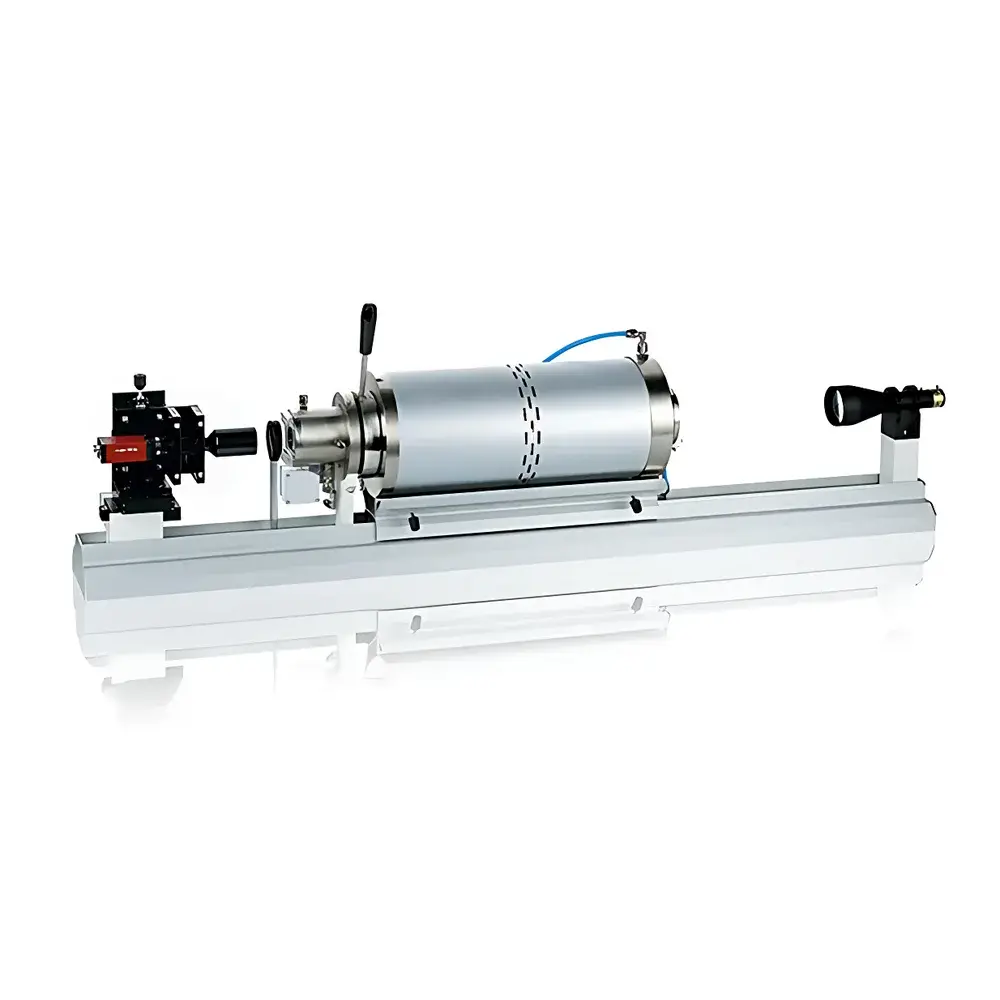
Krüss DSA High-Temperature Drop Shape Analyzer
| Brand | Krüss |
|---|---|
| Origin | Germany |
| Model | DSA |
| Max Operating Temperature | 2000 °C |
| Atmosphere Options | Oxidizing, Reducing, Inert Gas, Vacuum |
| Measurement Principle | Optical Contact Angle Analysis via High-Resolution CCD Imaging |
| Sample Environment | Non-contact, Gravity-driven Droplet Shape Evolution under Controlled Thermal Ramp |
| Compliance | ASTM D1857 (Ash Fusibility), ISO 562 (Coal Ash Fusibility), GLP/GMP-ready Data Audit Trail |
Overview
The Krüss DSA High-Temperature Drop Shape Analyzer is an engineered optical instrument designed for in situ, non-contact analysis of molten material behavior under precisely controlled thermal and atmospheric conditions. Based on the fundamental principle of sessile drop contact angle measurement—governed by Young’s equation and interfacial energy balance—the system quantifies wettability, surface tension, and dynamic shape evolution of liquid phases in contact with solid substrates at elevated temperatures. Unlike conventional room-temperature contact angle systems, the DSA-HT integrates a high-stability high-temperature furnace (up to 2000 °C), multi-spectral optical filtering, and real-time image acquisition synchronized with thermal profiling. This enables direct observation of time- and temperature-dependent interfacial phenomena—including spreading kinetics, dewetting onset, interfacial reaction layer formation, and melt–substrate adhesion—critical for process understanding in metallurgy, glass manufacturing, ceramic sintering, and ash fusibility assessment.
Key Features
- Temperature-controlled furnace with programmable ramp rates (0.1–50 K/min) and stability ≤ ±1 K at target setpoints up to 2000 °C
- High-resolution monochrome CCD camera (≥ 5 MP) with adjustable frame rate (1–30 fps) and synchronized thermal triggering
- Dual-band optical filtering system to suppress thermal emission from incandescent samples, ensuring high-contrast silhouette imaging for robust edge detection
- Modular atmosphere chamber supporting operation under air, synthetic air, N₂, Ar, H₂/N₂ mixtures, CO/CO₂ blends, or high-vacuum (≤ 10⁻³ mbar)
- Motorized XYZ sample stage with sub-micron positioning repeatability and rapid-load crucible holder compatible with Pt, Al₂O₃, graphite, and Mo substrates
- Real-time contact angle calculation using advanced contour fitting algorithms (Young–Laplace, axisymmetric drop shape analysis) with automatic baseline correction
- Integrated thermocouple monitoring (Type S or B) with spatially resolved temperature mapping across sample zone
Sample Compatibility & Compliance
The DSA-HT accommodates diverse sample forms: pressed powder compacts, pre-sintered pellets, machined substrate discs, and ash cones per ASTM D1857. It supports standard crucible geometries (Ø 8–12 mm) and permits direct deposition of molten phases (e.g., slags, glasses, metal alloys, biomass ash melts) onto refractory substrates. All measurements adhere to internationally recognized protocols for high-temperature interfacial characterization, including ISO 562 (coal ash fusibility), ASTM C1354 (glass–refractory interaction), and DIN 51068 (slag wetting behavior). The system architecture supports 21 CFR Part 11-compliant electronic records when paired with Krüss ADVANCE software, providing audit trails, user access control, and electronic signatures for regulated environments.
Software & Data Management
Krüss ADVANCE software provides full instrument control, thermal protocol definition, live image preview, and automated post-acquisition analysis. It computes contact angle, surface tension, base diameter, droplet height, and contact radius as continuous functions of time and temperature. Export formats include CSV, HDF5, and XML for integration into MATLAB, Python (NumPy/Pandas), or LIMS platforms. Batch processing allows comparative analysis across multiple runs under identical thermal profiles. Data integrity is ensured through timestamped metadata embedding (furnace power, gas flow rates, ambient pressure, camera exposure settings), and raw image archives are stored with lossless compression (TIFF/RAW). Software validation packages (IQ/OQ documentation) are available for GxP compliance.
Applications
- Metallurgical Process Optimization: Quantifying slag–refractory wettability to predict furnace lining erosion and optimize ladle design
- Glass Manufacturing: Evaluating interface reactivity between molten glass and alumina or zirconia-based refractories to mitigate devitrification and spalling
- Ceramic Sintering R&D: Monitoring green body deformation kinetics during heating to define optimal binder burnout and densification schedules
- Ash Fusibility Testing: Performing standardized ash cone tests (ASTM D1857) with digital morphology tracking beyond traditional softening/fusion point classification
- Enamel & Coating Development: Assessing molten enamel spreadability on steel or aluminum substrates to correlate contact angle hysteresis with final coating adhesion and defect formation
- Biomass & Waste-to-Energy Research: Characterizing low-melting eutectics in fly ash deposits to inform boiler tube material selection and sootblowing frequency
FAQ
What temperature accuracy and stability can be achieved during long-duration isothermal holds?
At 1600 °C, typical stability is ±0.8 K over 60 minutes with active PID feedback and dual-zone furnace control.
Can the system measure dynamic contact angles during heating ramps?
Yes—contact angle is calculated continuously at user-defined intervals (e.g., every 5 °C or 10 s), enabling kinetic modeling of wetting transitions.
Is calibration traceable to national standards?
Geometric calibration uses NIST-traceable stage micrometers; temperature calibration follows EURAMET cg-12 guidelines with certified reference thermocouples.
How is image quality maintained for highly emissive samples above 1500 °C?
Narrowband interference filters centered at 780 nm and 850 nm reject >99.9% of blackbody radiation outside these bands, preserving edge contrast without cooling the optical path.
Does the system support custom atmosphere switching during a single experiment?
Yes—gas sequencing is programmable via integrated mass flow controllers, allowing sequential exposure to oxidizing → inert → reducing atmospheres within one thermal cycle.



