
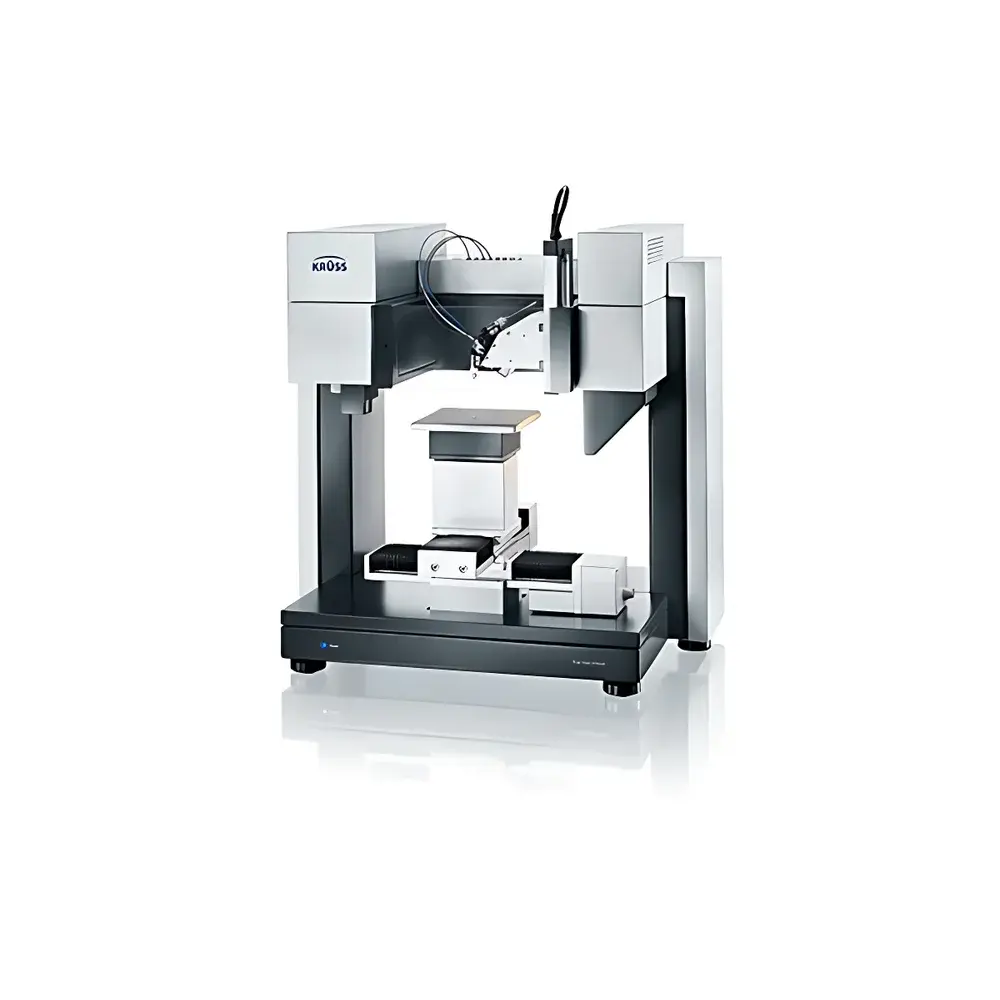
Krüss DSA100 Drop Shape Analyzer
| Brand | Krüss |
|---|---|
| Origin | Germany |
| Model | DSA100 |
| Measurement Principle | Contact Angle & Interfacial Tension Analysis via Image Processing |
| Temperature Range | –30 °C to 400 °C (with optional modules) |
| Humidity Control | Optional integrated chamber |
| Sample Positioning | Motorized 3-axis stage |
| Imaging System | High-resolution monochrome camera with motorized zoom lens and LED backlight |
| Software | ADVANCE v5.x with GLP-compliant audit trail, automated workflow sequencing, and ISO 19403 / ASTM D7334–18 compliant analysis algorithms |
| Compliance | Fully compatible with ISO 19403 (Parts 1–4), ASTM D7334–18, DIN 55660, and supports 21 CFR Part 11 data integrity requirements when configured with user authentication and electronic signature modules |
Overview
The Krüss DSA100 Drop Shape Analyzer is a high-precision optical instrument engineered for quantitative characterization of solid–liquid and liquid–liquid interfacial phenomena. It operates on the principle of digital image analysis of sessile, pendant, or captive bubbles/droplets, enabling rigorous determination of contact angles, surface and interfacial tensions, surface free energy components, and interfacial rheological properties (elastic modulus E′ and viscous modulus E″). Designed for research-grade reproducibility and industrial process validation, the DSA100 integrates a rigid optomechanical architecture with thermally stable illumination, motorized sample positioning, and calibrated imaging optics—ensuring sub-pixel droplet contour detection across dynamic wetting events and static equilibrium states. Its modular platform supports operation from cryogenic (–30 °C) to ultra-high temperature (up to 400 °C) environments, making it suitable for simulating real-world processing conditions in coating, adhesion, microelectronics, pharmaceutical formulation, and advanced materials development.
Key Features
- Motorized 3-axis precision stage for repeatable, vibration-damped sample positioning—enabling rapid repositioning without manual height adjustment.
- High-resolution monochrome CMOS camera with motorized zoom lens and uniform high-intensity LED backlight, optimized for sharp edge detection of microdroplets down to <100 µm diameter.
- Advanced optical path design featuring fixed-focus imaging geometry: once the viewing angle is calibrated, droplet centroid remains stationary in the field of view—eliminating iterative Z-height search routines.
- Integrated environmental control options: humidity-regulated sample chamber; temperature-controlled stages ranging from –10 °C to 120 °C (standard), –30 °C to 160 °C (rapid-change), and up to 400 °C (high-temp module).
- Dedicated hardware modules for specialized measurements: tilt stage for roll-off angle analysis; cylindrical/film/powder sample holders; picoliter-scale dispensing unit; bubble capture module for liquid–liquid interfacial tension; and interfacial rheology add-on for oscillatory pendant drop analysis.
- Robust enclosure housing all critical optical and fluidic components—including syringe pump, reservoir, prism, and camera—to minimize thermal drift and mechanical perturbation.
Sample Compatibility & Compliance
The DSA100 accommodates diverse substrate geometries and material classes—including wafers, thin films, textiles, porous media, powders, and curved surfaces (e.g., lenses, fibers)—via interchangeable sample stages and custom fixtures. Surface free energy calculations are performed using up to eight probe liquids per measurement cycle, supporting Owens–Wendt, Wu, van Oss–Chaudhury–Good, and Acid–Base models per ISO 19403–2/3/4. All contact angle and interfacial tension outputs comply with ASTM D7334–18 (Standard Test Method for Contact Angle Measurement of Solid Surfaces) and DIN 55660 (Coating Materials — Determination of Wettability). When deployed with ADVANCE software’s audit trail, user role management, and electronic signature configuration, the system meets data integrity requirements under FDA 21 CFR Part 11 and supports GLP/GMP laboratory workflows.
Software & Data Management
ADVANCE software (v5.x) provides a deterministic, menu-free interface where every measurement step—from droplet deposition and image acquisition to contour fitting and thermodynamic modeling—is explicitly defined in protocol files. Workflow automation eliminates operator-dependent variability: predefined sequences execute dispensing, image capture, environmental ramping, and post-processing in synchronized order. Built-in calibration tools verify pixel-to-length conversion, lens distortion, and baseline correction at runtime. Raw images, processed contours, numerical results, and metadata are stored in vendor-neutral HDF5 format, ensuring long-term archival integrity and third-party interoperability. Batch analysis, statistical reporting (mean ± SD, CV%), and export to CSV, Excel, or PDF are fully scriptable via Python API.
Applications
- Quantitative evaluation of plasma, corona, flame, or chemical surface treatments on polymers, metals, and ceramics.
- Optimization of inkjet printing, spray coating, and adhesive bonding processes through dynamic contact angle hysteresis mapping.
- Stability assessment of thin-film coatings and functional layers in semiconductor fabrication and display manufacturing.
- Surface cleanliness verification in medical device manufacturing and aerospace component cleaning validation.
- Interfacial viscoelasticity profiling of surfactant-laden oil–water interfaces relevant to emulsion stabilization and enhanced oil recovery.
- Wettability screening of battery separator membranes, fuel cell electrodes, and filtration media under controlled humidity and temperature.
FAQ
What standards does the DSA100 support for surface free energy calculation?
The system implements ISO 19403 Parts 1–4 and ASTM D7334–18 methodologies, with built-in support for multiple theoretical models including Owens–Wendt, Wu, and Acid–Base approaches.
Can the DSA100 measure interfacial rheology?
Yes—when equipped with the optional interfacial rheology module, it performs oscillatory pendant drop analysis to determine elastic (E′) and viscous (E″) moduli of fluid interfaces.
Is the ADVANCE software compliant with 21 CFR Part 11?
Full compliance requires configuration with user authentication, electronic signatures, and audit-trail logging—features available in ADVANCE Enterprise Edition.
What is the smallest droplet volume resolvable by the DSA100?
With the optional picoliter dispensing module, volumes as low as 10 pL can be deposited and analyzed reliably.
Does the DSA100 support automated multi-liquid surface energy analysis?
Yes—up to eight probe liquids can be loaded sequentially into the automated dispenser, with full workflow scripting for unattended multi-liquid contact angle acquisition and surface energy computation.



