
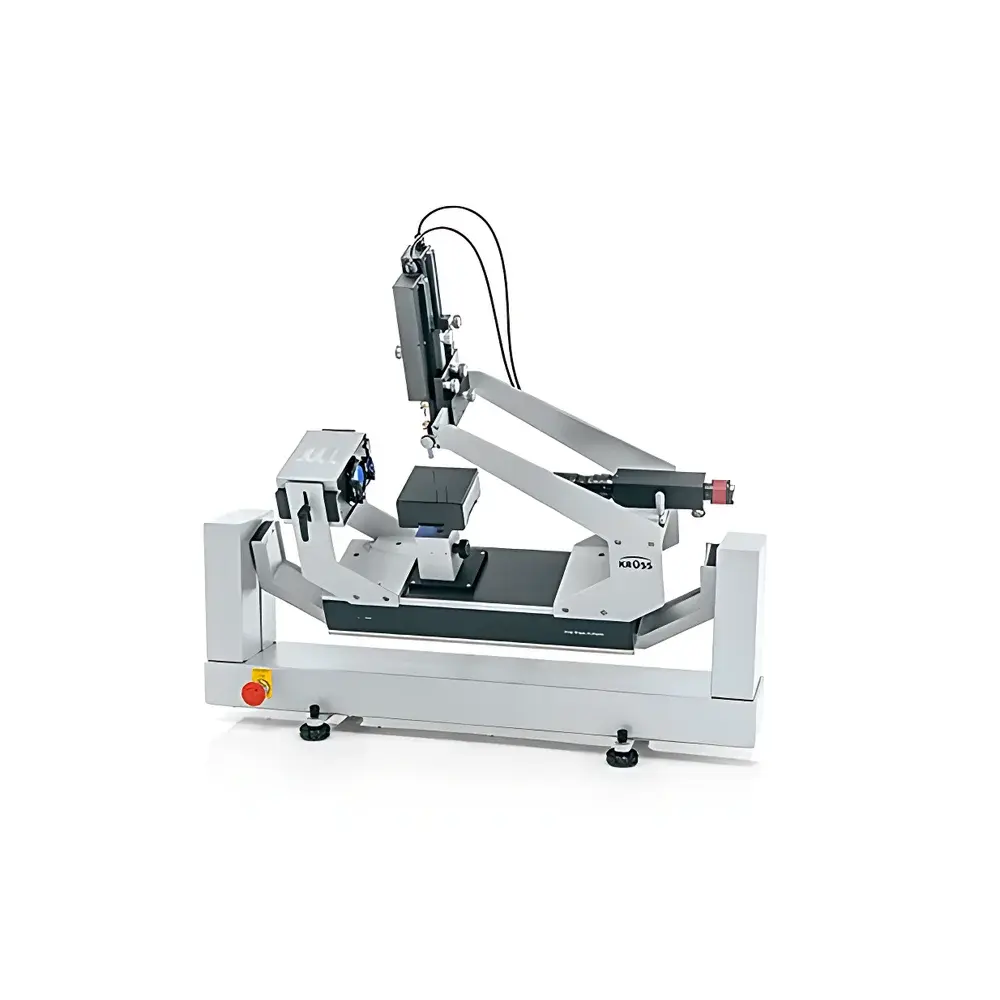
Krüss DSA25 Drop Shape Analyzer
| Brand | Krüss |
|---|---|
| Origin | Germany |
| Model | DSA25 |
| High-Speed Camera Options | CF03 (up to 2000 fps) / CF06 (up to 3400 fps) |
| Illumination | High-power monochromatic LED |
| Dispensing System | Up to 3 software-controlled dispensing units |
| Dispensing Mode | Liquid needle dispensing (optional) |
| Dispense Resolution | 0.1 µL |
| Tilt Range (internal) | 0–90°, Resolution: 0.01° |
| Contact Angle Range | 0–180°, Resolution: 0.01° |
| Surface/Interfacial Tension Range | 0.01–2000 mN/m, Resolution: 0.01 mN/m |
| Temperature Control Range | −30 to +400 °C |
| Humidity-Controlled Measurement Capability | Yes |
| Software | ADVANCE vX.X (compliant with GLP/GMP audit trail requirements) |
Overview
The Krüss DSA25 Drop Shape Analyzer is a precision-engineered optical instrument designed for quantitative analysis of solid–liquid and liquid–liquid interfacial phenomena. It operates on the principle of sessile drop, pendant drop, and tilting plate methodologies—leveraging high-resolution imaging and advanced contour fitting algorithms to extract contact angle, surface free energy, interfacial tension, and dynamic wetting behavior. As a core platform in surface science laboratories, the DSA25 supports both routine QC/QA workflows and research-grade investigations into wettability, adhesion, surface heterogeneity, and coating performance. Its modular architecture allows seamless integration of environmental control modules—including programmable temperature stages and humidity chambers—enabling measurements under physiologically or industrially relevant conditions (e.g., polymer processing, inkjet printing, biomedical device testing). The system complies with ISO 19403-2 (contact angle), ISO 19403-4 (surface free energy), and ASTM D7334 (surface energy of polymer films) standards.
Key Features
- High-speed imaging capability: Optional CF03 (2000 fps) or CF06 (3400 fps) camera modules for capturing rapid dynamic wetting events, such as droplet impact, spreading kinetics, or capillary rise.
- Precision dispensing system: Up to three independently controlled syringe pumps with 0.1 µL resolution; compatible with standard and custom needle geometries for reproducible droplet deposition.
- Motorized tilt stage: Integrated ±90° goniometer with 0.01° angular resolution for advancing/receding contact angle determination and critical surface tension analysis.
- Uniform monochromatic LED illumination: Optimized spectral output and collimation ensure consistent contrast and minimal distortion across the entire field of view—critical for accurate edge detection and Young–Laplace fitting.
- Adjustable Z-stage with magnetic sample holder: Enables rapid positioning and repeatable alignment of diverse substrates—including irregular, porous, or temperature-sensitive samples—without mechanical slippage.
- Thermal and environmental control readiness: Fully compatible with Krüss TCxx temperature controllers (−30 to +400 °C) and RHxx humidity modules, supporting ISO 18455-compliant environmental conditioning protocols.
Sample Compatibility & Compliance
The DSA25 accommodates rigid and flexible substrates up to 200 × 200 mm, including polymers, metals, ceramics, textiles, paper, thin films, and biological membranes. Its non-contact optical measurement principle eliminates sample damage or contamination. All hardware and software components meet CE marking requirements and conform to IEC 61000-6-3 (EMC) and IEC 61000-6-2 (immunity) standards. ADVANCE software includes full 21 CFR Part 11 compliance features—electronic signatures, role-based access control, immutable audit trails, and data integrity validation—making it suitable for regulated environments (pharmaceutical, medical device, aerospace QA labs). Calibration procedures follow traceable NIST-recognized reference methods using certified contact angle standards (e.g., Krüss PTFE and glass calibration slides).
Software & Data Management
ADVANCE software provides a deterministic, workflow-driven interface optimized for metrological rigor—not graphical convenience. Each measurement sequence is defined as a reusable method file containing camera exposure, focus, dispensing volume, tilt profile, and analysis model parameters. Real-time image acquisition is synchronized with dispensing and stage motion via hardware triggers, minimizing timing jitter. Contact angle analysis employs multiple fitting models (Young–Laplace, Circle, Ellipse, Spline) with user-adjustable baseline detection and outlier rejection thresholds. Surface free energy calculation supports Owens–Wendt, Wu, Fowkes, van Oss–Chaudhury–Good, and Schultz models, with optional dispersion/polar component deconvolution. All raw images, metadata, and processed results are stored in vendor-neutral HDF5 format with embedded EXIF-like tags for long-term archival and third-party interoperability.
Applications
- Quantitative assessment of plasma, corona, flame, or chemical surface treatments on plastics and composites.
- Determination of critical surface tension (γC) for predicting ink adhesion or paint wetting on packaging films.
- Dynamic contact angle hysteresis analysis for evaluating anti-fouling or self-cleaning surface performance.
- Surface free energy mapping of heterogeneous coatings, printed electronics, or functionalized biomaterials.
- Interfacial tension measurement of surfactant-laden oil–water systems for formulation optimization in agrochemicals and cosmetics.
- Temperature-dependent wettability studies during thermal cycling of solder pastes, battery separators, or heat exchanger surfaces.
FAQ
What contact angle models are supported in ADVANCE software?
Circle, ellipse, Young–Laplace, and spline-based contour fitting models are natively implemented—with automatic model selection based on droplet symmetry and contact line definition.
Can the DSA25 measure interfacial tension between two immiscible liquids?
Yes—using the pendant drop method for liquid–liquid interfaces, with density correction applied via user-input or integrated fluid property database.
Is remote operation and data export supported?
Yes—ADVANCE supports TCP/IP-based remote monitoring, scheduled unattended runs, and batch export to CSV, Excel, or MATLAB-compatible formats with full metadata preservation.
How is calibration verified across operating conditions?
Calibration verification uses traceable reference solids (e.g., Krüss PTFE slide, γ = 18.5 mN/m) and reference liquids (e.g., water, diiodomethane) at defined temperatures—per ISO 19403-1 Annex A.
Does the system support GMP/GLP-compliant documentation?
Yes—ADVANCE generates electronic records compliant with FDA 21 CFR Part 11, including audit trails, electronic signatures, and version-controlled method files.



