
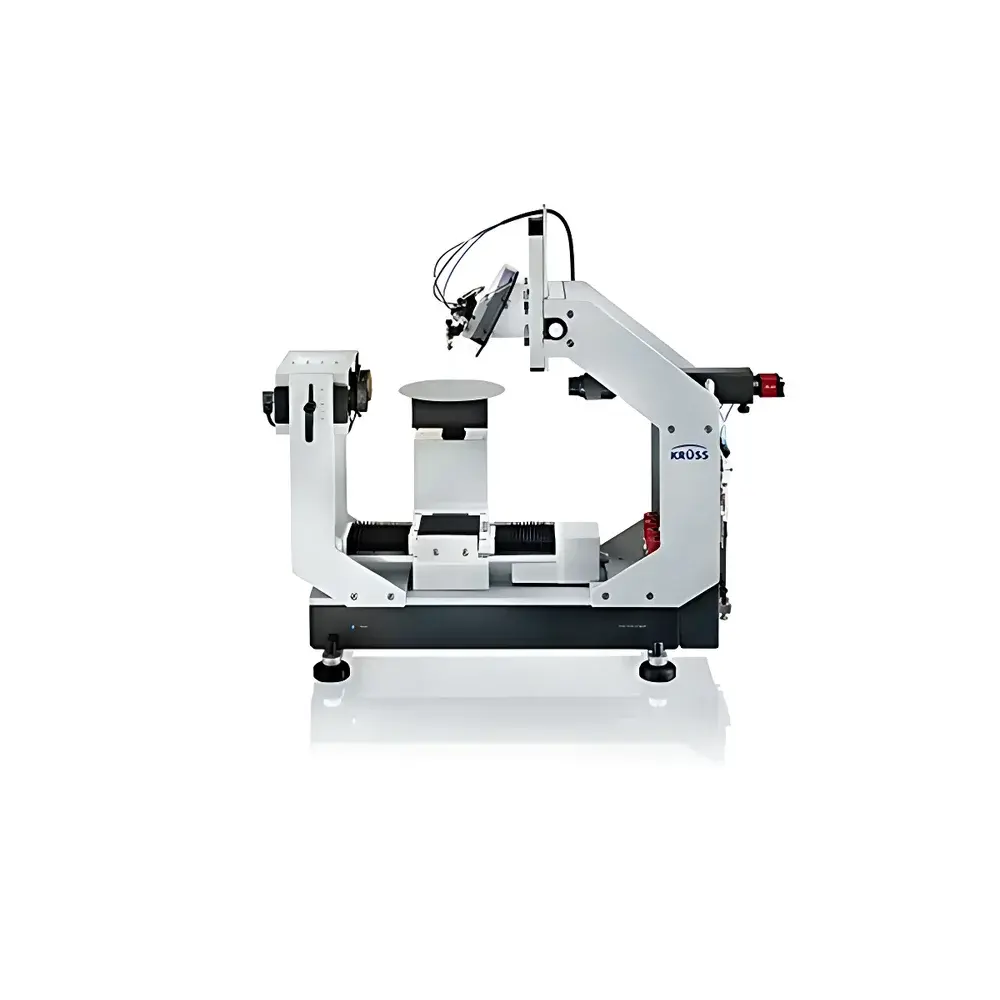
Krüss DSA30 Drop Shape Analyzer
| Brand | Krüss |
|---|---|
| Origin | Germany |
| Model | DSA30 |
| Camera System | CF03 (up to 2000 fps) / CF06 (up to 3400 fps) |
| Illumination | High-power monochromatic LED |
| Dispensing System | Up to 4 software-controlled or 1 manual syringe units |
| Dispensing Resolution | 0.1 µL |
| Tilt Range | 0–90° (built-in motorized tilt, 0.01° resolution) |
| Contact Angle Range | 0–180° |
| Contact Angle Resolution | 0.01° |
| Surface/Interfacial Tension Range | 0.01–2000 mN/m |
| Surface/Interfacial Tension Resolution | 0.01 mN/m |
| Temperature Control Range | –30 °C to +400 °C |
| Humidity Control | Optional environmental chamber integration |
| Software | ADVANCE v5.x with audit trail, user management, and SOP-based workflows |
Overview
The Krüss DSA30 Drop Shape Analyzer is an advanced optical tensiometer engineered for high-precision, reproducible measurement of contact angles, surface free energy, interfacial tension, and dynamic wetting behavior. Based on the pendant/sessile drop method and profile-fitting algorithms (e.g., Young–Laplace equation solving), the DSA30 quantifies interfacial phenomena by analyzing the shape of liquid droplets deposited on solid substrates—or suspended in immiscible phases—under controlled environmental conditions. Its modular architecture integrates high-speed imaging, motorized sample positioning, programmable liquid dispensing, and precision thermal/humidity regulation. Designed for routine quality control and fundamental surface science applications, the DSA30 delivers traceable, GLP-compliant data suitable for regulatory submissions, process validation, and material development workflows in pharmaceuticals, coatings, microelectronics, and advanced composites.
Key Features
- High-speed imaging options: CF03 camera (2000 fps at full resolution) or CF06 ultra-high-speed module (3400 fps), enabling robust dynamic contact angle analysis including advancing/receding measurements and droplet oscillation studies.
- Monochromatic high-intensity LED illumination with adjustable aperture control—optimized for low-contrast, reflective, or highly curved surfaces where conventional lighting yields poor edge definition.
- Motorized 3-axis sample stage (X/Y/Z) with sub-micron repeatability; programmable height adjustment ensures consistent droplet placement and eliminates manual alignment drift.
- Multi-syringe dispensing system supporting up to four independent, software-controlled liquid reservoirs—enabling automated sequential testing with different probe liquids for surface energy calculation (e.g., Owens–Wendt, Wu, van Oss–Chaudhury–Good models).
- Integrated motorized tilt stage (0–90°, 0.01° resolution) for roll-off angle, sliding angle, and hysteresis characterization—critical for anti-fouling, self-cleaning, and adhesion screening.
- Environmental control compatibility: Direct coupling with Krüss Peltier-based temperature stages (–30 °C to +400 °C) and optional humidity chambers (10–90% RH, ±2% accuracy) to replicate real-world processing or storage conditions.
Sample Compatibility & Compliance
The DSA30 accommodates rigid and flexible substrates—including metals, polymers, ceramics, textiles, paper, glass, and thin films—with dimensions up to 200 × 200 mm and thicknesses from 0.1 mm to 50 mm. Its non-contact optical methodology avoids mechanical perturbation, preserving sample integrity during repeated measurements. All hardware and firmware comply with CE marking requirements. The ADVANCE software supports 21 CFR Part 11 compliance via electronic signatures, role-based access control, immutable audit trails, and secure data export (CSV, PDF, XML). Measurement protocols can be locked as SOPs, ensuring consistency across shifts and laboratories. The system meets ISO 19403-2 (contact angle), ISO 19403-4 (surface free energy), and ASTM D7334 (surface energy of polymer films) standards.
Software & Data Management
ADVANCE software (v5.x) provides a streamlined, workflow-driven interface—eliminating nested menus and modal dialogues. Each measurement step (e.g., droplet deposition, image capture, baseline selection, contour fitting) is represented as a discrete, timestamped action within a linear protocol timeline. Users define reusable templates for recurring sample types, embedding instrument parameters, analysis models, pass/fail criteria, and report formatting. Raw images, fitted contours, numerical outputs, and metadata are stored in a structured SQLite database with automatic versioning. Export options include batch PDF reports with embedded calibration certificates, CSV files for LIMS integration, and JSON for automated QA analytics pipelines. Data integrity is enforced through checksum verification and write-once archive modes.
Applications
- QC/QA of surface pretreatment efficacy (plasma, corona, flame, chemical etching) prior to bonding, painting, or printing.
- Quantitative assessment of coating adhesion stability under thermal cycling or humidity stress.
- Development and optimization of hydrophobic/hydrophilic surfaces for medical devices, filtration membranes, and lab-on-chip platforms.
- Surface cleanliness verification—detecting monolayer-level contamination (e.g., silicone oils, mold release agents) via contact angle deviation from reference values.
- Interfacial tension mapping of surfactant formulations, emulsions, and microemulsions across concentration gradients.
- Dynamic wetting analysis of inkjet inks, solder pastes, and conductive adhesives on printed circuit boards and flexible substrates.
FAQ
What contact angle models are implemented in ADVANCE software?
ADVANCE includes static, advancing, receding, and tilting-angle analysis with support for Young–Laplace fitting, circle/ellipsoid approximation, and polynomial spline methods. Surface energy calculation modules cover Owens–Wendt, Fowkes, Wu, van Oss–Chaudhury–Good, and Acid–Base approaches.
Can the DSA30 measure interfacial tension between two immiscible liquids?
Yes—using the pendant drop method, the DSA30 determines interfacial tension between liquid–liquid systems (e.g., oil/water, polymer melt interfaces) with the same accuracy and resolution as surface tension measurements.
Is remote operation and monitoring supported?
The DSA30 supports TCP/IP-based network connectivity. ADVANCE allows remote desktop access via secure VNC or RDP configurations compliant with corporate IT policies; live image streaming and real-time parameter adjustment are fully functional.
How is calibration verified and documented?
Krüss supplies NIST-traceable contact angle calibration standards (e.g., PTFE, silicon wafer, glass slide with certified θa/θr). ADVANCE logs calibration events—including date, operator ID, standard ID, measured value, tolerance, and deviation—with digital signature capture.
Does the system support GMP/GLP audit readiness?
Yes—ADVANCE’s audit trail records every user action, parameter change, image acquisition, and result export with timestamps, IP addresses, and role identifiers. All data files are cryptographically hashed and archived in tamper-evident formats per ALCOA+ principles.



